

Entertainment
Over Rs540m worth of kites sold ahead of Basant in Lahore

- 500,000 kites sold in Lahore markets on Tuesday alone: officials.
- Two-day public holiday announced in Punjab on Feb 6-7.
- Met Office says weather to remain suitable for kite-flying.
More than Rs540 million worth of kite string and kites were sold in Lahore over three days ahead of Basant, reflecting strong public enthusiasm as the historic festival returns to the city after 25 years.
According to the Kite Association, over 500,000 kites were sold in city markets on Tuesday alone, as buying activity for Basant continued for the third consecutive day.
The festival is set to be celebrated in Lahore from February 6 to 8, following the lifting of a long-standing ban under strict conditions.
Markets designated for kite-flying material remained crowded as enthusiasts prepared for the festival’s return after more than two decades.
A large number of buyers thronged the Mochi Gate market to purchase kite strings and kites of their choice. The festive mood was heightened by the district administration’s Basant float, where the beats of dhol added to the excitement of shoppers.
Some citizens, however, complained that the prices of kites and string were too high, calling on the government to take steps to bring prices down.
Senior Provincial Minister Maryam Aurangzeb also visited Mochi Gate to review Basant shopping arrangements. Speaking to the media, she said that preparations for a safe Basant had been completed and urged citizens to strictly follow SOPs while celebrating the festival.
Meanwhile, Punjab Chief Minister Maryam Nawaz announced a Basant celebration at Liberty Chowk on February 7.
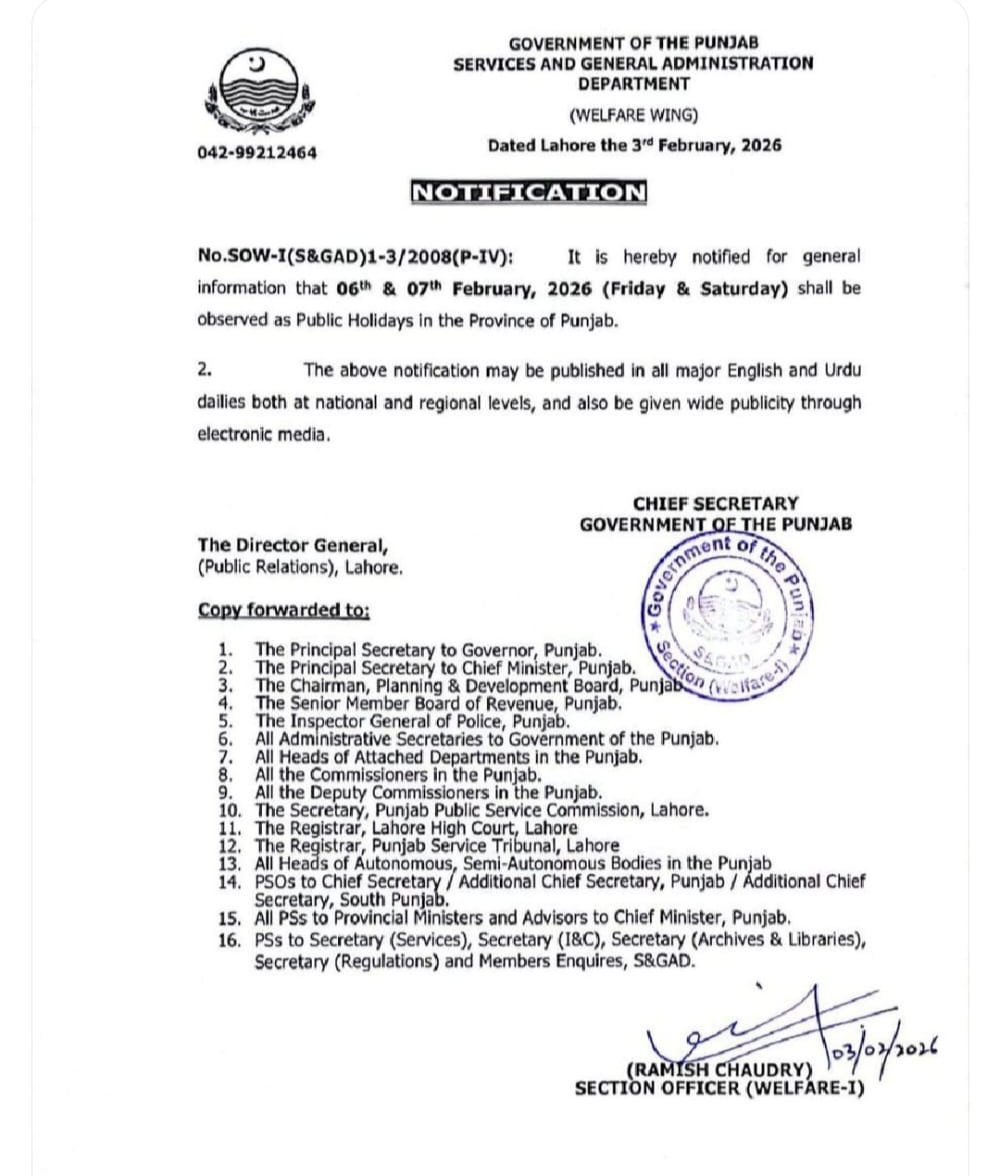
Moreover, public holiday has been announced across the province on February 6 and 7, according to an official notification issued by the Punjab administration.
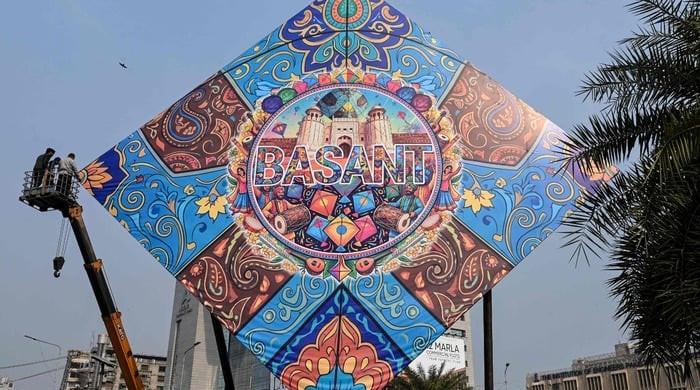
Lahore has been swept in colours as the Basant preparations peaked, with a giant kite installed at Liberty Chowk as part of the celebrations.
It may be noted that the Punjab cabinet allowed the manufacturing of kite-flying material not only in Lahore but also in four other districts. The provincial government has said foolproof security arrangements are being put in place to ensure safety during the event.
According to the Pakistan Meteorological Department, Lahore’s weather during Basant will remain cold and dry on February 6 and 7, while partly cloudy conditions are expected on February 8. The department said the weather conditions from
February 6 to 8 will be suitable for kite flying, with winds blowing at 10 to 15 kilometres per hour.
The Met Office has advised kite flyers to avoid electricity wires.

RAWALPINDI: The Pakistan Space and Upper Atmosphere Research Commission (Suparco) has launched the Space4Climate Initiative to strengthen climate resilience and support environmental action through advanced space-based technologies, The News reported.
According to a statement issued by the Inter-Services Public Relations (ISPR), the initiative centres on a GeoAI-enabled climate observatory, an integrated digital platform that combines satellite data, geospatial analytics and predictive modelling to generate actionable insights for policymakers, researchers and local communities.
The platform is designed to comprehensively monitor a wide range of environmental indicators, including atmospheric pollutants such as aerosols, sulphur oxides (SOx), and nitrogen oxides (NOx), as well as key greenhouse gases like carbon dioxide and methane.
In addition, it provides continuous observation of forests, glaciers, coastal dynamics, river systems and patterns of land use across the country.
Beyond monitoring, the climate observatory is equipped to track and analyse climate-induced hazards, including floods, droughts, heatwaves, sea-level rise and glacial lake outburst floods (GLOFs), thereby enabling early warning and improved preparedness.
By integrating satellite-based observations with in-situ ground data, the Space4Climate Initiative is expected to significantly strengthen evidence-based policymaking and support sustainable development planning.
The initiative represents a major step forward in aligning Pakistan’s climate response framework with global environmental goals and best practices, while leveraging cutting-edge technology to address the growing challenges posed by climate change.
- Gun salutes mark Pakistan Day across major cities.
- Leaders stress unity and national security achievements.
- Simple ceremonies held nationwide under austerity policy.
Pakistan Day was marked across the country on Monday with traditional zeal and patriotic fervour, albeit with simple ceremonies in line with austerity measures announced by the government in light of the ongoing Gulf oil crisis.
Pakistan Day, observed on March 23 every year, commemorates the passing of the Lahore Resolution on March 23, 1940, when the All-India Muslim League demanded a separate nation for the Muslims of the British Indian Empire.
Last week, the federal government announced austerity measures to cope with the situation that emerged due to the US-Israel war on Iran, which has led to a global oil crisis affecting various countries, including Pakistan.
The day began with gun salutes in the federal and provincial capitals, while flag-hoisting ceremonies were held nationwide to commemorate the historic occasion.
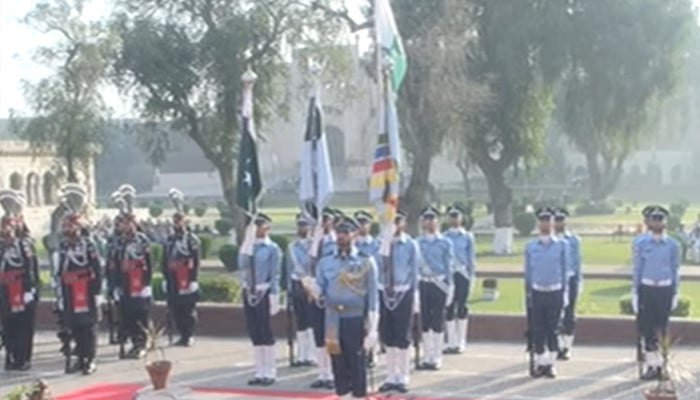
In Lahore, a dignified change of guards ceremony was held at the mausoleum of Allama Iqbal, where a contingent of the Pakistan Air Force assumed ceremonial duties.
The day is being observed with renewed commitment to the ideals of the Pakistan Resolution, alongside adherence to broader austerity policies.
‘Unity and solidarity’
President Asif Ali Zardari and Prime Minister Shehbaz Sharif, in their separate messages, extended heartfelt felicitations to the nation on the occasion of Pakistan Day.
In his message, President Zardari said Pakistan Day serves as a reminder that unity and solidarity are essential to transform national resolve into reality. He noted that the Pakistan Resolution of 1940 laid the foundation for a separate homeland, paying tribute to the sacrifices of the country’s founding leaders.
He said that despite early challenges after independence, Pakistan achieved remarkable progress through collective effort, including building strong institutions, attaining nuclear capability, and successfully combating terrorism.
Referring to recent developments, the president said the country had responded decisively to aggression during Marka-e-Haq, teaching the enemy a lesson it would remember. He added that operations such as Operation Bunyan-um-Marsoos and Operation Ghazab-lil-Haq have yielded significant results in countering threats.
He reiterated that Pakistan would not allow any group, including Fitna al-Khawarij or other elements, to use foreign soil against it, vowing to eliminate terrorism and safeguard national security.
The president also highlighted ongoing challenges, including the situation in Indian Illegally Occupied Jammu and Kashmir (IIOJK), terming it an unfinished agenda of partition, and called on the international community to ensure the right to self-determination for Kashmiris.
He further urged global efforts to end atrocities against Palestinians and stressed the need to resolve tensions in West Asia through dialogue and diplomacy.
‘Regional and global peace’
Meanwhile, PM Shehbaz, in his message, said Pakistan had steered its economy towards stability despite significant challenges, citing declining inflation and improved investor confidence as signs of progress.
He described March 23 as a historic milestone that united Muslims of the subcontinent, leading to the creation of Pakistan within seven years under the leadership of Quaid-i-Azam Muhammad Ali Jinnah.
The prime minister praised the armed forces for their professionalism and sacrifices in defending the country, stating that recent operations had demonstrated Pakistan’s “impregnable defence and unshakable resolve”.
He reiterated Pakistan’s commitment to regional and global peace, emphasising that lasting stability in South Asia is linked to a just resolution of the Kashmir dispute. He also expressed solidarity with the people of Palestine and called for diplomacy to ease tensions in the Middle East.
‘National sovereignty’
Separately, the armed forces’ leadership, Chief of Defence Forces (CDF) and Chief of Army Staff (COAS) Field Marshal Asim Munir, Chief of Naval Staff Admiral Naveed Ashraf and Chief of Air Staff Air Chief Marshal Zaheer Ahmed Baber Sidhu, extended congratulations to the nation, describing March 23 as a defining moment that shaped Pakistan’s destiny.
“March 23rd 1940, stands out as a defining moment in our history as the day that crystallised our collective vision and set the course for the creation of an independent homeland,” stated a message issued by the Inter-Services Public Relations (ISPR).
With steadfast determination and divine guidance, the ISPR said, Pakistan remains resolute in strengthening its democratic institutions, ensuring national security, and safeguarding the well-being of its citizens.
They reaffirmed the military’s commitment to defending national sovereignty, combating terrorism, and ensuring internal security, while emphasising Pakistan’s role as a responsible member of the international community promoting peace and stability.
“At a time when our nation continues to confront the menace of terrorism and extremism, the armed Forces of Pakistan, alongside our resilient people and law enforcement agencies, remain united and unwavering in our resolve to eradicate the threats to Pakistan’s security.
“The Armed Forces of Pakistan, ever vigilant and steadfast, reaffirm their enduring commitment to defending our sacred frontiers, protecting national sovereignty, and maintaining internal security against all forms of aggression and terrorism,” it added.
- PTI leader brought to Pims with his consent, says hospital authorities.
- Anti-VEGF injection administered as part of eye care treatment: Hospital.
- Procedure carried out under strict medical protocols at op theatre: Pims.
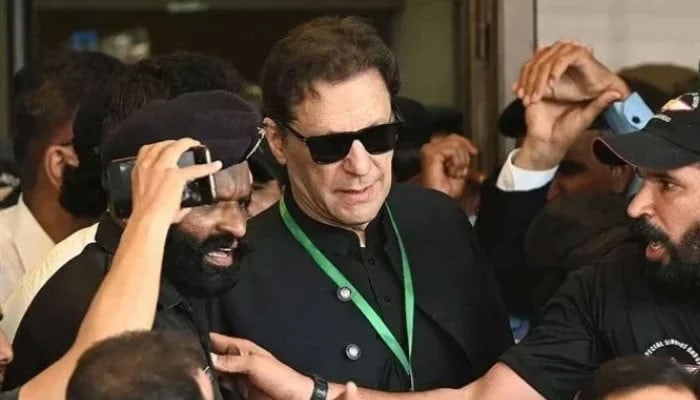
ISLAMABAD: Pakistan Tehreek-e-Insaf (PTI) founder Imran Khan has undergone a third eye procedure at the Pakistan Institute of Medical Sciences (Pims), where doctors declared his vision satisfactory following a detailed examination, hospital authorities said on Monday.
The former premier was brought to the hospital with his consent, where he was administered a third anti-VEGF injection as part of his ongoing treatment, according to a statement issued by the hospital administration.
The procedure was carried out at an operation theatre under strict medical protocols and precautionary measures, it noted.
A medical board assessed his condition after the procedure and expressed satisfaction with his eyesight, the hospital said. Officials stressed that the PTI leader remained stable throughout and was discharged shortly after the treatment.
Monday’s procedure marks the latest phase in his eye care. He was earlier shifted to the hospital from Adiala jail on February 24, when he received the second dose following a comprehensive examination.
At the time, cardiology tests, including echocardiography and an electrocardiogram, had shown his normal results, and he was declared medically stable, according to an earlier statement.
On March 18, his medical check-up was completed by a newly formed board comprising five doctors and staffers at Adiala jail following instructions from the Islamabad High Court (IHC).
Earlier this month, the IHC directed the capital city’s chief commissioner to constitute a medical board to assess his health condition, while rejecting a petition seeking his transfer to a private hospital.
The jailed PTI founder was diagnosed with central retinal vein occlusion (CRVO), a serious eye condition, according to a report submitted to the Supreme Court by his lawyer and the court’s amicus curiae, Salman Safdar.
The condition occurs when the main vein draining blood from the retina becomes blocked and is often associated with cardiovascular risk factors such as high blood pressure, high cholesterol, diabetes and heart disease.
Sources said that the medical team, comprising five doctors and supporting medical staff, completed a thorough two-hour assessment during which they examined the PTI founder’s affected eye.
The team includes ENT specialist Professor Altaf Hussain, cardiologist Professor Akhtar Ali Bandesha, Dr Muhammad Ali Arif, and Professor Nadeem Qureshi from Al-Shifa Eye Hospital.
SC report
The PTI founder’s health emerged as the latest point of contention between the government and the opposition comprising PTI and the TTAP alliance after a report, submitted to the Supreme Court by his lawyer and SC’s amicus curiae Barrister Salman Safdar.
The report revealed that the PTI founder was diagnosed with a serious eye condition known as central retinal vein occlusion (CRVO).
CRVO is a disorder that commonly affects older adults and is linked to underlying cardiovascular risk factors such as high blood pressure, high cholesterol, diabetes and heart disease.
Furthermore, the report stated that the former premier — who has been in jail since August 2023 — has complained of losing 85% of the vision in his right eye.
Khan, 73, has been jailed since August 2023 after convictions he and his PTI call politically motivated.
Since his 2022 ouster in a no-confidence vote, he has faced multiple cases, including over state gifts and an unlawful marriage.
Some convictions have been suspended or overturned, with appeals pending. He denies wrongdoing.


Sri Lanka GDP grows 4.8% in Q4; full-year growth at 5%

Suparco rolls out Space4Climate initiative for climate monitoring
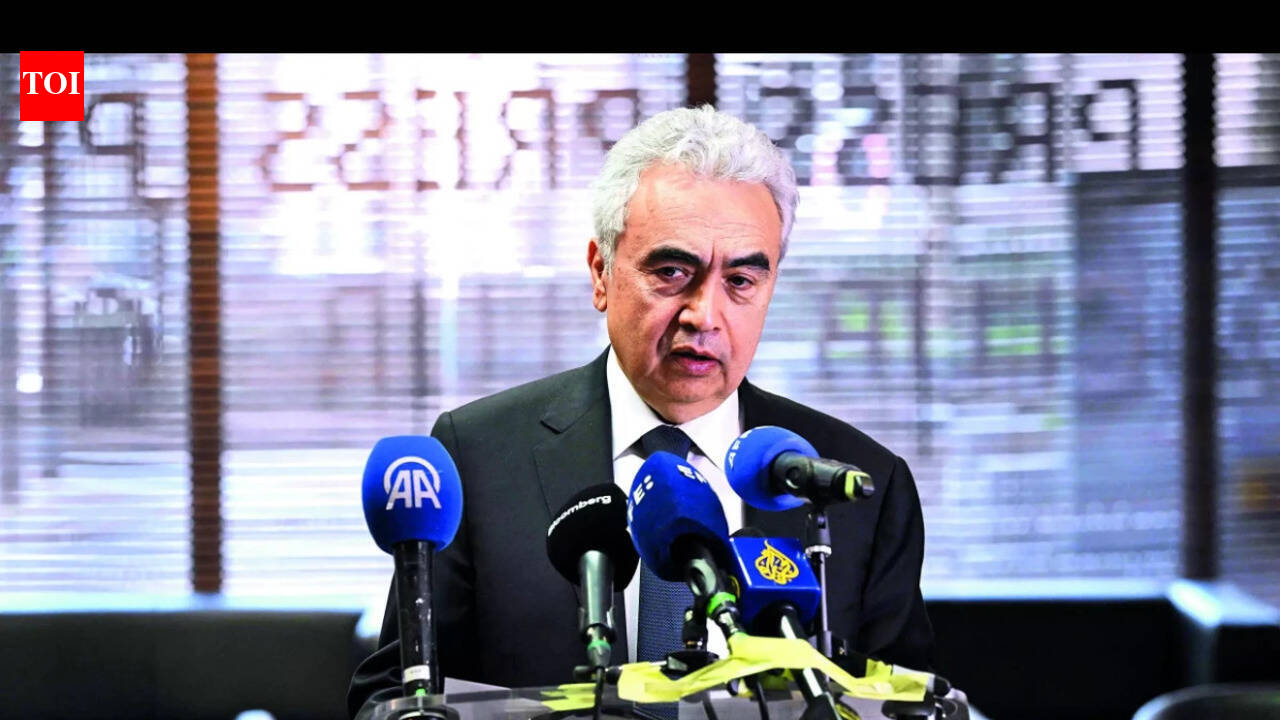
‘Crisis worse than two 1970s oil shocks put together’: IEA chief’s big warning on Strait of Hormuz – The Times of India

Tips and Advice for Buying Used or Refurbished Electronics

UAE savings strategies 2026 explained: Best apps, tools, budget rules and smart money hacks to beat rising cost of living in emirates – The Times of India

Strategic oil stocks to be released ‘immediately’ in Asia and Oceania: IEA

-
 Tech1 week ago
Tips and Advice for Buying Used or Refurbished Electronics
-
Business1 week ago
UAE savings strategies 2026 explained: Best apps, tools, budget rules and smart money hacks to beat rising cost of living in emirates – The Times of India
-

 Sports1 week ago
Japan suffers shocking collapse to Venezuela in World Baseball Classic
-

 Politics1 week ago
How can US get out of Iran war?
-
 Entertainment1 week ago
Strategic oil stocks to be released ‘immediately’ in Asia and Oceania: IEA
-
 Entertainment1 week ago
Iran at war
-

 Sports1 week ago
College Basketball Invitational abruptly cancels 2026 tournament
-

 Entertainment1 week ago
Meet one of the last true paparazzi