

Fashion
Paris is torn between Elie Saab’s working girl and the whimsical creations of Japanese designers

Published
October 5, 2025
Japan’s leading fashion houses once again made a major splash at Paris Fashion Week on Saturday, as evidenced on the sixth day of the women’s ready-to-wear shows for spring-summer 2026 by three of the country’s most emblematic labels: Junya Watanabe, Noir by designer Kei Ninomiya, and Comme des Garçons. On the same day, Elie Saab sent his army of power women down the catwalk.
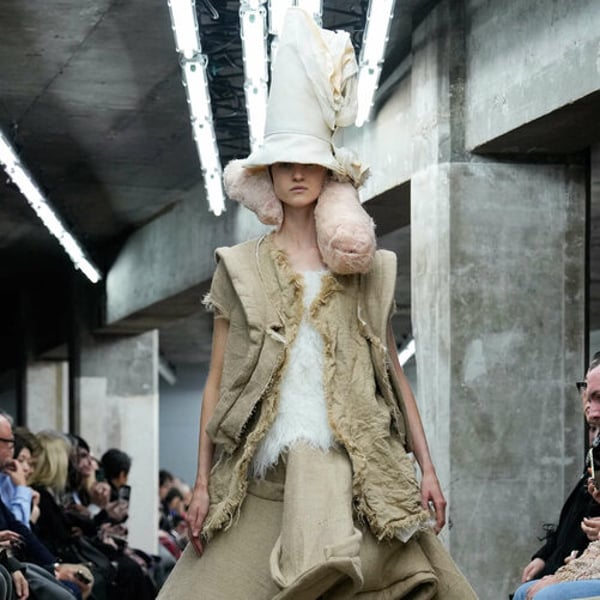
As so often, it was Rei Kawakubo‘s show for Comme des Garçons that moved us most and left the deepest impression. In today’s chaotic world, where catastrophes and human tragedies follow one after another, the designer seemed intent on returning to origins, reconnecting with the values of the Earth. Folk songs and traditional tunes accompanied the show.
A procession of amorphous, swollen silhouettes advanced, draped in great swathes of burlap, hemp or linen, hastily knotted, or in old lace sheets, curtains and bedspreads. Some jackets appeared to be cut directly from the large beige canvas sacks used to store potatoes and other produce from the land. A waistcoat and goat-hair coats completed this rustic look.
These sculptural garments, generated by the play of layering, volume and padding techniques, lent a sense of solemnity to the whole. Topped with battered top hats and cotton-wool hair in pastel shades, the models evoked rag dolls or cloth puppets—old crones or witches—burned in the countryside in January in antiquity to lay the past year to rest and celebrate a richer, more auspicious new season.

This season, Junya Watanabe pushed the boundaries further in his experimental exploration of clothing, delivering a breathtaking collection in which constructions were constantly reinvented, with unexpected intrusions along the way. The Japanese designer folded, with complete ease, the ordinary elements of the textile universe and everyday life into his creations—objects and accessories that usually pass unnoticed.
The result was at once surreal and playful. Old white lace parasols unfurled like a corolla at the hem of a summer dress, while a flock of straw hats created a ruffled volume at the collar and across the shoulders of a long evening gown in nude-coloured guipure lace.
Bright red pumps adorned the shoulders of a black sheath. A cascade of metallic cutlery formed the sleeves of a crinkled silver nylon T-shirt. Rendered in gold, knives and forks compose intriguing sculptures on a shoulder or a flank. The emblematic coat hanger completed this kind of “prévert inventory”: trench coats, shirt dresses and polka-dot dresses were threaded onto it two or three at a time, then secured to either side of the body.

At Noir, Kei Ninomiya continued to explore three-dimensional structures through a mathematical approach. By infinitely multiplying elements as modules—flowers, stars or metal cones, for example—he created fairytale, sculptural ensembles. The show opened with a series of white tulle petticoats paired with sparkling, silver, carapace-like tunics.
The models’ faces were masked or hidden by bulky headdresses, reminiscent of aggregates of quartz crystals or other organic forms. In black and white, they also appeared in unexpected fluorescent hues (pink, orange, and yellow). Paradoxically, behind this whimsical appearance lies a rather classic, even retro wardrobe, composed of prim white blouses, black balloon or pleated skirts, and suits with gathered ruffles. Not forgetting platform moccasins set on a platform and fitted with a small stiletto heel.
These outfits were enhanced by harnesses or cage tunics slipped over the garments, to which all manner of spectacular structures were attached: a giant star covered in precious stones, a basket-dress-shaped grid formed by a Meccano-like chain, clouds of tulle, glittering garlands and other fabric petals.

A change of register at Elie Saab. The mood evoked the electric air of the great metropolises. In the darkness, the sound of heels echoed on the pavement. Suddenly, silhouettes emerged in a fog bathed in a ruddy glow. The first model cut across the catwalk. The tone is set—a little like “Bright Lights, Big City”.
The look was that of the working girl: a chic, tailored suit; a pencil skirt with a back slit; a silk blouse with a plunging neckline; or little polka-dot tops. She’s as at ease in pleat-front trousers as in a strapless python-skin dress, and has never looked more elegant than simply wearing a flowing camel trench that slips over her skin, or a jacket and T-shirt with those sensual, floaty silk trousers with a denim effect.
Her favourite game? Mix & match. She happily pairs Prince of Wales check with polka dots, a leather skirt with a metallic-fringed tank top, a worn leather jacket with an openwork sequinned skirt. For evening, the Elie Saab woman pulls out all the stops with glittering draped maxi dresses or shorter dresses with long trains.
This article is an automatic translation.
Click here to read the original article.
Copyright © 2025 FashionNetwork.com All rights reserved.








“The improved order situation in industry has brightened sentiment somewhat. However, as a result of the Iran war, energy costs have risen sharply, and uncertainty among companies has also increased. That runs counter to a stronger economic recovery,” said Timo Wollmershauser, head of forecasts at ifo.
Firms in Germany have raised investment plans, with ifo expectations rising to 0.2 points in March from -3.1 in December 2025.
Industry led gains, especially non-energy sectors, while energy-intensive segments and chemicals remained weak.
Services showed modest optimism, but trade stayed pessimistic.
Rising energy costs and geopolitical uncertainty temper recovery.
The most notable rise in the willingness to invest was in industry. Expectations rose to +0.1 points in March, up from -6.9 points in December. The outlook improved particularly strongly in non-energy-intensive industries, where significantly more companies were planning to expand their investments this year, ifo said in a press release.
In energy-intensive industries, however, the willingness to invest remains subdued. At -9 points in March, the balance remained virtually unchanged from December (-8.9 points). In the chemical industry, investment expectations even declined further, from -15.8 to -16.2 points.
Overall, the corresponding balance in manufacturing rose from -4.1 to +1.2 points. “Companies across all sectors also want to invest more in software. The growing use of artificial intelligence is likely to play a role in that,” said ifo economic expert Lara Zarges.
In trade, companies remain the most pessimistic. The balance of investment expectations stood at -9.6 points in March, virtually unchanged from the level in December. Service providers, on the other hand, confirmed their slightly positive outlook from December: Their investment expectations improved from +1.1 to +2.8 points.
The points for the ifo investment expectations indicate the percentage of companies that intend to increase their investments on balance.
Fibre2Fashion News Desk (SG)
The report highlighted that although overall energy demand growth slowed compared with 2024 and remained slightly below the previous decade’s average, electricity demand rose by around 3 per cent, driven by increased usage across buildings, industry, electric vehicles, and data centres.
Global energy demand growth slowed to 1.3 per cent in 2025, while electricity demand rose around 3 per cent, driven by EVs, industry, and data centres, according to IEA.
Solar PV led supply growth for the first time.
Oil demand grew modestly, and coal growth slowed.
CO2 emissions rose slightly.
Renewables and nuclear expansion highlighted an accelerating shift towards cleaner energy systems.
Solar photovoltaic (PV) emerged as the largest contributor to global energy supply growth for the first time, accounting for over 25 per cent of the increase. Natural gas followed with a 17 per cent share, while renewables and nuclear together met nearly 60 per cent of additional demand.
Global oil demand rose modestly by 0.7 per cent, reflecting the continued expansion of electric vehicles, with sales surpassing 20 million units in 2025. Coal demand growth slowed overall, with declines in China offset by increases in the United States due to high natural gas prices.
“Global energy demand continued to increase in 2025 against a complex economic and geopolitical backdrop, with one trend unmistakeable: the expanding electrification of economies,” said Fatih Birol, IEA executive director.
He added that electricity consumption was growing much faster than overall energy demand, with one energy source outpacing all others. He noted that solar PV accounted for over a quarter of global energy demand growth for the first time, followed by natural gas, and added that countries prioritising resilience and diversification would be better placed to manage volatility and ensure secure, affordable energy.
Regional trends varied significantly. Energy demand growth in the United States rose sharply, supported by industrial activity, data centre expansion, and colder weather, while China’s growth slowed to 1.7 per cent due to rising renewable adoption and improved efficiency.
Global energy-related CO2 emissions increased marginally by around 0.4 per cent. Emissions declined in China and remained flat in India, aided by renewable deployment and favourable weather conditions, while advanced economies recorded higher emissions growth due to colder winter conditions.
In the power sector, solar PV generation surged by a record 600 terawatt-hours, marking the largest annual increase for any electricity generation technology. Battery storage emerged as the fastest-growing segment, with around 110 gigawatts of new capacity added, while nuclear energy also saw renewed momentum with over 12 gigawatts of new reactors under construction.
The IEA noted that cumulative deployment of low-emissions technologies since 2019 now offsets fossil fuel consumption equivalent to the entire energy demand of Latin America, underscoring the accelerating transition towards cleaner energy systems.
Fibre2Fashion News Desk (SG)
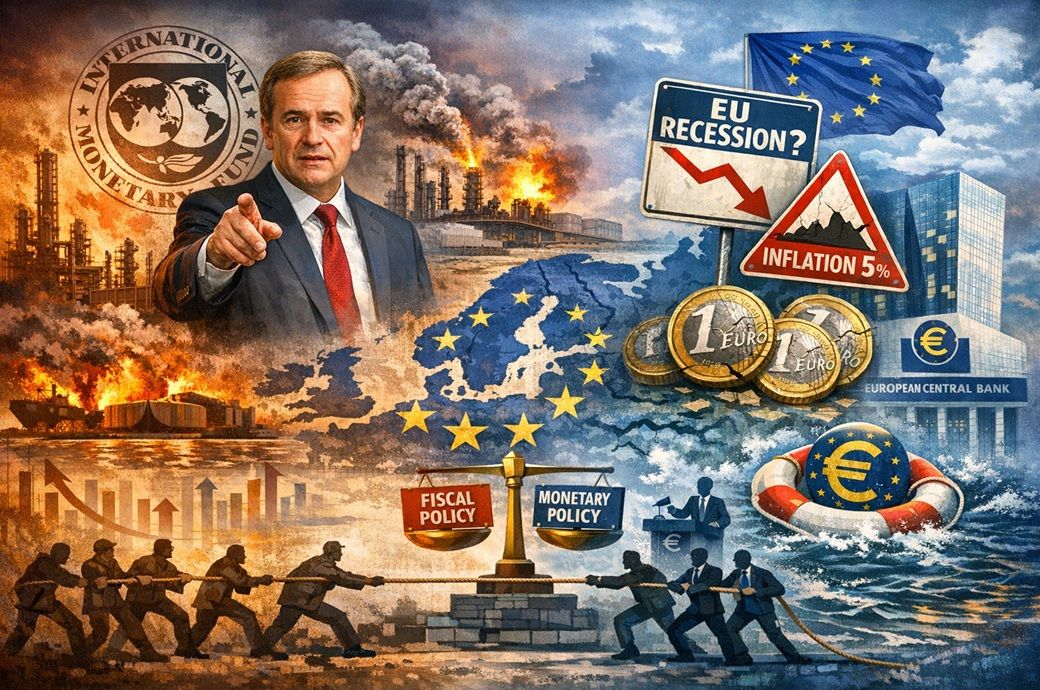
In a blog post, Alfred Kammer, director of the IMF’s European department, said his organisation sees growth slowing down in the continent. Initial data point already to weaker private investment and consumption.
The energy shock that has hit Europe due to the Middle East conflict, though smaller than in 2022, is weighing on growth and pushing inflation higher, an IMF expert recently cautioned.
IMF sees growth slowing down in the continent.
Initial data point already to weaker private investment and consumption.
Central banks must remain laser focused on keeping inflation expectations anchored, he wrote.
The outlook for euro area growth is projected at just 1.1 per cent in 2026, for the European Union it is 1.3 per cent; and this forecast comes with a high degree of uncertainty.
In a more severe scenario as described in the World Economic Outlook—a persistent supply shock compounded by tightening financial conditions—the EU could come close to recession with inflation approaching 5 per cent. No European country is spared, Kammer observed.
Policymakers face intense pressure—to act fast, visibly and for all, which results in policies that have more long-term downsides than short-term benefits, he wrote.
Targeted support is much more effective. Europe’s response to this shock should be shaped by two imperatives, he suggested. First, robust macroeconomic policy that is fit for a world with unpredictable and frequent shocks, and second, resilience built without wasting fiscal resources or getting in the way of markets.
The first imperative involves getting monetary and fiscal policy right. Central banks must remain laser focused on keeping inflation expectations anchored, the IMF expert wrote.
In the euro area, where inflation is close to target and medium-term expectations are broadly anchored, the European Central Bank has some scope to wait and observe the shock evolve before acting. IMF now expects a cumulative 50 basis point increase in the policy rate by the end of this year, maintaining a broadly neutral monetary stance in light of higher near-term inflation expectations, Kammer noted.
A rise in core inflation or increasing medium-term expectations would warrant a more restrictive stance, he wrote.
“Europe must reform under pressure. The current shock is not an argument for delay. It is all the more reason to push forward the reform agenda,” Kammer added.
Fibre2Fashion News Desk (DS)


Trump repeats call for Congress to rein in college sports
I was left with an £8,000 vet bill when my insurer cancelled my pet policy

Reese Witherspoon breaks silence after AI support controversy

-

 Fashion6 days ago
France’s LVMH Q1 revenue falls 6%, shows resilience amid Iran war
-

 Sports1 week ago
The case for Man United’s Fernandes as Premier League’s best
-

 Entertainment1 week ago
Palace left in shock as Prince William cancels grand ceremony
-
 Business1 week ago
UK could adopt EU single market rules under new legislation
-

 Entertainment6 days ago
Is Claude down? Here’s why users are seeing errors
-

 Fashion1 week ago
Energy emerges as biggest cost driver in textile margins
-
 Business1 week ago
Delta Air Lines unveils first new Delta One suite in premium cabin arms race
-

 Fashion1 week ago
Asia claims largest share of markets on Kearney FDI Confidence Index