

Business
Shares skid as oil surge threatens inflation shock | The Express Tribune

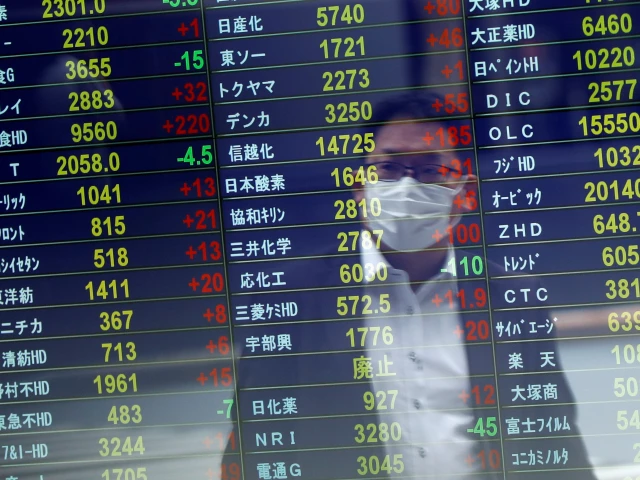
Brent crude jumps 27% in biggest daily gain since 1988 as Iran conflict rattles global markets
Share markets nosedived in Asia on Monday as the inflationary jolt from surging oil prices threatened to raise living costs and interest rates across the globe, while investors desperate for liquidity fled to the United States dollar.
Brent crude LCOc1 soared 27% to $117.58 a barrel, the biggest daily gain since at least 1988, which came on top of a 28% rise last week. US crude CLc1 shot up a staggering 28% to $116.51, promising to push petrol prices quickly skyward.
Iran named Mojtaba Khamenei to succeed his father Ali Khamenei as supreme leader, signalling that hardliners remained firmly in charge in Tehran a week into its conflict with the US and Israel. That was unlikely to be welcomed by US President Donald Trump, who had declared the son “unacceptable.”
With no sign of an end to hostilities in the Middle East and tankers still not daring to cross the Strait of Hormuz, investors were bracing for a long stretch of higher energy costs.
“Faced with the worst oil supply shock since the 1970s, all eyes will be on Washington’s response,” said Helima Croft, head of global commodity strategy at RBC Capital Markets. “With no clear definition of what winning looks like, it is hard to forecast whether this will be a multi-week or multi-month conflict.”
Read: Who is Iran’s new supreme leader, Mojtaba Khamenei?
“To date, neither White House policy prescriptions nor upbeat television soundbites have alleviated acute market anxiety about the shipping standstill and cascading shut-ins across the region.”
The news was sobering for Japan, a major importer of oil and gas, knocking the Nikkei .N225 down 7.0% on top of a 5.5% drop last week. South Korea’s high-flying market fell closer to Earth with a drop of 8.2%, having already shed more than 10% last week.
China is another big oil importer, though it also has a huge stockpile of crude; its blue-chip index .CSI300 fell 1.7%. China on Monday said inflation had already picked up in February ahead of the current oil spike, with consumer prices rising 1.3% on the year. This is not necessarily a negative development, given the country has long struggled with disinflation.
Central banks face inflation conundrum
The wave of market selling swept over Wall Street as S&P 500 futures ESc1 shed 2.0%, while Nasdaq futures NQc1 dived 2.3%. Over in Europe, EUROSTOXX 50 futures STXEc1 and DAX futures FDXc1 both slid 3.2%, while FTSE futures FFIc1 dropped 1.4%.
In bond markets, the risk of rising inflation outweighed safe-haven considerations to shove yields higher globally. Yields on 10-year Treasury notes US10YT=RR rose 6 basis points to 4.204%, up from a trough of 3.926% just a week ago.
Read More: Hong Kong, China stocks tumble as Iran war knocks Asian markets
Interest rate futures 0#FF slipped as investors feared the risk of higher inflation would make it harder for the Federal Reserve to ease policy, even though disappointing jobs numbers seemed to argue for stimulus.
Data on US consumer prices due on Wednesday is forecast to show the annual pace holding at 2.4% in February.
The Fed’s preferred measure of core inflation is out on Friday and is forecast to hold at 3.0%, well above the central bank’s 2% target, and analysts see a risk of an even higher number.
The danger of energy-driven inflation has led markets to wager the next move in rates from the European Central Bank could be up, possibly as early as June (0#EURIRPR). For the Bank of England, markets have shifted to pricing just a 40% chance of one more easing, compared with two cuts or more before the Middle East conflict started (0#GBPIRPR).
Also Read: Gulf war risks global economic shock
Nervous investors sought the liquidity of dollars while shunning currencies from countries that are net energy importers, including Japan and much of Europe. “Asia takes the brunt of the sharp escalation in oil prices and there are few places to run and hide,” said Vishnu Varathan, head of macro research for Asia ex-Japan at Mizuho.
“The dollar has to be the one outperforming, given Japan and Korea’s exposures here and the sharp pain that can be expected from Brent at $107.”
The dollar added 0.6% to 158.72 yen JPY=EBS, while the euro slipped 0.8% to $1.1525 EUR=EBS. The Australian dollar, often sold as a hedge during periods of market volatility, skidded 0.9% to $0.6964 AUD=D3.
Gold fell 1.8% to $5,075 an ounce XAU=, with dealers speculating that investors were having to book profits made on the metal’s long climb to cover losses elsewhere.






Mumbai: Warburg Pincus-backed housing finance company Truhome Finance ( formerly Shriram Housing) has filed draft papers with capital markets regulator SEBI to raise Rs 3,000 crore through an initial public offering.The IPO will comprise a fresh issue of equity shares of face value Rs 10 aggregating up to Rs 1,500 crore and an offer for sale of equity shares of face value Rs 10 aggregating up to Rs 1,500 crore, according to the draft red herring prospectus filed with SEBI. The offer for sale will be undertaken by promoter selling shareholder Mango Crest Investment, which plans to offload shares worth up to Rs 1,500 crore.Truhome Finance plans to use the net proceeds from the fresh issue to augment its capital base to support future capital requirements, including onward lending and general corporate purposes. The funds will also help the company comply with RBI’s capital adequacy norms as its business expands.The company said the proceeds are expected to be deployed over the financial years ending March 31, 2027 and March 31, 2028.JM Financial, IIFL Capital Services, Jefferies India and Kotak Mahindra Capital Company are the book running lead managers to the issue.Warburg Pincus completed its acquisition of Shriram Housing Finance (SHFL) from Shriram Finance and other sellers in December 2024 for approximately Rs 4,630 crore, marking a strategic shift in India’s housing finance sector.
Business
Ticketmaster parent Live Nation reaches settlement with Department of Justice over antitrust concerns

Signs are seen at the Live Nation NYC headquarters on May 23, 2024 in New York City.
Michael M. Santiago | Getty Images
Live Nation Entertainment has reached a settlement with the Department of Justice over antitrust concerns surrounding its Ticketmaster platform, a senior DOJ official said Monday.
The settlement would see Ticketmaster unwind some of its exclusivity agreements with musical artists and open up the ticketing industry to greater competition. It still needs approval by more than 20 states that had filed suit and by the court.
As part of the settlement, Ticketmaster will offer a standalone third-party ticketing system for other companies like SeatGeek to use its technology. Live Nation has also agreed to divest at least 13 of its amphitheaters and will no longer be able to require artists to use other Live Nation products tied to its venues. It has also agreed to pay roughly $280 million in civil penalties.
Shares of Live Nation rose 5% in morning trading. Live Nation and Ticketmaster did not immediately respond to requests for comment.
Ticketmaster has long faced criticism that its dominance in the live events and ticketing space pushes up prices for consumers. The company has come under heightened scrutiny in recent years from fans who argue that it’s become harder and pricier to snag coveted event tickets.
In 2022, the backlash boiled over when the rollout of tickets for Taylor Swift’s Eras Tour was mishandled, leading to a probe of the company. And in 2024, the DOJ — along with more than two dozen states — sued to break up Live Nation and Ticketmaster, which merged in 2010.
In September, Live Nation was separately sued by the Federal Trade Commission over what the agency called “illegal” ticket resale tactics. The FTC said Ticketmaster controls roughly 80% of major concert venues’ ticketing.
In a Monday statement, New York Attorney General Letitia James said her office would continue to fight against Live Nation’s alleged monopoly even after its agreement with the DOJ.
“The settlement recently announced with the U.S. Department of Justice fails to address the monopoly at the center of this case, and would benefit Live Nation at the expense of consumers. We cannot agree to it,” said James, who is joined by the attorneys general of more than 20 other states.

The conflict in the Middle East could raise the cost of petrol, household energy bills and even food.
Source link


Adidas salutes USMNT’s 1994 World Cup run with denim jersey

Oil surges past $100 a barrel as stocks tumble amid US-Israeli aggression against Iran
Espresso Machines Are Like Guitars: The Rich Don’t Win

-

 Politics2 days ago
India let Iran warship dock the day US sank another off Sri Lanka, say officials
-

 Sports3 days ago
Pakistan set for FIH Pro League debut | The Express Tribune
-

 Sports1 week ago
College basketball star suspended by team for spitting toward opposing fan
-

 Entertainment1 week ago
Al Jazeera broadcast interrupted by emergency missile alert in Qatar
-

 Entertainment2 days ago
Harry Styles kicks off new era with ‘One Night Only’ comeback show
-
 Business3 days ago
Home heating oil: ‘Most of my pension has gone on home heating oil’
-
 Business1 week ago
Labour parliamentarians urge UK Government to oppose Rosebank oil field
-

 Sports1 week ago
Michigan loses L.J. Cason for rest of season with torn ACL