

Business
Shares steady, oil turbulence deepens over Middle East war fears | The Express Tribune

Investors remain on edge as the Middle East conflict threatens to freeze global energy trade and ignite a price shock
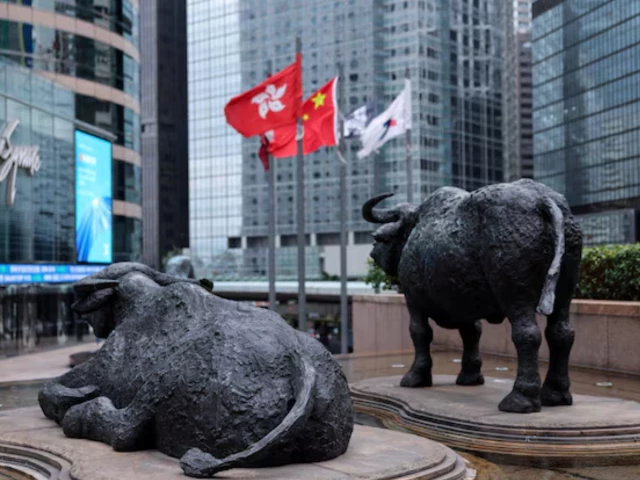
Bull statues near screens showing the Hang Seng stock index and stock prices outside Exchange Square, in Hong Kong, China, February 3, 2026 PHOTO: REUTERS
Shares steadied on Wednesday following a retreat in oil prices, but contradictory signals from the US-Israeli war on Iran kept investors anxious over the risks to inflation and global growth.
A pullback in oil came after the Wall Street Journal reported that the International Energy Agency had proposed the largest release of oil reserves in its history to bring down crude prices, providing some relief to battered global stocks while currencies and bonds were little changed.
Brent crude futures swung between gains and losses in volatile trade, falling 0.4% to $87.45 per barrel, while US crude was up 0.3% at $83.67 a barrel.
“Markets are presently trading on the news flow and the here-and-now rather than being forward-looking,” said Chidu Narayanan, head of APAC macro strategy at Wells Fargo.
“The measures announced, aiming to offset oil supply declines, might be insufficient. It is likely to help on the margin to assuage some of the fears, but as long as the conflict continues, risk aversion is likely to remain elevated.”
Still, regional stocks found some reprieve, with MSCI’s broadest index of Asia-Pacific shares outside Japan up 1.4%, while the Nikkei rose 1.7% and South Korea’s Kospi advanced 1.75%.
US stock futures also pushed higher after a mixed cash session overnight, with Nasdaq futures and S&P 500 futures adding about 0.2% each.
EUROSTOXX 50 futures slipped 0.12%, while FTSE futures lost 0.14%.
Investors remain on edge as the Middle East conflict threatens to freeze global energy trade and ignite a price shock – a risk that world leaders are scrambling to address.
Read: PSX rebounds after sell-off, KSE-100 gains nearly 9,700 points
Still, energy markets remain hostage to how long – and how intense – the conflict becomes.
“Several major questions loom over the oil market’s trajectory. Chief among them is the timing of safe passage for vessels through the Strait of Hormuz, a critical chokepoint for global oil supply,” said Kerstin Hottner, Vontobel’s head of commodities.
“Another concern is the possibility of infrastructure damage… Even if major hostilities subside, the prospect of ongoing low-level Iranian drone attacks on energy infrastructure could prolong market instability into next year.”
Dollar fever
The dollar held to its gains on Wednesday as investors assessed the fallout from the war, with the greenback proving the safe-haven asset of choice in the ongoing market turmoil.
Against the yen, the dollar was up slightly at 158.15, while the euro and sterling were nursing losses and fetched $1.1633 and $1.3450, respectively.
“You have only one safe asset, which has been the US dollar,” said Frank Benzimra, head of Asia equity strategy and multi-asset strategist at Societe Generale.
“Even gold or Treasuries did not play this huge safe-haven role. In the case of Treasuries, because of the inflation concerns, and in the case of gold, because we could see some investors selling their gains in gold to offset some losses in the equity market.”
Bond markets have come under pressure over the past few sessions on risks that the prolonged spike in energy prices could stoke inflation and cause central banks across the globe to turn more hawkish.







A “For Lease” sign in the Financial District of San Francisco, California, US, on Wednesday, May 3, 2023.
Jason Henry | Bloomberg | Getty Images
A version of this article first appeared in the CNBC Property Play newsletter with Diana Olick. Property Play covers new and evolving opportunities for the real estate investor, from individuals to venture capitalists, private equity funds, family offices, institutional investors and large public companies. Sign up to receive future editions, straight to your inbox.
Despite the war with Iran and continued economic uncertainty in the U.S., demand for office space is recovering at a strong clip.
In the first quarter of this year, new in-person and virtual office tours reached their highest level since the pandemic began, as measured by the VTS Office Demand Index. The index is a future indicator of lease signings about a year or more out.
The index rose 18% from the fourth quarter 2025 and 13% from the same quarter one year ago.
“Although tested against a turbulent backdrop, demand for office space has seen an exceptional start to the year,” Nick Romito, CEO of commercial real estate software company VTS, said in a release. “What perhaps is most notable about this quarter’s positive performance is that it was led not just by tech’s sustained AI boom – but also by finance and legal companies entering the market as well.”
The surge in demand is curious, given that office-using employment is still down 2% from 2022, according to the Bureau of Labor Statistics. Usually, that would result in less office demand, but the drop in employment could also be giving employers more leverage to get workers back into the office.
Nationally, for all buildings, the office vacancy rate fell 14 basis points to 22.2% in the first quarter of this year from the previous quarter and is down 30 basis points from the last peak in Q2 2025, according to a report from JLL, a commercial real estate services and investment management company. Vacancy remains hyper-concentrated predominantly in larger-scale, aging buildings with financially constrained owners, with 10% of office buildings comprising more than 60% of total national vacancy.
As with everything in real estate, the office recovery is local. San Francisco and New York City are leading office demand, as AI tech employment rises quickly in the former and diversity of employment fuels the latter. Los Angeles also saw double-digit increases in demand on a quarterly basis, fueled by significant growth in the creative industry, according to VTS.
Cities seeing weaker demand include Boston, which was the worst-performing market in the report. Life science offices have taken a hit in that city, due to significant government funding cuts.
In addition, demand is contracting in Seattle, Washington, D.C., and Chicago, as they are not seeing strong employment growth.
“The AI boom continues to be a dominant headline for office, and markets that lack a major tech presence, or are without a primary growth lever in another industry, are seeing declines in demand,” Ryan Masiello, chief strategy officer of VTS, said in a release. “LA’s positive performance this time around was a new bright spot – and it remains to be seen if Los Angeles can sustain growth in the near term.”
Protesters have forced NatWest to halt its shareholder meeting, as the bank’s chairman defended its climate policy in response to investors claiming it has “backtracked” on commitments.
The annual general meeting (AGM) was being held on Tuesday morning but had to be stopped for about half an hour amid disruption during chairman Rick Haythornthwaite’s opening speech.
Protesters were singing and making statements about NatWest’s climate policies.
The boss heard a statement presented by ShareAction, backed by investors managing 1.4 trillion US dollars (£1 trillion) in assets, including the Church of England Pensions Board, Greater Manchester Pension Fund and Rathbones Investment Management.
The statement said investors are “concerned by the bank’s changed outlook on climate change” having “reduced the ambition of its fossil fuel policy and climate targets”.
“The bank dropped its commitment not to finance oil and gas majors lacking a credible transition plan or failing to report their overall emissions,” it said.
It called for Mr Haythornthwaite to meet the group of shareholders to discuss the bank’s climate strategy.
Campaigners including ShareAction are also calling for shareholders to vote against the re-election of the bank’s chair over concerns of climate backtracking, which the Church of England’s pensions body said it plans to do.
Mr Haythornthwaite responded to the statements saying that he “takes climate change very seriously, as does all of this board” and that he was happy to meet the group.
“We’ve had to wrestle with the questions of how do we balance supporting our customers in their transition efforts with managing the risks in what is an increasingly complex policy environment,” he said.
He stressed that the bank’s “overwhelming” balance of lending was on renewables and that oil and gas financing comprises 0.6% of total lending.
NatWest also retained targets to at least halve the climate impact of its financing activity by 2030, against a 2019 baseline.
“I don’t want to take what sounds like a backtracking as a major shift,” Mr Haythornthwaite said, adding that “these targets matter”.

The battle between the AI big hitters has largely played out on social media. Now it is coming to the courtroom.
Source link


Japan’s apparel imports rise 2.8% to $24.3 bn in FY 2025-26

Get Ready for More Brain-Scanning Consumer Gadgets
Office demand rebounds to highest level since Covid pandemic began

-

 Sports1 week ago
NCAA men’s gymnastics championship: All-time winners list
-

 Sports1 week ago
WWE WrestleMania 42 Night 2: Live match results and analysis
-

 Politics1 week ago
UK’s Starmer seeks to deflect blame over Mandelson appointment
-

 Fashion1 week ago
UK’s Sosandar returns to profitability amid robust FY26 performance
-
 Business1 week ago
No fuel shortage: Govt assures 100% domestic LPG, PNG, CNG supply amid Hormuz energy crunch – The Times of India
-

 Entertainment1 week ago
Lee Anderson, Zarah Sultana kicked out of UK Parliament for calling PM ‘liar’
-
 Business1 week ago
How Trump’s psychedelics executive order could unlock stalled cannabis reform
-

 Sports1 week ago
Quetta Gladiators opt to bowl after winning toss against Peshawar Zalmi in PSL 11 clash