

Business
Silver price shock: ETFs tumble 38% in 7 trading sessions— Time to invest? – The Times of India


Silver exchange-traded funds (ETFs) saw a dramatic 38 per cent drop, from their peak just seven days ago on January 29. This sharp decline was triggered by increased trading costs and investors cashing out profits. The market saw wild swings as silver prices first fell below $65 per ounce before bouncing back up by 8.6 per cent to $77.33 on Friday.The market turmoil intensified when CME Group, a major trading platform, raised the money needed to trade silver futures. This was their third such increase in just two weeks. The higher costs forced many traders to sell their holdings quickly. Adding to the pressure were concerns about the Federal Reserve’s strict monetary policy after Kevin Warsh’s nomination and a stronger US dollar.“Last week’s steep plunge was driven by hawkish Fed expectations after Kevin Warsh’s nomination, a stronger dollar, and sharp CME margin hikes that forced leveraged unwinding,” said Hareesh V, who leads commodity research at Geojit Investments Limited. He added that profit-taking after reaching record highs made the market even more unstable, as quoted by ET.The recent events have shown how quickly silver prices can change. These sudden price moves have left many investors nervous about the market’s stability. The combination of higher trading costs, profit-taking, and broader economic factors has created a perfect storm in the silver market.
Time to invest?
Fund managers are encouraging investors to consider silver investments despite recent volatality, recommending a systematic approach for long-term gains. While silver prices have fallen sharply from recent highs above $120, experts believe the fundamental outlook remains strong due to supply deficits and robust industrial demand, though they emphasize the importance of careful position sizing and risk management.“Yes, at current levels investors can consider taking exposure to silver ETFs with a long-term perspective and through a systematic approach,” said Satish Dondapati, Fund Manager at Kotak Mahindra AMC, as quoted by ET. He advised limiting precious metals allocation to 15-20% based on risk tolerance.The recent price decline was amplified by silver’s thin market structure. “Silver has come off mainly because it has run up too fast in a short period,” said Akshat Garg, Head of Research & Product at Choice Wealth. He noted that silver typically shows more dramatic price swings than gold due to its smaller market size.Technical signs suggest prices may stabilise soon, according to ET analysis. Silver now trades in the $71-$80 demand zone, with support near $64 matching the 100-day moving average. This indicates potential recovery after the correction from $120 levels.Wealth managers strongly recommend a staggered buying approach over lump-sum investments. “Investors should avoid chasing prices or reacting to day-to-day moves. Silver works best as a small, supporting allocation in a portfolio, not as a core holding,” Garg advised.Experts emphasised staying focused on long-term fundamentals like geopolitical tensions and central bank policies while monitoring the dollar and Fed signals. They suggest the recent decline may offer opportunities for those who missed earlier gains, provided they can handle continued market volatility.“For long-term investors, this phase is about patience and discipline rather than action,” Garg added. A move above $80-$85 could signal further recovery toward $100-$105, though investors should prepare for ongoing market turbulence, according to him.(Disclaimer: Recommendations and views on the stock market and other asset classes given by experts are their own. These opinions do not represent the views of The Times of India)
Business
Noida International Airport inauguration: Delhi-NCR gets new airport – all you need to know – The Times of India

NEW DELHI: Prime Minister Narendra Modi on Saturday inaugurated Phase I of the Noida International Airport at Jewar in Uttar Pradesh, marking a significant milestone in India’s expanding aviation infrastructure.PM Modi was accompanied by Uttar Pradesh chief minister Yogi Adityanath and Governor Anandiben Patel.
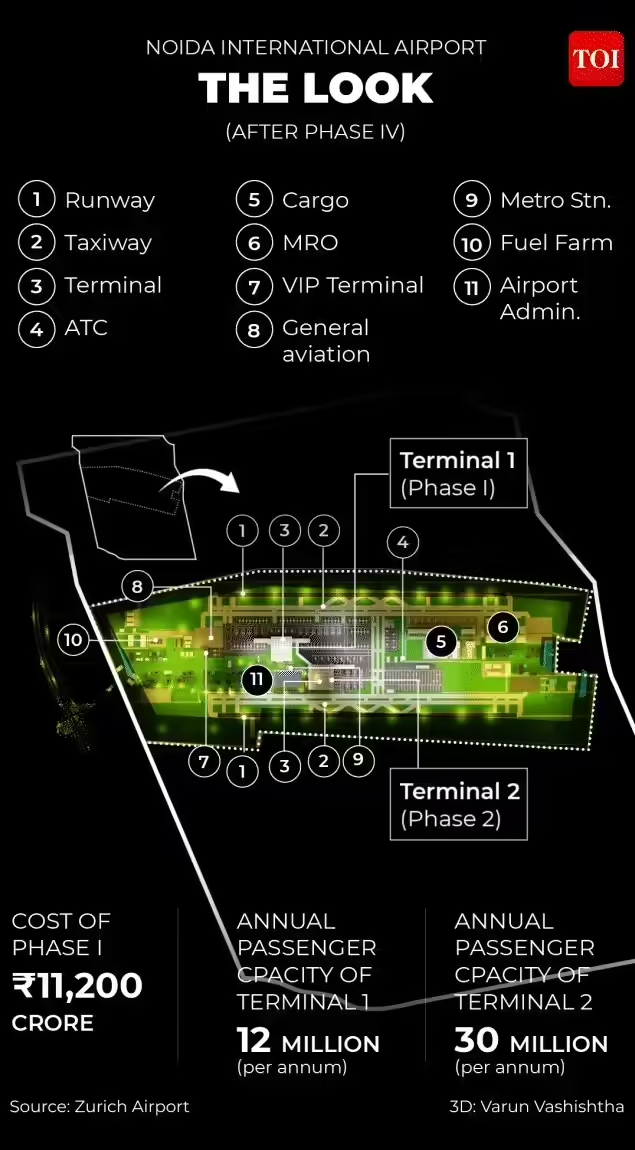
Developed at an investment of around Rs 11,200 crore under a Public–Private Partnership (PPP) model, the project is expected to enhance both regional and international connectivity for the National Capital Region (NCR).The airport is being positioned as a key addition to India’s aviation network, aimed at easing pressure on existing infrastructure while supporting the country’s ambition of becoming a global aviation hub.
Second international gateway for Delhi NCR
Noida International Airport has been developed as the second international gateway for Delhi NCR, complementing the existing Indira Gandhi International Airport, which currently handles the majority of the region’s air traffic.
.
With rising passenger demand and capacity constraints at IGI Airport, the new facility is expected to play a crucial role in distributing traffic more efficiently.Together, the two airports will function as an integrated aviation system, helping reduce congestion, improve connectivity, and enhance the region’s standing among leading global aviation hubs.
Phase I capacity and future expansion plans
Phase I of the airport is designed to handle 12 million passengers per annum (MPPA), providing immediate relief to the region’s growing air travel demand.The project has been planned with scalability in mind, with provisions to expand capacity to 70 million passengers annually in subsequent phases. This long-term vision reflects the government’s strategy to future-proof infrastructure and accommodate sustained growth in air travel.
Modern infrastructure and all-weather operations
The airport features a 3,900-metre runway capable of handling wide-body aircraft, making it suitable for both domestic and international long-haul operations.
.
Equipped with advanced navigation systems such as the Instrument Landing System (ILS) and modern airfield lighting, the facility is designed to support efficient, all-weather, round-the-clock operations. These features ensure operational reliability even under challenging weather conditions.
Cargo hub and logistics ecosystem
In addition to passenger services, the airport includes a comprehensive cargo ecosystem aimed at strengthening logistics and trade.The Multi-Modal Cargo Hub comprises an Integrated Cargo Terminal and dedicated logistics zones, with an initial handling capacity of over 2.5 lakh metric tonnes annually. This capacity is expected to expand significantly to around 18 lakh metric tonnes in the future, positioning the airport as a major cargo and logistics centre in North India.
Dedicated MRO facility to enhance efficiency
A key component of the airport’s infrastructure is a 40-acre Maintenance, Repair and Overhaul (MRO) facility.This dedicated facility is expected to improve operational efficiency by enabling airlines to service and maintain aircraft locally, reducing turnaround times and operational costs. It also strengthens India’s capabilities in aviation maintenance services.
Sustainability and future-ready design
Noida International Airport has been designed as a sustainable and future-ready infrastructure project, with a focus on achieving net-zero emissions.The project incorporates energy-efficient systems and environmentally responsible practices, aligning with India’s broader climate goals. The airport’s development reflects a growing emphasis on green infrastructure in large-scale projects.
Architecture inspired by Indian heritage
Blending modern infrastructure with cultural aesthetics, the airport’s architectural design draws inspiration from traditional Indian elements such as ghats and havelis.This approach aims to create a distinctive identity for the airport while offering passengers a sense of place rooted in Indian heritage.
Strategic location and multi-modal connectivity
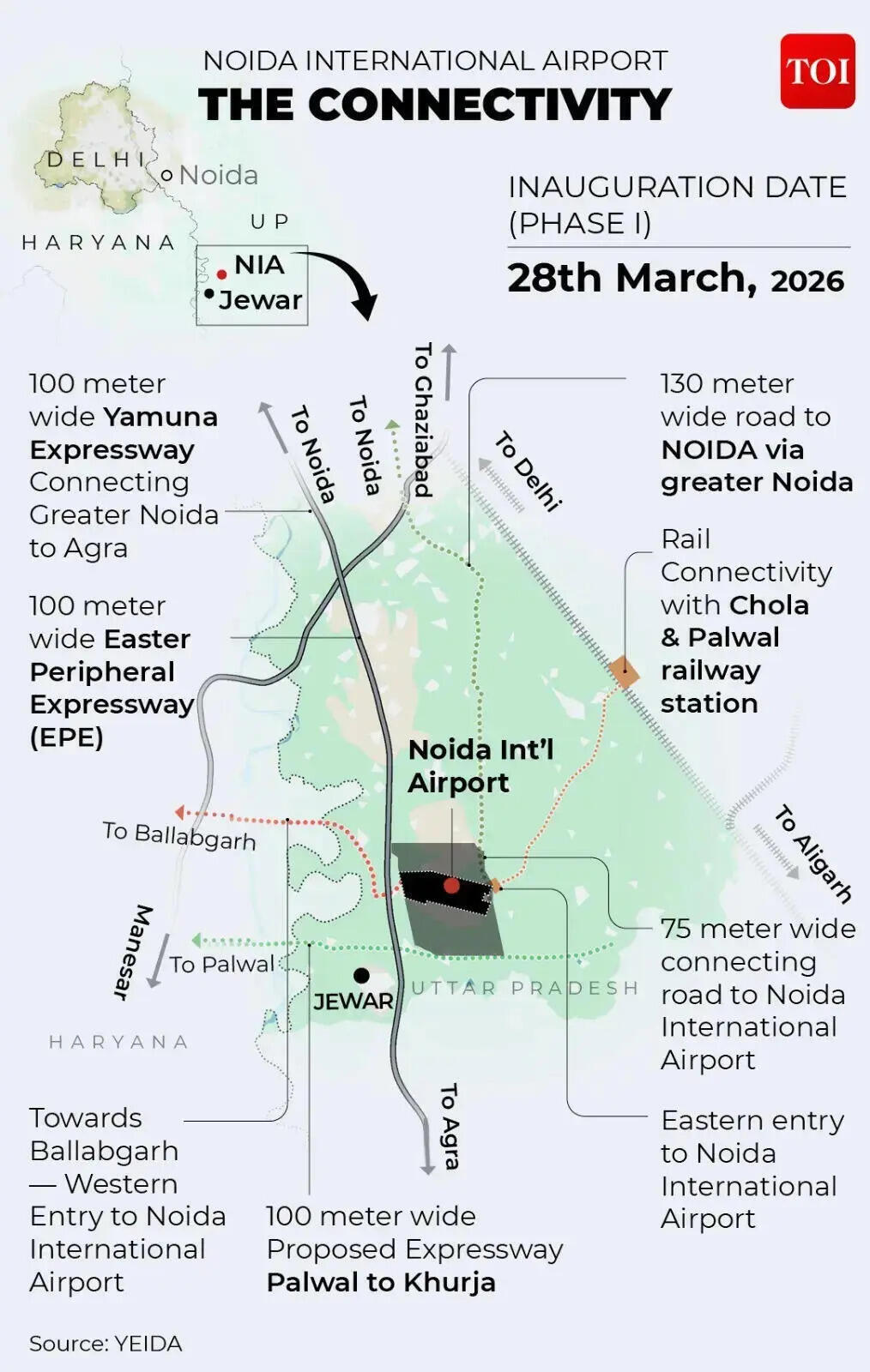
Strategically located along the Yamuna Expressway in Gautam Buddha Nagar district, the airport is planned as a multi-modal transport hub.It will feature seamless integration with road, rail, metro and regional transit systems, ensuring smooth connectivity for passengers and cargo. This connectivity is expected to significantly improve accessibility for travellers across Delhi NCR and neighbouring regions.
Boost to India’s aviation ambitions
The inauguration of Phase I of Noida International Airport is being seen as a major step in strengthening India’s aviation ecosystem.By expanding capacity, improving connectivity, and integrating modern infrastructure with sustainability, the project is expected to play a key role in positioning Delhi NCR as a major global aviation hub while supporting economic growth and regional development
Business
Iran permits 2 Pakistani cargo ships to pass through Strait of Hormuz | The Express Tribune

Iran has permitted two Pakistani cargo ships to transit through the Strait of Hormuz, sources in the Ministry of Maritime Affairs confirmed on Saturday.
The vessels, Multan and P-Akili, which were previously held after Iranian forces took control of the strait — a key global oil supply route — have now crossed and are en route to Karachi. They are expected to dock at Karachi port on March 31, a source familiar with the matter said.
Multan is a general cargo ship, while P-Akili is carrying over 80 million litres of crude oil. Sources added that Iranian authorities not only allowed the vessels to pass but also provided an escort until they cleared the strait’s flashpoint line.
Read: Global poll says Iran war leaves US increasingly isolated internationally
This move comes amid ongoing mediation efforts by Islamabad, in coordination with Turkiye and Egypt, to curb the escalating conflict in the Middle East.
It is the second time Tehran has permitted a Pakistani ship to pass through the Strait of Hormuz since the conflict began on February 28. Previously, a Pakistani oil tanker transited the strait on March 16.
The Middle East region remains on high alert following the joint US-Israel offensive on Iran that began on February 28, which has resulted in over 1,900 deaths, including then-Supreme Leader Ali Khamenei.
Tehran has retaliated with drone and missile strikes targeting Israel, Jordan, Iraq, and Gulf countries hosting US military assets, causing casualties, infrastructure damage, and disruption to global markets and aviation.

Butter, chocolate, coffee and milk have all seen prices rocket. Tracing back through the story of one particular supermarket staple begins to explain why
Source link


NHL playoff watch: Guide to all 15 games on Showdown Saturday

I Tested Garmin Watches for a Decade While Hiking, Biking, and Climbing. Here’s What You Should Buy

Children hope for perks as David Beckham awarded knighthood

-
 Business1 week ago
Flipkart group CFO to leave co amid IPO plans – The Times of India
-
 Business1 week ago
Video: The Effects of High Oil Prices
-

 Fashion1 week ago
China’s textile & apparel exports surge 17% to $50 bn in Jan-Feb 2026
-

 Sports1 week ago
Rating Adidas’ 2026 World Cup away shirts: Argentina, Spain, Mexico and more
-

 Sports1 week ago
American Conference Commissioner Tim Pernetti thanks Trump for Army-Navy game executive order
-
Tech1 week ago
The Corsair 4000D RS PC Case Keeps Your System Cool
-

 Tech1 week ago
‘Uncanny Valley’: Nvidia’s ‘Super Bowl of AI,’ Tesla Disappoints, and Meta’s VR Metaverse ‘Shutdown’
-

 Tech1 week ago
Gamers Hate Nvidia’s DLSS 5. Developers Aren’t Crazy About It, Either