

Business
Stocks post modest gains while gold pushes higher

The FTSE 100 made steady progress on Monday with a boost from defence stocks and gold miners partially offset by falls in utility stocks.
The FTSE 100 index closed up 9.0 points, 0.1%, at 9,196.34. The FTSE 250 ended 27.97 points higher, 0.1%, at 21,633.69 and the AIM All-Share finished up 4.54 points, 0.6%, at 768.64.
In Europe, the CAC 40 in Paris up 0.1%, while the DAX 40 in Frankfurt closed 0.6% higher.
Financial markets in New York were closed on Monday for Labor Day.
This week’s US calendar is packed with labour market data, culminating in Friday’s August jobs report.
FactSet consensus looks for a nonfarms figure of 110,000 in August compared to 73,000 in July, and an unchanged unemployment rate of 4.2%.
Attention will focus on the extent of revisions to the prior month’s figures, given the hefty revisions in July’s report.
June was revised down from 147,000 to just 14,000, the worst monthly reading since January 2021, when 183,000 jobs were shed. May’s reading was downwardly revised to 19,000 from 144,000. In total, employment in May and June combined was 258,000 lower than previously reported.
The pound firmed to 1.3548 dollars late on Monday afternoon in London, compared to 1.3510 dollars at the equities close on Friday. The euro rose to 1.1705 dollars, against 1.1699 dollars. Against the yen, the dollar was trading higher at 147.27 yen compared to 146.92 yen.
There was mixed news on the UK housing market, with a stronger-than-forecast rise in mortgage approvals in July offset by a surprise drop in house prices in August.
Data from the Bank of England showed net mortgage borrowing by individuals fell to £4.5 billion in July from £5.4 billion in June, but mortgage approvals for house purchases edged up slightly to 65,400 from 64,600, beating FXStreet consensus for a fall to 64,000. Approvals for remortgaging fell to 38,900 from 41,600.
But separate figures from Nationwide showed UK annual house price growth softened in August as affordability concerns continue to weigh on buyers.
The Nationwide house price index showed a 0.1% monthly decline in seasonally adjusted UK house prices in August, weakening from 0.5% growth a month earlier.
This underperformed against an FXStreet-cited consensus of 0.2% growth.
RBC Capital Markets analyst Anthony Codling said transaction volumes are “more important” to housebuilders than house prices.
“It doesn’t matter how high the price is if no one is buying, but with mortgage approvals just above their 10-year average, there are plenty of willing home buyers in the housing market and mortgage lenders are willing to approve the mortgages required to complete those purchases,” he added.
This points to a picture of a “healthy” housing market, he said.
On the FTSE 100, housebuilders Taylor Wimpey, Persimmon and Berkeley Group rose 0.3%, 1.0%, 0.1% respectively.
Elsewhere, a report showed the downturn in the UK manufacturing sector sharpened in August, as the sector contracted for the 11th month running.
Data from S&P Global showed the manufacturing purchasing managers’ index fell to 47 points in August from 48 in July, remaining below the 50-point neutral mark. It also slightly underperformed the flash reading of 47.3 points.
Weak market conditions, tariff uncertainty and subdued client confidence contributed to a sharp drop in new order intake in August, as both domestic and overseas demand fell.
BAE Systems rose 1.9% after the UK government announced on Sunday that Norway had selected the firm’s Type 26 frigate for its anti-submarine requirement for five ships, worth about £10 billion.
Analysts at Citi said the Norwegian order is worth about 10p to 15p per share for BAE Systems.
Rolls-Royce climbed 2.8% after reports suggested it is speaking to advisers about funding options for its small nuclear reactor business, which could include an initial public offer of shares.
Endeavour Mining and Fresnillo benefited from the rising gold price, advancing 3.5% and 2.1%.
Gold climbed to 3,476.94 dollars an ounce against 3,445.38 dollars on Friday.
Tesco rose 2% as analysts at UBS and JPMorgan issued positive research notes.
UBS raised its share price target to 475p from 435p and thinks robust first-half results, due in October, will set the tone for further earnings upgrades.
The broker expects the food retailer to lift the lower end of group earnings before interest and tax guidance, currently £2.7 billion to £3 billion, though likely to maintain the top end for now.
Kainos jumped 23% as it said it expects revenue to be at the top end of expectations after a strong start to the financial year.
The London-based Workday partner and provider of IT services to public sector, commercial and healthcare customers said it delivered a sequential improvement in the period from April 1 to date, building on a “solid” fourth-quarter 2025 performance.
As a result, Kainos now expects revenue for the financial year ending March 31 at the upper end of the consensus range of forecasts of £378 million to £393.4 million, which would be growth of as much as 7.1% from £367.2 million the year prior.
Shore Capital analyst Martin O’Sullivan reckons “resilient, well-managed” Kainos is primed to capitalise on the upturn in digital services that is beginning to materialise.
Flying high, shares in Immupharma leapt 99% as it announced the filing of a “ground-breaking” new patent application for its lead asset P140, the world’s first immunormalizer.
London-based Immupharma said the patent application, which provides the potential for 20 years of commercial exclusivity, discloses a novel diagnostic test and precision treatment approach.
The new diagnostic test is expected to shorten the time to diagnosis, improve patient selection for clinical trials, and enable smaller, faster and more successful trials, significantly increasing the probability of regulatory approval.
A barrel of Brent traded at 68.63 dollars (£50.68) late Monday afternoon, up from 67.41 dollars (£49.78) on Thursday.
The biggest risers on the FTSE 100 were Endeavour Mining, up 88p at 2,624p; IAG, up 11.5p at 393.6p; Rolls Royce, up 30p at 1,100p; Fresnillo, up 37p at 1,825p and Babcock International Group, up 21p at 1,037p.
The biggest fallers on the FTSE 100 were SSE, down 53.5p at 1,676.5p; United Utilities, down 28.5p at 1,121.5p; National Grid, down 21.5p at 1,019.5p; BT Group, down 4.3p at 212.2p and Severn Trent, down 48p at 2,538p.
Tuesday’s local corporate calendar sees full-year results from Alumasc and half-year numbers from Oxford Nanopore, Johnson Service Group and Uniphar.
The global economic calendar on Tuesday has US manufacturing PMI data and a eurozone inflation print.
Contributed by Alliance News.
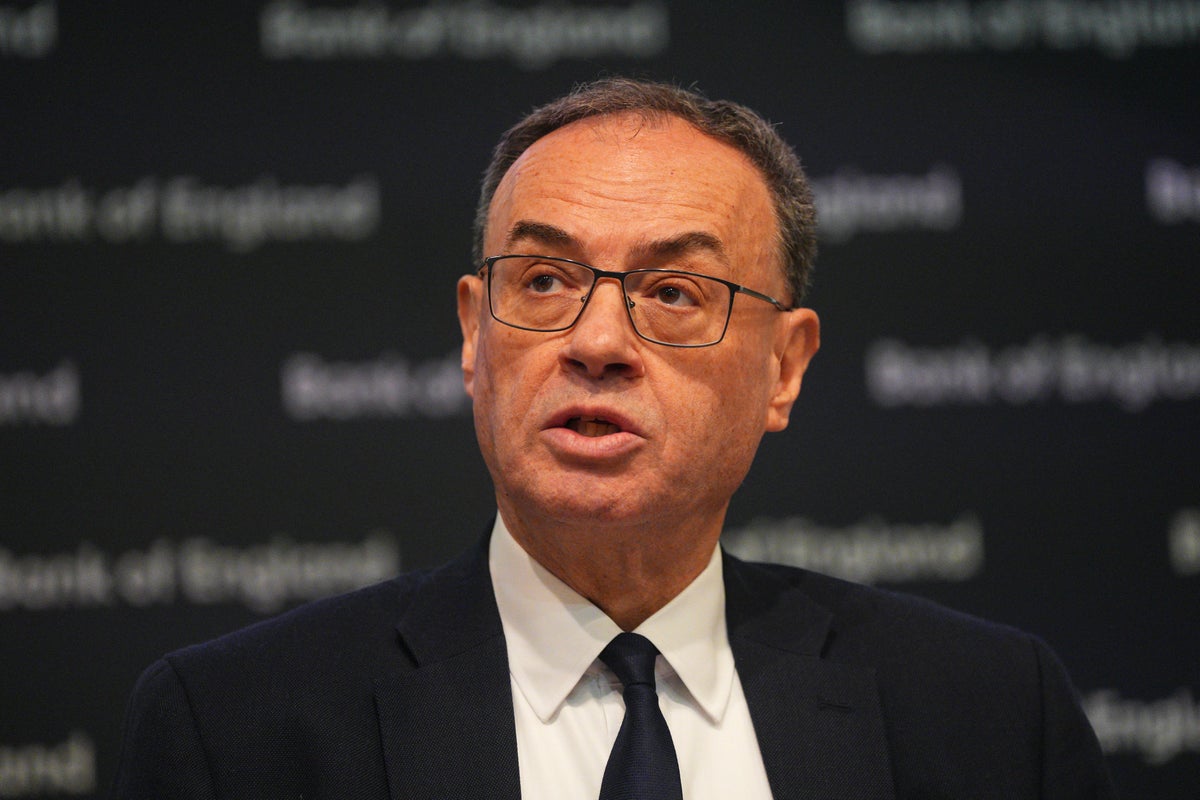
Reopening the Strait of Hormuz is “the best thing to do” to prevent interest rates rising, Bank of England governor Andrew Bailey has said.
In an interview on Thursday evening after the Bank’s Monetary Policy Committee (MPC) voted unanimously to leave the rate unchanged at 3.75%, Mr Bailey said any further cuts are “not on the horizon” as he hinted at possible hikes.
It is the first time that all members have voted the same way since September 2021.
Iran effectively closed the vital oil and gas shipping route after the US and Israel attacked the country, which has pushed up global prices.
Mr Bailey said the war in the Middle East is hitting petrol pumps now, will likely increase household energy costs in summer, and put pressure on food prices.
He told LBC’s Andrew Marr: “The duration of this problem is crucial.
“I would also say very clearly that the best way to solve this situation is not through monetary policy. It is through sorting out at the source of what’s going on.
“Frankly, reopening the Strait of Hormuz is the best thing to do. Get the energy market back on its normal footing, as it were.”
Asked if he has a message for US President Donald Trump, Israeli Prime Minister Benjamin Netanyahu, and “whoever’s in charge in Tehran”, Mr Bailey said: “The best thing we can do actually for the world economy… is to sort out the problem in terms of reopening the energy supply lines, because that is in the best interest of people in the world.”
UK military planners have joined the US Central Command to help formulate proposals for opening the Strait.
The MPC now expects Consumer Prices Index inflation to be around 3% in the second quarter of 2026, up from the 2.1% that had been forecast in February, with a potential rise in inflation up to 3.5% in the third quarter.
Mr Bailey was asked if he foresees, in the final two years of his term, the ambition to reduce inflation to at or below 2% being fulfilled.
He told the programme: “If you’d asked me this question three weeks ago, I was very optimistic on this.”
The governor added: “We are fully committed to the inflation target, and our job, frankly, is to deal with the shocks as they come along.
“I have to do that. I don’t wish them. I wish they were not happening, but they are and we will have to deal with them.”
He said the impact of the war will likely feed through into a higher Ofgem energy price cap from July.
It was put to Mr Bailey that the Middle East crisis comes at a time when the UK economy has already “not been growing strongly”.
He responded: “It is a very difficult time to have this happen, but frankly, any time would be pretty difficult to have this happen.
“This is a major shock to energy prices, and we have to deal with it.”
He said the “sustainable rate of growth” in the UK needs to be raised which could come from investment from pensions and artificial intelligence.
“I’m not starry-eyed about it, but it is probably the most likely area that we’re going to raise the growth rate of the economy and that’s important”, he said of AI.
The MPC signalled that if the conflict persists and has a bigger impact on UK prices, it would need to take a “more restrictive policy stance”, which indicates higher interest rates to control inflation.
The governor added: “The longer it goes on… I’m afraid to say, but it is rather an obvious point, the effect will be larger.”
He said that is why it is “imperative” that “everything is done that can be done to alleviate this effect”, adding: “That is the critical thing.”

new video loaded: The Effects of High Oil Prices
By Ben Casselman, Sutton Raphael, James Surdam, Joey Sendaydiego, Estelle Caswell and June Kim
March 19, 2026
Business
FDA approves higher dose version of weight loss drug Wegovy as Novo Nordisk tries to win back market share

The logo of pharmaceutical company Novo Nordisk is displayed in front of its offices in Bagsvaerd, Copenhagen, Denmark, Feb. 4, 2026.
Tom Little | Reuters
The Food and Drug Administration on Thursday approved a higher-dose version of Novo Nordisk‘s blockbuster weight loss injection Wegovy, as the company pushes to win back market share from chief rival Eli Lilly.
Novo expects to launch the higher, 7.2-milligram dose of Wegovy in April. The Danish drugmaker is positioning that version to better compete with Lilly’s obesity drug Zepbound, which has proven to be more effective at promoting weight loss than the standard, 2.4-milligram dose of Wegovy.
That higher efficacy has helped Zepbound become the preferred obesity medication among prescribers and patients, even though it entered the U.S. market later than Wegovy, and has solidified Lilly’s position as the dominant player in the space.
The high-dose Wegovy helped patients with obesity lose an average 20.7% of their weight after 72 weeks in a phase three trial. The standard dose of Wegovy has shown around 15% weight loss on average in clinical trials.
“I think it really makes it more competitive, and it really reduces the delta there,” Dr. Jason Brett, principal U.S. medical head at Novo Nordisk, said in an interview Thursday ahead of the approval.
“But even more importantly, I think it just gives patients another option if they’re not reaching their targets, and achieving some of these higher weight losses for certain patients,” he added.
In a separate phase three trial on patients with obesity and Type 2 diabetes, high-dose Wegovy demonstrated an average weight loss of 14.1%. People with diabetes typically have a harder time losing weight than people without the condition.
It marks the first approval of a GLP-1 treatment under the FDA’s new national priority voucher plan that aims to cut drug review times to one to two months for companies the agency says are supporting U.S. national health priorities. The FDA launched the pilot plan in June.


Enzo Fernández ‘completely committed’ to Chelsea – Liam Rosenior

What happened to Chuck Norris? Actor rushed to hospital in Hawaii

Lionel Messi scores 900th goal, but Miami bounced from CCC

Stock market crash today (March 12, 2026): Nifty50 opens below 23,600; BSE Sensex down over 900 points on continuing US-Iran war – The Times of India

UK’s Topshop unveils Tolu Coker capsule collection

US ignites Iran war, but Gulf Arab states pay the price | The Express Tribune

-
Business1 week ago
Stock market crash today (March 12, 2026): Nifty50 opens below 23,600; BSE Sensex down over 900 points on continuing US-Iran war – The Times of India
-
 Fashion1 week ago
UK’s Topshop unveils Tolu Coker capsule collection
-
Business1 week ago
US ignites Iran war, but Gulf Arab states pay the price | The Express Tribune
-

 Fashion1 week ago
India’s textile recycling market may reach $3.5 bn by 2030: Report
-

 Tech1 week ago
Meta Developed 4 New Chips to Power Its AI and Recommendation Systems
-
 Business1 week ago
8th Pay Commission: How Much Will Central Govt Employees’ Salaries Rise? What We Know So Far
-

 Sports1 week ago
Bangladesh crush Pakistan in ODI series opener | The Express Tribune
-

 Tech1 week ago
Labour scarcity is forcing IT leaders to rethink automation economics | Computer Weekly