

Politics
Strait of Hormuz blockage drives up Gulf food bills

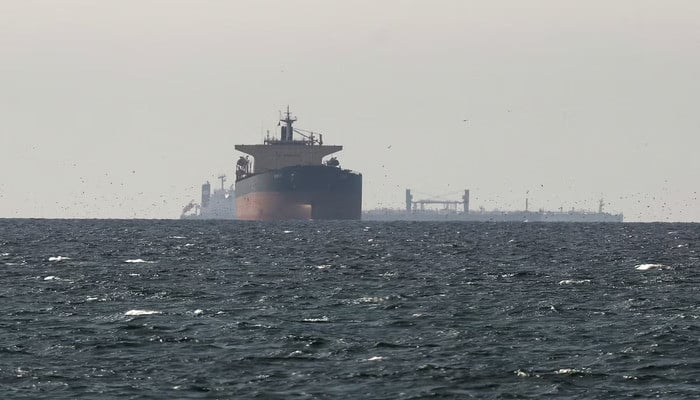
In a supermarket in Bahrain, Mahmoud Ali fills his cart as usual. The shelves remain stocked despite the war in the Middle East, but the blockade of the main shipping routes into the Gulf is now being felt at checkout.
“There’s no shortage”, but over the past few days “there has been a noticeable increase in the price of certain food products”, the father of four said.
The price of meat in particular has almost doubled, he added.
Like most of its neighbours in this arid region, the small Gulf monarchy depends heavily on imports, especially for its food supply.
But the war, triggered on February 28 by Israeli-US strikes against Iran, has severely disrupted the transport of goods through the strategic Strait of Hormuz, which is effectively closed.
“Most major ports in the UAE, Qatar, Kuwait and Bahrain have suspended or heavily reduced cargo processing,” said economist Frederic Schneider, from the Middle East Council on Global Affairs.
Air transport, another logistical pillar of the region, is also running below capacity because of daily Iranian drone and missile attacks, he added.
With the main gateways to the Gulf — the ports of Abu Dhabi, Jebel Ali in Dubai and Dammam in eastern Saudi Arabia — almost inaccessible, ships are turning to others located south of the strait in Oman and the Emirates.
Saudi Arabia has also positioned itself as a key supply hub at the heart of the Gulf region, as its airspace remains open and maritime traffic to its Red Sea ports continues.
To address the disruption of traffic in the ports along the Gulf coast, the kingdom has launched a new initiative to strengthen its transport networks by adding logistics routes and operational corridors to handle containers and cargo diverted from the country’s eastern ports, according to officials in the transport sector.
AFP journalists recently saw a stream of heavy trucks crossing the border with Qatar.
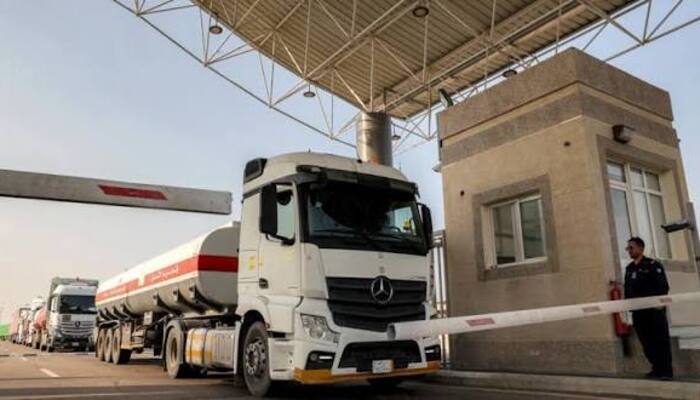
Other land-based alternatives exist, including road corridors linking to the Mediterranean through Syria or Jordan.
But these overland routes are too congested, expensive and insufficient to make up for the paralysis of traditional routes, Schneider said.
Fresh products, most of which are imported from Asia and cannot be stored for long, are the first to be affected.
‘Tangible risk’
Faced with this situation, the Gulf states are not on equal footing.
Saudi Arabia has direct access to the Red Sea. The United Arab Emirates claims to have four to six months of stock. And Qatar has invested heavily in its strategic reserves, following the three-year blockade imposed by its neighbours in 2017.
Bahrain and Kuwait, on the other hand, are already seeing consumers paying the price for the conflict.
After a rush on supermarkets in the first days of the war, Kuwaiti authorities froze the prices of certain basic products and subsidised meat imports.
“Overall, prices have remained stable,” an official from the Kuwaiti commerce ministry told AFP, speaking on condition of anonymity.
“But an increase of more than 30% was recorded for meat and fish,” which were affected by the suspension of fishing in the Gulf and the halt of imports from Iran, India and Pakistan, he said.
The private sector is also trying to contain the impact of the blockade.
The Lulu retail chain, which has 280 supermarkets in the region, said it maintains four to six months of reserve stock of non-perishables and has chartered special flights to fly in fruit, vegetables, meat, seafood and poultry.
So far, “37 special chartered flights have brought in more than 6,000 tons of fresh produce”, its communications director V Nandakumar told AFP, adding that the additional cost was “not going to be passed on to the consumer as of now”.
According to Schneider, “there is a certain level of preparedness and prices are elevated but under control for the moment”.
However, “as the war does not seem to end soon, there is a tangible risk of a price spiral on imported goods, in particular food”, he added.
- No Russian military hardware was on display.
- Putin invokes Soviet victory to rally support for army.
- Ukraine, Russia exchange drone attacks overnight.
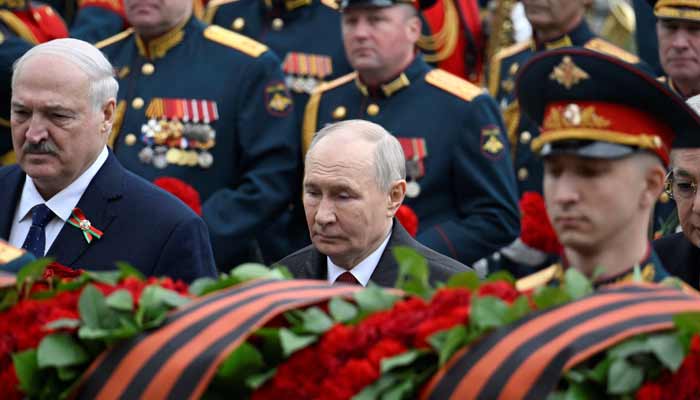
Russian President Vladimir Putin said on Saturday that his soldiers in Ukraine were fighting an “aggressive force” backed by all of Nato and described his war goals as “just”, in a combative address to the annual Victory Day parade on Red Square.
Putin has made the memory of the Soviet victory over Nazi Germany in World War II a central narrative of his 25-year rule, and authorities typically mark the parade with pomp and grandeur.
But a spate of Ukrainian long-range attacks in recent weeks prompted the Kremlin to ramp up security measures and downsize this year’s celebrations.
The parade was vastly scaled back compared to previous years, with no military hardware on display for the first time in nearly two decades and only a handful of foreign dignitaries in attendance — most of them leaders of Russia’s close allies.
Both Moscow and Kyiv agreed to observe a three-day ceasefire over the event, following a last-minute appeal from US President Donald Trump. Moscow had threatened a “massive” strike on central Kyiv if Ukraine disrupted the proceedings.
In an address to the parade, attended by Russian military units as well as soldiers from North Korea, Putin invoked the Soviet victory to rally support for his army in Ukraine.
“The great feat of the generation of victors inspires the soldiers carrying out the goals of the special military operation today,” Putin said.
“They are confronting an aggressive force armed and supported by the entire Nato bloc. And despite this, our heroes move forward,” he said.
“I firmly believe that our cause is just,” he added later.
Three-day ceasefire
After two failed attempts at truces this week by both Russia and Ukraine, Trump announced on Friday a three-day ceasefire between both sides would come into effect from May 9.
“Hopefully, it is the beginning of the end of a very long, deadly, and hard-fought War,” Trump posted on his Truth Social network, adding the ceasefire would be accompanied by a prisoner exchange.
Ukrainian President Volodymyr Zelensky issued a decree on Friday ordering the Ukrainian military not to attack the parade and in a separate statement confirmed his government would adhere to the ceasefire to enable the swap of 1,000 detainees from each warring side.
“Red Square is less important to us than the lives of Ukrainian prisoners who can be returned home,” Zelensky said, referring to the historic site in the Russian capital where the annual event is held.
Both the Ukrainian air force and Russian defence ministry reported fewer drone attacks overnight.
Now in its fifth year, the war has killed hundreds of thousands of people and spiralled into Europe’s deadliest since World War II.
US-mediated talks on ending the fighting have shown little progress since February, when Washington shifted focus to its war against Iran.
Before Trump’s announcement on Friday, Zelensky had balked at the idea of a truce over the parade and warned Moscow’s allies against attending.
Russia had threatened a massive strike on the heart of Kyiv if Ukraine disrupted the commemoration and urged foreign diplomats to leave the Ukrainian capital ahead of the event.
Security was tight in the capital before the parade, with AFP reporters seeing empty streets.
Mobile internet was also disrupted.
Only the leaders of Belarus, Malaysia and Laos, as well as Slovak Prime Minister Robert Fico, were set to attend, in contrast to high-profile visitors including China’s Xi Jinping during last year’s event.
Zelensky expressed hope on Friday that US envoys would visit Ukraine in the coming weeks to reboot talks on ending the war.
- Iran still weighing its response to the US proposal.
- UAE says its air defences engaged Iranian missiles, drones.
- US imposes sanctions for aiding Iran’s weapons sector.
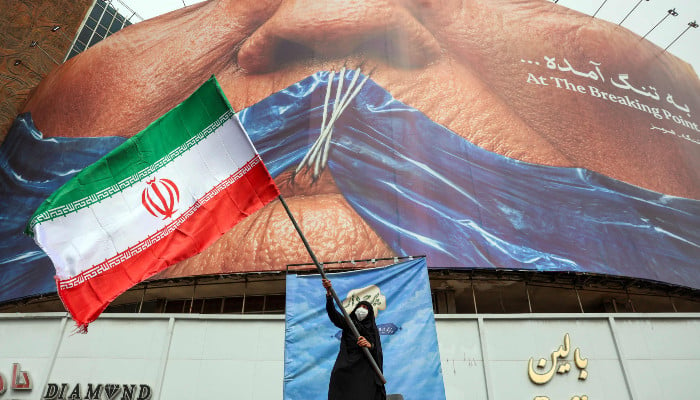
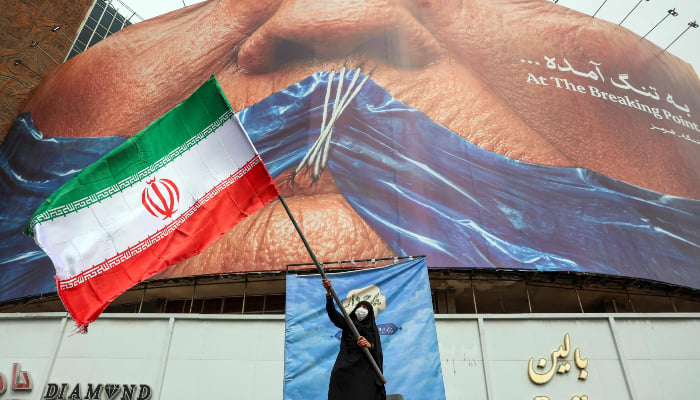
Efforts to end the war between the United States and Iran appeared to stall as the two sides traded fire in the Gulf on Friday, while a US intelligence analysis concluded Tehran could withstand a naval blockade for months.
A CIA assessment indicated that Iran would not suffer severe economic pressure from a US blockade of Iranian ports for about another four months, according to a US official familiar with the matter, suggesting that US leverage over Tehran remains limited as the two sides seek to end a conflict that has been unpopular with US voters.
The Washington Post first reported the assessment.
A senior intelligence official called the “claims” about the CIA analysis “false,” saying the blockade “is inflicting real, compounding damage – severing trade, crushing revenue, and accelerating systemic economic collapse.”
Recent days have seen the biggest flare-ups in fighting in and around the Strait of Hormuz since a ceasefire began a month ago, and the United Arab Emirates came under renewed attack on Friday.
Washington is awaiting Tehran’s response to a US proposal that would formally end the war before talks on more contentious issues, including Iran’s nuclear program.
“We should know something today,” US Secretary of State Marco Rubio told reporters in Rome earlier in the day. “We’re expecting a response from them.”
Iran’s foreign ministry spokesperson said Tehran was still weighing its response, and none was reported by mid-afternoon in Washington, just before midnight in Tehran.
Sporadic clashes in Strait of Hormuz
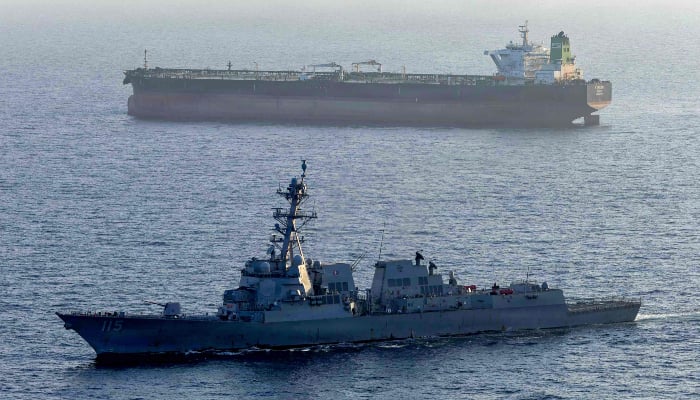
Meanwhile, more sporadic clashes between Iranian forces and US vessels took place in the Strait of Hormuz, Iran’s semi-official Fars news agency reported.
The Tasnim news agency later cited an Iranian military source saying the situation had calmed, but warned more clashes were possible.
The US military said it struck two Iran-linked vessels attempting to enter an Iranian port, with a US fighter jet hitting their smokestacks and forcing them to turn back.
Iran has largely blocked non-Iranian shipping through the strait since the war began with joint US-Israeli airstrikes across Iran on February 28. The US imposed a blockade on Iranian vessels last month.
Oil prices rose, with Brent crude futures above $101 a barrel, though still down more than 6% for the week.
Trump said on Thursday the ceasefire was still holding despite the flare-ups in the strait, which before the war handled one-fifth of the world’s oil supply.
The confrontation extended beyond the waterway. The United Arab Emirates said its air defences engaged with two ballistic missiles and three drones from Iran on Friday, with three people sustaining moderate injuries.
During the war, Iran has repeatedly targeted the UAE and other Gulf states that host US military bases. In what the UAE called a “major escalation”, Iran stepped up attacks this week in response to Trump’s announcement of “Project Freedom” to escort ships in the strait, which he paused after 48 hours.
Iran accuses US of breaching truce
Iran accused the US of breaching the ceasefire, which had largely held since it was announced on April 7 but has come under strain this week.
“Every time a diplomatic solution is on the table, the US opts for a reckless military adventure,” Foreign Minister Abbas Araqchi said on Friday. Iran’s Mehr news agency reported that one crew member was killed, 10 wounded and four missing after a US Navy attack on an Iranian commercial ship late on Thursday.
Rubio, after meeting with Italian Prime Minister Giorgia Meloni, questioned why Italy and other allies were not backing Washington’s efforts to reopen the strait.
“Are you going to normalise a country claiming to control an international waterway? Because if you normalise that, you’ve set a precedent that’s going to get repeated in a dozen other places,” he said.
US imposes sanctions
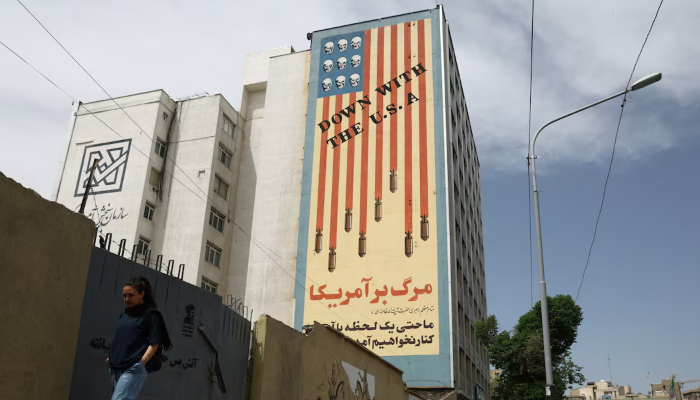
While pursuing diplomacy, the US also ratcheted up sanctions to pressure Iran.
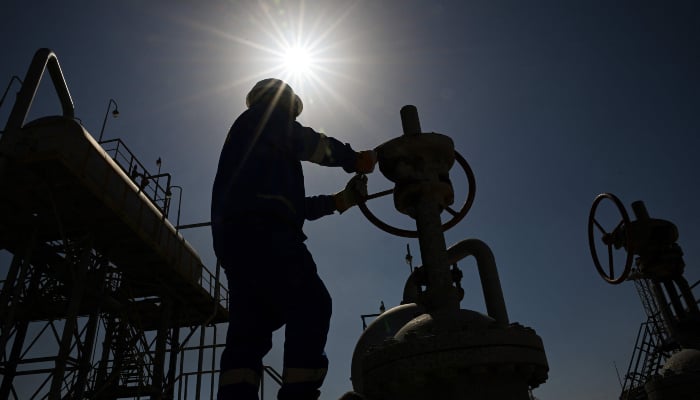
The US Treasury on Friday announced sanctions against 10 individuals and companies, including several in China and Hong Kong, for aiding efforts by Iran’s military to secure weapons and raw materials used to build Tehran’s Shahed drones.
Treasury said in a statement it remains ready to take economic action against Iran’s military industrial base so Tehran cannot reconstitute its production capacity and project power abroad.
It also said it was prepared to act against any foreign company supporting illicit Iranian commerce and could impose secondary sanctions on foreign financial institutions, including those connected to China’s independent “teapot” oil refineries.
The announcement came days before Trump plans to travel to China for a meeting with President Xi Jinping.


Sri Lankan authorities arrested a senior Buddhist monk on Saturday for the alleged sexual abuse of an underage girl, police said, marking the highest-profile case involving clergy in the country.
Pallegama Hemarathana, 71, was arrested at a private hospital in the capital Colombo, where he had sought treatment over the weekend amid an investigation into the alleged abuse of the 11-year-old girl in 2022.
The crime is alleged to have taken place at a highly venerated temple in Anuradhapura, around 200 kilometres (125 miles) north of Colombo, where Hemarathana is the chief priest.
“We will be guided by the magistrate on further action,” a police statement said Saturday.
The monk will soon be presented before a judge.
Authorities added that the victim´s mother has also been arrested for aiding and abetting the monk.
The development comes a day after a local court in Anuradhapura imposed a foreign travel ban on the monk.
There have been several cases of clergy abusing children in Sri Lanka, but the latest arrest involves the most senior monk to be accused of such a crime.
The 71-year-old is the chief custodian of a tree believed to have been grown from a sapling of the Bodhi tree in India that sheltered the Buddha when he attained enlightenment more than 2,500 years ago.
He is also the chief of eight highly venerated temples that are on a key Buddhist pilgrimage route.


CDF Munir to address Marka-e-Haq victory ceremony at GHQ tomorrow
Putin says army fighting ‘aggressive’ Nato-backed force in Victory Parade address

I Tried the Best Captioning Smart Glasses, and Only One Leads the Pack

-
 Politics6 days ago
Iran weighs US reply delivered via Pakistan as Trump signals opposition to deal terms
-

 Tech1 week ago
This Indigenous Language Survived Russian Occupation. Can It Survive YouTube?
-
 Fashion1 week ago
Canada’s Lululemon appoints Esi Eggleston Bracey to board of directors
-
 Fashion1 week ago
US’ J.Jill, Inc. appoints Kimberly Wallengren as CMO
-
 Business1 week ago
Government hikes jet fuel prices by 5% for international airlines – The Times of India
-
 Business1 week ago
Apollo Sports Capital and Tom Dundon make landmark $225 million investment in pickleball
-

 Fashion1 week ago
US’ Gap partners with Victoria Beckham on timeless wardrobe essentials
-
 Fashion1 week ago
AAFA pushes for swift US House passage of key anti-counterfeiting law