

Entertainment
The Paparazzi: Once making big money, now a casualty of social media











Ages ago, when our war with India in 1965 began, I had just become a young reporter in an English eveninger. It so happened that I was asked to write a column on the war for the group’s Urdu daily, ‘Hurriyet’. And the directive was to find historical examples to raise people’s morale and promote their patriotism.
I had read a review of a new book titled ‘Russia at war 1941-45’, written by Alexander Werth, who had been a BBC correspondent in the Soviet Union during the Second World War. I was able to get it and was fascinated by its contents. Based on his personal experiences, Werth had described and explained the great resistance of the Soviet people. He told the story of the Russians in startling human terms.
That has remained one of the books that I cherish. I still have it, though it is now in poor condition. I searched it out this week from the chaos that my collection has become and have been browsing through it while mentally and emotionally preoccupied with the war that is raging in Iran and the Middle-East.
Naturally, I am also reminded, with a touch of nostalgia, of what I had picked from this book to write my Urdu columns. I found so much material in the book that only a few references were possible. The most touching was the story of Leningrad, now renamed Saint Petersburg, and how its citizens braved the siege and the famine.
One column that I fondly recall was on a poem: ‘Wait for me’. A soldier, leaving for the front, tells his beloved: “Wait for me, and I will return, only wait very hard”. To quote Werth: “It is difficult at this distance, except for those who were in Russia at that time, to realise how important a poem like this was to literally millions of Russian women; no one could tell how many hundreds of thousands had died at the front or had been taken prisoner or were otherwise missing”.
As an aside, I want to point out this astounding fact that the Soviet Union suffered the highest number of casualties in the Second World War, with total deaths estimated to be around 24 to 27 million people.
Now, this may seem like a distraction. But I thought of it as a point of departure to underline the importance of the morale of a people during a war or a time of deep crisis. A nation is to be judged by the quality of its people. That is how some nations are stronger than others. The patriotic strength of the Russian people was demonstrated during the Great War, even though they were ruled by an authoritarian system, with Joseph Stalin at the helm.
Initially, I was thinking of reviewing the state of the people of Pakistan in this context. We, as a country, are certainly in a very difficult situation because of the complexity of our relations with Iran and the US and the Gulf countries. Specifically, we are bound by a security pact with Saudi Arabia. In addition, we are at war with Afghanistan. It is a critical situation and anything can happen at any time.
So, what kind of social capital does Pakistan have? Are its citizens capable of bearing hardships in a disciplined manner? One may refer to the significant rise in petrol prices and the austerity measures announced by Prime Minister Shehbaz Sharif, both relevant from an economic point of view. But the real strength of a society lies in its civilisational and moral values, and in the people’s spirit of sacrifice in the national interest.
Considering the increasing tempo of the war and the intensity of American and Israeli attacks on Iran, it is the resilience of the Iranian forces that has surprised the world. One expects that some historians and journalists are documenting the human stories of this monumental encounter between Iran and the most powerful military in the world.
Already, a number of social media analysts are meaningfully exploring the reasons why Operation Epic Fury is not able to bring about a regime change in Iran or achieve whatever goals that have confusedly been articulated by President Trump. Meanwhile, the cost of this war is becoming unbearable for the world, mainly due to the energy crisis.
Actually, Iran at war is a spectacle that has baffled many in the world. One aspect of this has perceptively been explained by noted Iranian writer and scholar of religion, Reza Aslan, in a longish piece published last week in The New York Times. Based in Los Angeles, he belongs to the Iranian diaspora. But he rejects the thought that an American president can be Iran’s liberator. Hence the title of his article: ‘The mistake that Iranians make about America’. I also heard him repeat his views in an interview with Christiane Amanpour on CNN on Friday.
Reza Aslan concedes that when American leaders speak of helping Iranians to take over their government, they are tapping into “a powerful longing”, but recent history confirms that regime change delivered from outside “rarely produces the democracy imagined in the inside”.
One excerpt from his article: “Here is what I know for certain: Iran is older than any regime that has ruled it – older than the revolution, older than the shahs, older than the foreign powers that have sought to shape its fate. Across three millenniums of poetry, philosophy, empire and renewal, this civilisation has outlasted conquerors and kings, clerics and generals. It has done so not because a saviour from abroad intervened but because its people endured – sustained by a fierce pride in their language and heritage, by a literary and intellectual tradition that has survived invasion and upheaval, by a collective memory shaped as much by resistance as by rule”.
The ongoing war is a manifestation of Iran’s resistance. A time will come when other battles are fought in another arena.
The writer is a senior journalist. He can be reached at: [email protected]
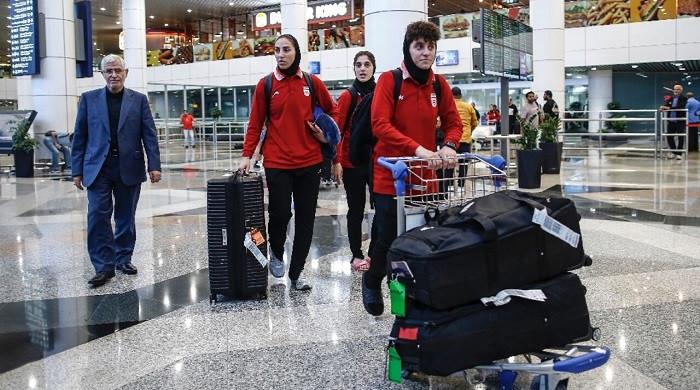
Three more members of the Iranian women’s football team have left their asylum in Australia and decided to return home, Canberra said Sunday.
Seven members of Iran’s visiting football delegation competing in the Women’s Asian Cup had sought sanctuary in Australia after they were branded “traitors” at home for refusing to sing the national anthem.
Only three of them will now remain in Australia, after another member of the group had second thoughts earlier in the week.
“Overnight, three members of the Iranian Women’s Football Team made the decision to join the rest of the team on their journey back to Iran,” Home Affairs Minister Tony Burke said in a statement.
“After telling Australian officials they had made this decision, the players were given repeated chances to talk about their options,” he said.
The Australian government gave team members the opportunity to seek refuge, but players faced “incredibly difficult decisions”, the minister said.
The football drama has unfolded against a backdrop of war in the Middle East, unleashed by US-Israeli air strikes on Iran.
Rights groups have repeatedly accused Iranian authorities of pressuring athletes abroad by threatening relatives or with the seizure of property if they defect or make statements against the republic.
“The Australian Government has done everything we could to make sure these women were provided with the chance for a safe future in Australia,” Burke said.
“Australians should be proud that it was in our country that these women experienced a nation presenting them with genuine choices and interacted with authorities seeking to help them.”
Iranian state broadcaster IRB said Saturday that three team members — two players and one member of the technical staff — had given up their asylum application and were currently heading to Malaysia.
‘Traitors’
Australian Prime Minister Anthony Albanese has lauded the bravery of the women, vowing they would be welcomed with open arms.
But Iran’s governing football body has accused Australia of kidnapping the players and forcing them to forsake their home nation against their will.
Iranian players fell silent as the national anthem played ahead of a tournament match in Australia, an act seen as a symbol of defiance against the Islamic republic.
A presenter on Iranian state TV branded the players “wartime traitors”, fuelling fears they could face persecution, or worse, if they returned home.
Although the side sang Iran’s anthem — an ode to the glory of the country — in later matches, human rights activists warned the damage was done.
Five players, including captain Zahra Ghanbari, slipped away from the team hotel under the cover of darkness to claim asylum in Australia.
Two more team members — a player and a support staffer — claimed asylum before the team flew out of Sydney on Tuesday evening.
Entertainment
Indian criticism of Pakistan’s anti-terror Afghan operations shamefully hypocritical, says FO
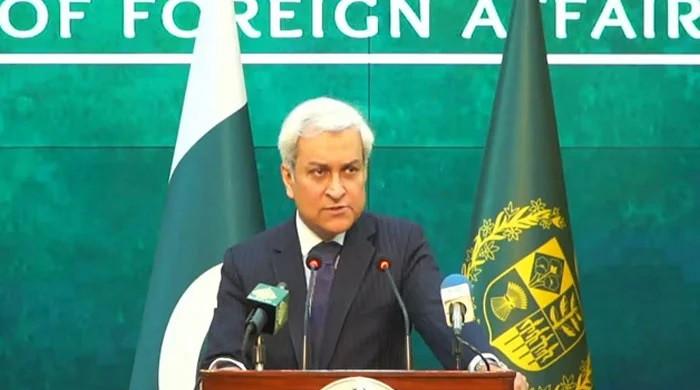
- Spokesperson Andrabi calls Indian remarks “absurd, unwarranted.”
- Says India’s criticism of Pakistan’s actions “shamefully hypocritical.”
- Stresses Pakistan will continue self-defence actions as per the law.
Pakistan hit back at India on Saturday, labelling its criticism of Pakistan’s precise Afghan counterterror operations “absurd and unwarranted” and exposing India’s role in supporting terrorism and flouting international law.
It was stated by Tahir Andrabi, Spokesperson for the Ministry of Foreign Affairs, responding to media queries regarding Pakistan’s response to a statement issued by the Ministry of External Affairs of India.
“The remarks by the spokesperson of the Ministry of External Affairs of India regarding Pakistan’s legitimate, targeted and precise actions against terrorist hideouts and support bases inside Afghanistan are not only absurd and unwarranted but also shamefully hypocritical.”
He added, “India’s active support and sponsorship of terrorist groups operating from Afghan soil, including Fitna-al-Khawarij and Fitna-al-Hindustan, are well known.
“Therefore, India’s frustration at the destruction of its terrorist franchise in Afghanistan, as reflected in such statements, is quite understandable.”
Andrabi went on to accuse India of human rights violations, saying, “India, a serial violator of human rights and international law, continues to illegally occupy Indian Illegally Occupied Jammu and Kashmir (IIOJK) in violation of the UN Charter and relevant UN Security Council resolutions, and has been responsible for perpetrating state terrorism in the occupied territory.”
He further criticised India’s domestic and regional policies: “Guided by Hindutva extremist ideology, it also continues to systematically marginalise its minorities, spread Islamophobia, and has even weaponised water in contravention of its treaty obligations.
“India has not only played the role of a spoiler in Afghanistan, but also in the entire region.”
On India’s legitimacy to comment on Pakistan’s actions, he said, “With such shameful credentials, India is in no position to make such statements and must instead focus on refraining from stoking terrorism inside Pakistan from Afghan soil.”
He concluded by reaffirming Pakistan’s stance: “For its part, Pakistan remains determined to take all appropriate actions in self-defence and to protect its citizens in accordance with international law, including the UN Charter.”


St. John’s routs UConn for 2nd straight Big East tourney title

Gulf conflict could disrupt India’s trade, energy supplies: ASSOCHAM

US, China economic chiefs to meet in Paris to clear path to Trump-Xi summit

-
 Politics1 week ago
India let Iran warship dock the day US sank another off Sri Lanka, say officials
-
 Sports1 week ago
Pakistan set for FIH Pro League debut | The Express Tribune
-

 Entertainment1 week ago
Harry Styles kicks off new era with ‘One Night Only’ comeback show
-
 Business1 week ago
Restaurant group changes name after bid to buys pubs across the UK
-
 Business3 days ago
Stock market crash today (March 12, 2026): Nifty50 opens below 23,600; BSE Sensex down over 900 points on continuing US-Iran war – The Times of India
-
 Business1 week ago
Home heating oil: ‘Most of my pension has gone on home heating oil’
-

 Sports1 week ago
Winners and losers of the 2026 NHL trade deadline
-

 Entertainment1 week ago
Kanye ‘Ye’ West trips during trial: ‘Is he asleep?’