

Sports
The Raiders lean on Tom Brady’s insight. Other NFL teams don’t love that.

Read more
Source link
Sports
NBA star hits back at NYC Mayor Zohran Mamdani for blaming him over expensive playoff tickets
NEWYou can now listen to Fox News articles!
The New York Knicks and the Atlanta Hawks are set to play in the first round of the NBA playoffs and New York City Mayor Zohran Mamdani was asked why it is so much more expensive to attend Knicks’ playoff games compared to the Hawks.
Mamdani jokingly cited Knicks’ foe Trae Young, who starred for the Hawks when they beat the Knicks in the first round of the 2021 playoffs, as the reason for the expensive tickets.
“I would say that I blame Trae Young, and I think it’s always important to blame Trae Young,” Mamdani said at a press conference.
CLICK HERE FOR MORE SPORTS COVERAGE ON FOXNEWS.COM
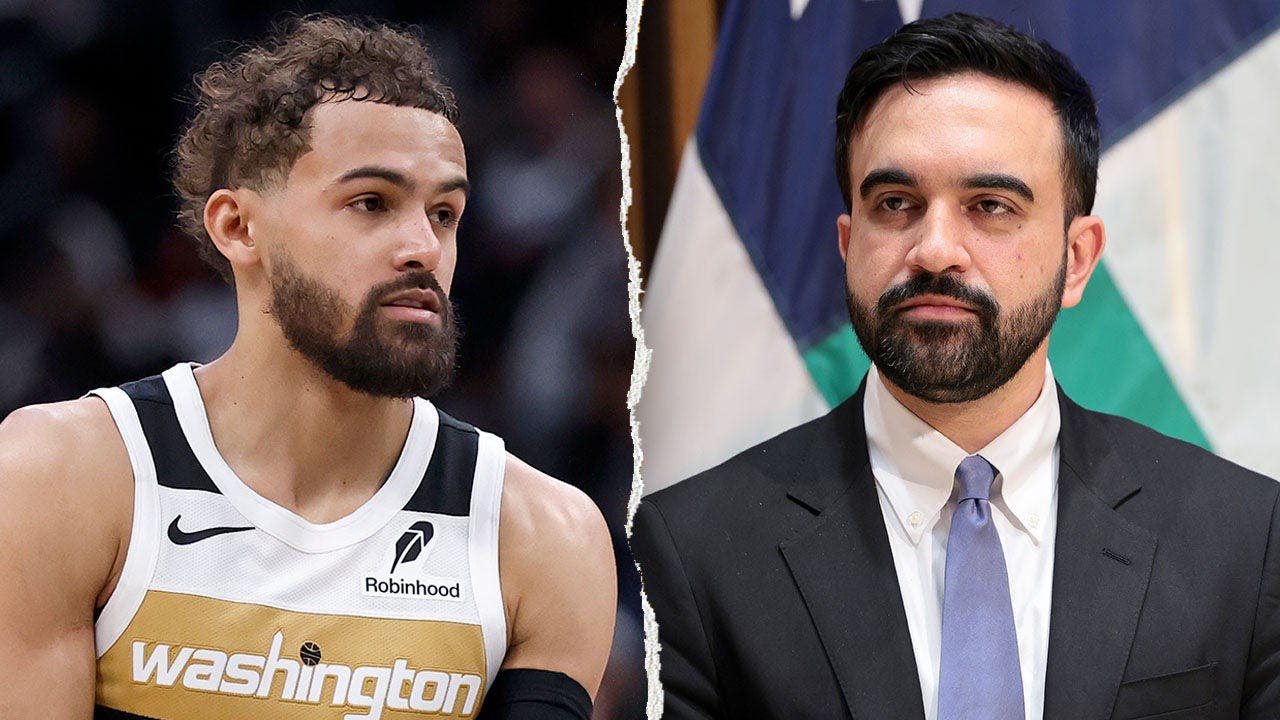
(Left) Washington Wizards guard Trae Young (3) stands on the court against the Utah Jazz in the second half at Capital One Arena in Washington, District of Columbia, on March 5, 2026. (Right) New York Mayor Zohran Mamdani attends a press conference that discussed New York City’s first-quarter crime statistics in New York, New York, on April 2, 2026. (Geoff Burke/Imagn Images;Michael M. Santiago/Getty Images)
Mamdani put the blame on Young, who was traded to the Washington Wizards in January. Even though Young isn’t with the Hawks, he caught wind of Mamdani’s remarks and fired back at the mayor.
“Remember what happened the last time the Mayor of that City has my name in his mouth during a time like this. #DontBlameMeWhenItHappensAgain,” Young posted to X with a laughing crying emoji and a hand emoji.
Regardless of whether Mamdani knows Young is no longer a member of the Hawks, it is not the first time the mayor of New York City has shaded Young, as Bill de Blasio told Young to stop hunting for fouls during that 2021 playoff series.
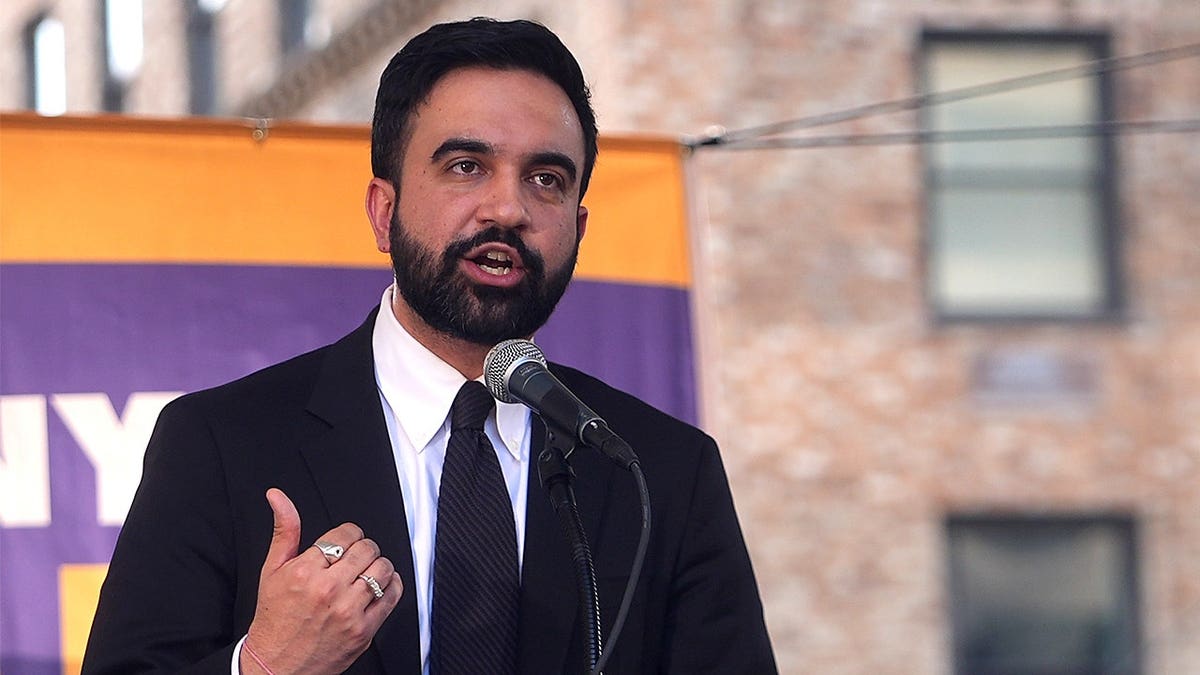
New York City Mayor Zohran Mamdani delivers remarks at the Service Employees International Union 32BJ SEIU rally on Park Avenue in Manhattan on April 15, 2026. (Selcuk Acar/Anadolu)
The Hawks defeated the Knicks 4-1 in that series. The Knicks lost that series as the No. 4 seed, while the Hawks were the No. 5 seed.
This time around, the Knicks are the No. 3 seed, and the Hawks are the No. 6 seed in the Eastern Conference playoffs.
CLICK HERE TO DOWNLOAD THE FOX NEWS APP
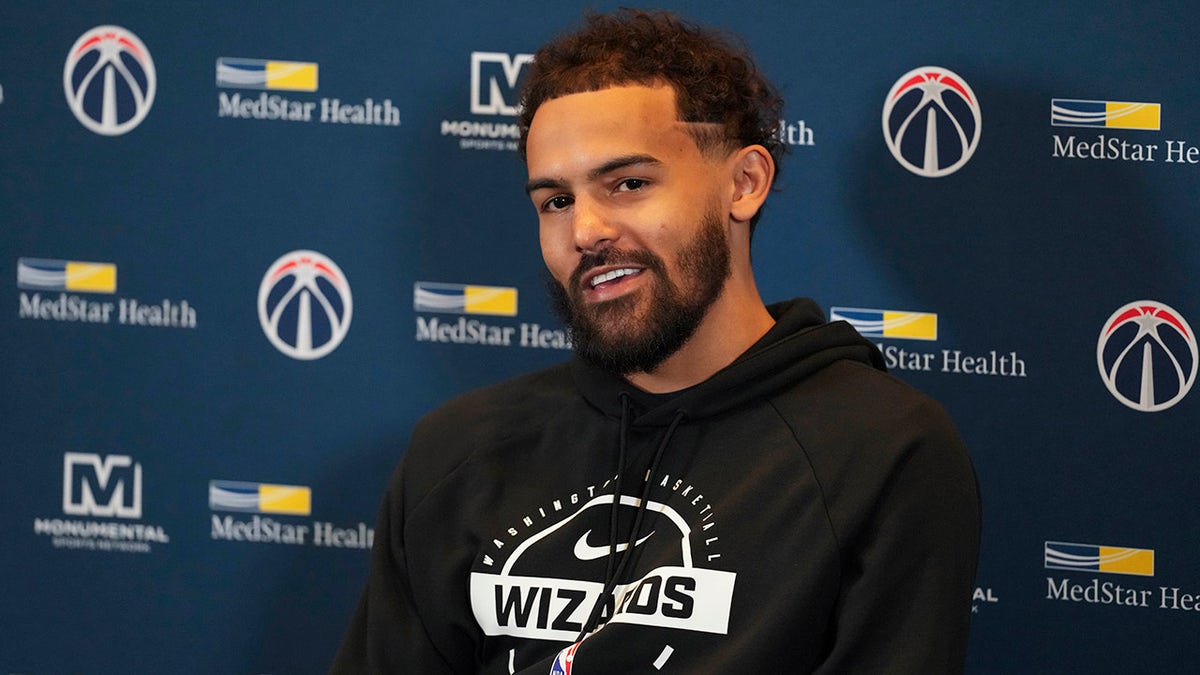
Washington Wizards guard Trae Young (3) meets with the media during his first return to play the Atlanta Hawks at State Farm Arena on Feb. 24, 2026. (Dale Zanine/Imagn Images)
Mamdani said he is “still confident and hopeful” of the Knicks winning a championship this season, and wishes the playoff tickets were more affordably priced.
The Knicks play the first game of the series against the Hawks at Madison Square Garden at 6 p.m. ET on Saturday.
Follow Fox News Digital’s sports coverage on X, and subscribe to the Fox News Sports Huddle newsletter.
We’ve reached the point of the Premier League season where things start to look more like a knockout competition. There are only so many games remaining, and things such as systems, cohesion and managerial decisions don’t matter as much as they do over the course of the whole year. From here, individual brilliance — a great save, a perfect pass, a fantastic finish — takes on an outsize role in determining how things will shake out.
That’s true at the top of the table, where the gap might only be three points (and a game in hand) for Manchester City up to Arsenal if Pep Guardiola’s side win their head-to-head this weekend. It’s definitely true in the Champions League race, where eight points separate third from eighth. And it’s clearly true at the bottom, where 18th-place Tottenham trail 17th-place West Ham by two points and 16th-place Nottingham Forest by three.
So, what players will have the biggest say in how things go from now until the end of the season? We’ve got another edition of ESPN’s Premier League Top 50 to answer that exact question.
How we rank, and who isn’t eligible
I say this every time, but ranking players with any degree of confidence is impossible. And if I really just wanted to identify the true talent of every Premier League player, I’d probably defer to the market, which means the majority of the list would be made up of players from all the best teams.
But I’d rather reward a star at Brentford instead of a squad player at Arsenal, so the rankings are intended to be something of a balance between the two: your talent in a vacuum and how much value you’ve actually provided so far this season. The rankings are definitely weighted toward attackers, and attackers are the highest-paid players in the world because they’re the most important players in the world, but I’m using a midfielder who produces like an attacker, or a defender who does things that no one else at his position can do, as they will also grade out highly.
In each edition, anyone who is out with a long-term injury will also be removed from the list. So Hugo Ekitike — who would’ve been pushing toward the top 10 but just ruptured his right Achilles — isn’t on the list. All injuries are awful, but this one was particularly brutal.
All right, enough throat-clearing. Onto the list!
He’s experiencing one of the biggest late-career drop-offs we’ve ever seen from one year to the next. And despite that, among players with at least 1,500 minutes played this season, only Erling Haaland, Hugo Ekitike, Bruno Fernandes and Bukayo Saka are generating more non-penalty expected goals+assists per 90 minutes.
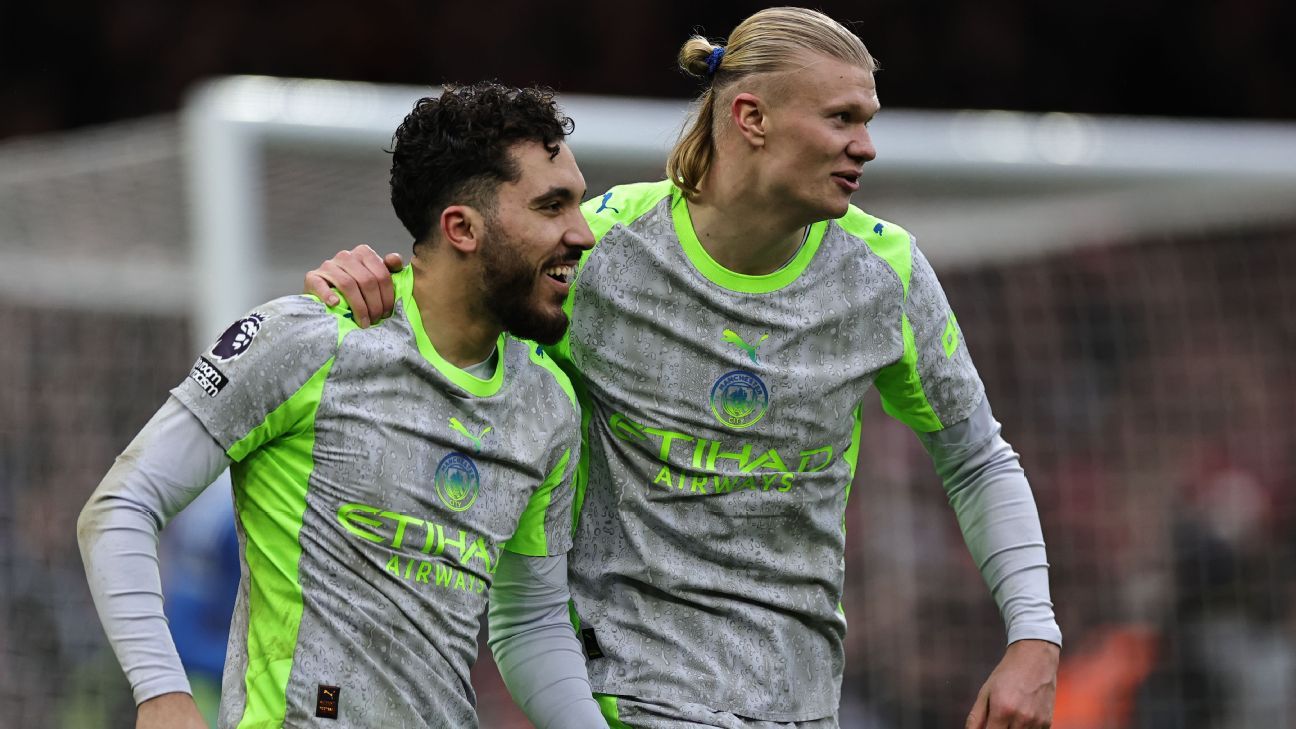
 49. Matheus Nunes, fullback, Manchester City
 48. Eberechi Eze, attacking midfielder, Arsenal
46. David Raya, goalkeeper, Arsenal
 44. Morgan Gibbs-White, attacking midfielder, Nottingham Forest
Goalkeeping performance is a notoriously volatile thing to measure. What Gradient Sports found is that the percentage of mistakes a keeper makes on shots faced is the most stable number from season to season. It measures this through its grading system, and every time a keeper receives a negative grade, it’s considered a mistake.
Verbruggen has only made a mistake on 1.5% of the shots he has faced this season — the second-best mark in the Premier League.
1:14
Laurens: Top clubs will want Andoni Iraola this summer
Julien Laurens explains why Andoni Iraola has chosen now to leave Bournemouth and what club he could end up at in the summer.
 34. Casemiro, midfielder, Manchester United
33. Bernardo Silva, midfielder, Manchester City
 31. Igor Thiago, forward, Brentford
Donnarumma has faced 93 shots this season and made a total of one mistake, according to Gradient. That’s the best mistake-less rate in the league.
1:15
Would signing Anthony Gordon make sense for Bayern Munich?
Gab Marcotti & Julien Laurens discuss reports linking Bayern Munich with Anthony Gordon.
 29. Anthony Gordon, winger, Newcastle United
 26. Ezri Konsa, center back, Aston Villa
 25. Marcos Senesi, center back, Bournemouth
You know how there are certain positions under certain managers or clubs that just seem to produce? Strikers at Eintracht Frankfurt, attacking midfielders under Gian Piero Gasperini, every attacker who has ever played for Hansi Flick and now, maybe center backs for Andoni Iraola?
Last year, Dean Huijsen and Illia Zabarnyi played well enough to secure moves to Real Madrid and Paris Saint-Germain, respectively, and now Senesi is having a kind of season I’m not sure I’ve really seen before. He’s one of the best attacking passers in the Premier League despite playing as a center back.
Now, ball-playing center backs have always been a thing, and they tend to be cornerstones of all the best teams in the world. But Senesi isn’t just playing line-breaking passes into the feet of his midfielders. No, he is creating opportunities like he is an attacking midfielder. And I don’t mean this hyperbolically.
If we look at the expected possession value created from open-play passes this season — in other words, how much your passes have increased your team’s chances of scoring a goal — then there are seven players who have generated at least five goals worth of value: Jérémy Doku, Adam Wharton, Cody Gakpo, Morgan Rogers, Pedro Neto and Senesi. Five attackers, one incredibly aggressive midfielder and one central defender.
Senesi’s contract expires after the season. It’ll be fascinating to see if someone recognizes this special skill set and figures out a way to use it.
24. Rodri, midfielder, Manchester City
23. Morgan Rogers, attacking midfielder, Aston Villa
 22. Florian Wirtz, attacking midfielder, Liverpool
Rogers and Wirtz don’t look that similar in how they move across the field or even stand still. But I think these two are quite similar players.
Below is a plot of what I’m calling “good passes” and “good receptions.” These are passes made or received that increased the team’s expected possession value by somewhere between 1% and 9%. Increasing xPV by 10% or more with a single action is rare, so we can think about what we’re seeing here as players who consistently add marginal value to possessions.
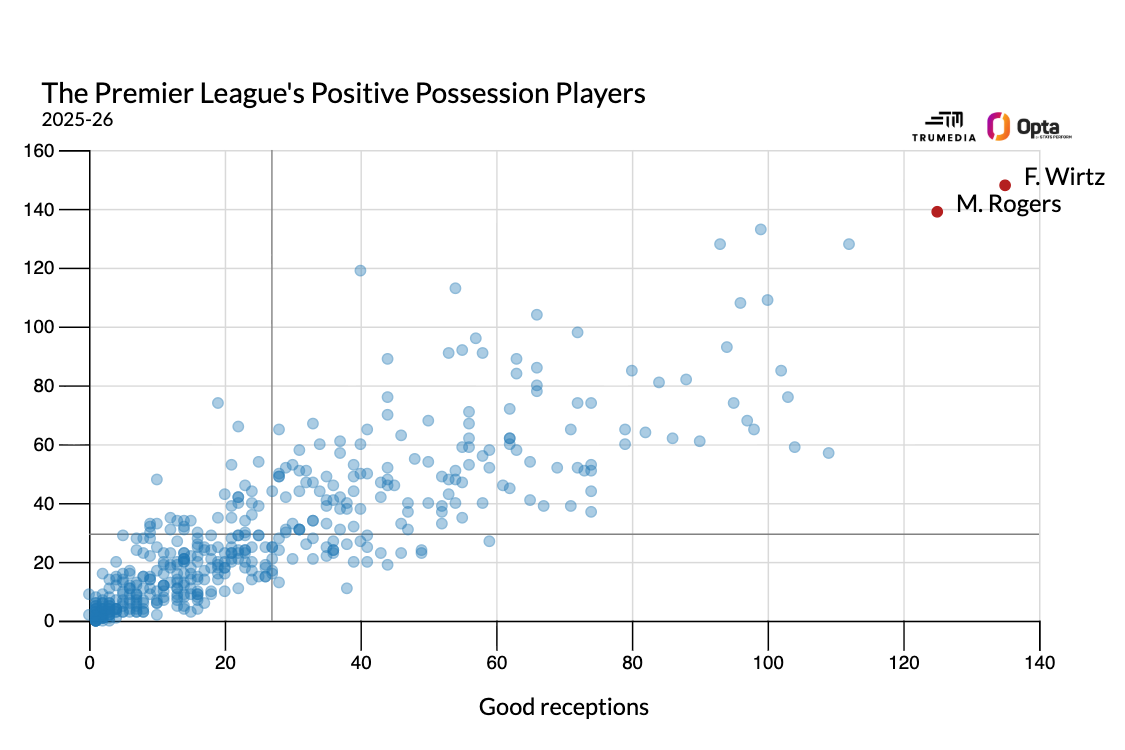
Rogers and Wirtz are alone at the top of both metrics. It’s funny because even though we’re quantifying it, I’d call this a kind of version of hidden value. It’s not goals and assists or even expected goals and assists, but neither player is an under-the-radar prospect. Wirtz is the second-most-expensive player in the history of the Premier League, and Rogers burst into the wider consciousness this season with all the goals he was scoring.
The promise for each player, then — as they’re both still in their pre-prime years — is that they keep doing all these little things and they start to create and score more goals.
21. Marc Guéhi, center back, Manchester City
 19. Reece James, fullback/midfielder, Chelsea
18. Nico O’Reilly, fullback/midfielder, Manchester City
16. Elliot Anderson, midfielder, Nottingham Forest
 15. Adam Wharton, midfielder, Crystal Palace
Adam Wharton is the Marcos Senesi of midfielders. I know if you throw enough chimpanzees behind a typewriter, you’ll get “War and Peace” or whatever, but I’m pretty sure I’m the first person to say those eight words together.
I mean, look at this!
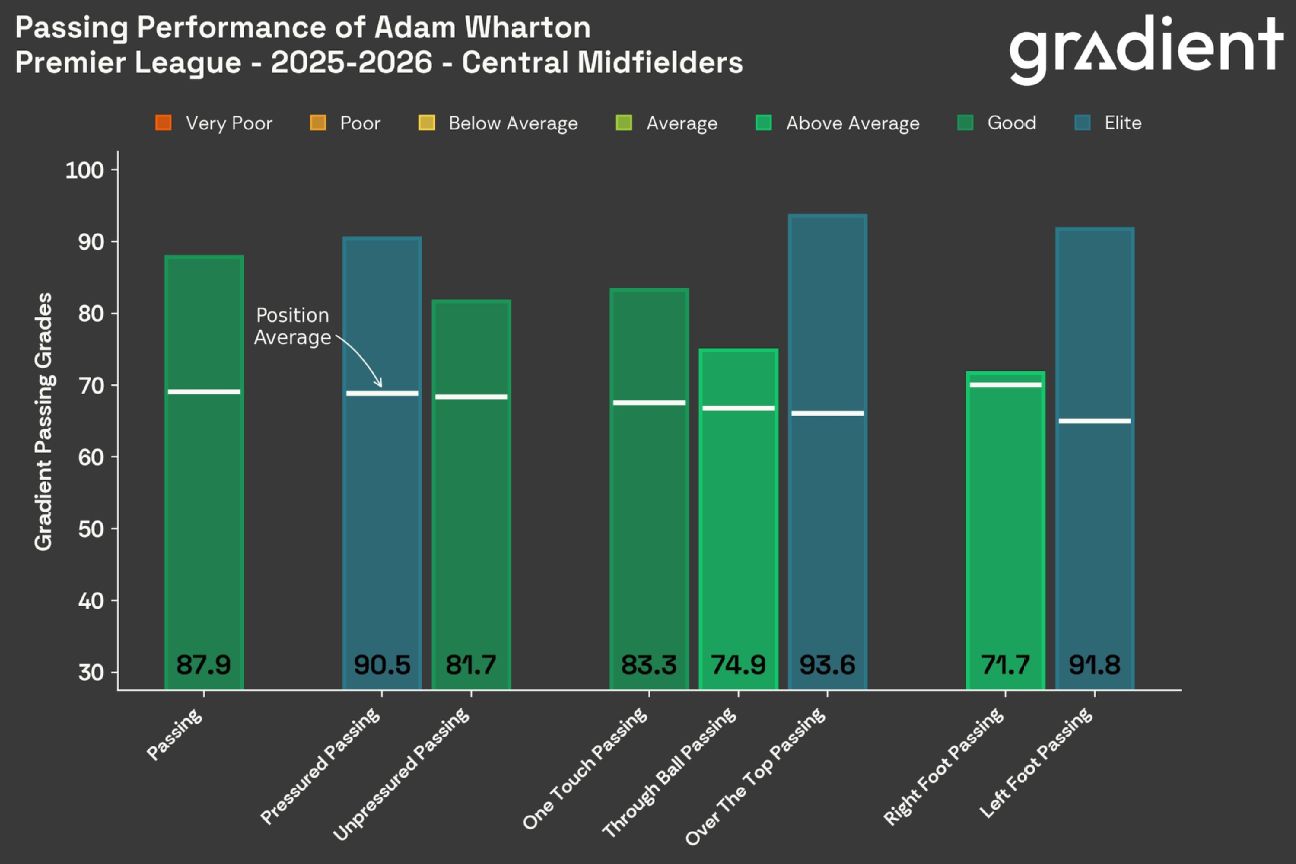
Crystal Palace play a chaotic style that encourages Wharton to play aggressive passes all game, but those grades wouldn’t be so high if he wasn’t constantly making the big plays. His security under pressure and his defensive ability are the big question marks for whomever signs him, but he’s so good with the ball at his feet — in pretty much any situation — that it might even be worth it for the biggest clubs in the world to build their midfields around his passing and do whatever else they need to do to cover up his deficiencies.
If João Pedro played a different sport with the same name as the one he’s currently paid millions of dollars to play, then we would hear commentators saying the same thing every Sunday: This João Pedro guy? He’s just a FOOTBALL player.
What the heck are they talking about? NFL commentators, yes, will frequently refer to a football player as “a football player” as a means of describing what type of football player that football player is. They are not just citing biographical details, and their brains are not short-circuiting. What they mean — as I’ve gleaned from hearing the phrase hundreds of times now — is that these “football players” don’t necessarily have any flashy attributes to their games, but that they tend to do all of the little things right. Their innate understanding and technical skill sets make it seem like they were almost born to play football.
I feel the same way about João Pedro, who doesn’t stand out in any particular way. He’s not a goal-scoring striker. He’s not a creative midfielder. He’s not a dribbling winger. But he can score goals, he can press, he can defend one-on-one, he can receive passes under pressure, he can make the necessary passes, and he can win headers. He is, quite simply, a football player.
2:28
Burley: Liverpool didn’t get embarrassed by PSG
Steve Nicol and Craig Burley react to Liverpool’s Champions League exit vs. PSG.
12. Bryan Mbeumo, forward, Manchester United
10. Gabriel, center back, Arsenal
Earlier this week I wrote about how Tottenham’s obsession with acquiring athletic players created a massive blind spot in their team-building approach. The immediate result: a team where no one can pass. The longer-term result: a team that’s incredibly expensive and would be relegated if the season ended today.
Part of the issue, and something I didn’t touch on much in the piece, is that being fast and being good at passing have something of a negative relationship. Perhaps when you’re younger and fast, you don’t need to worry about being a good passer since you’re always running by everyone. And maybe great passers at a young age never really need to develop speed because, well, the ball moves faster than the man. Or maybe the power needed for high-speed running actively works against the subtle movements needed to place a pass.
Anyway, all this is to say that players such as Dominik Szoboszlai are incredibly rare. He’s the only player in the Premier League who ranks in the top 30 both for the maximum speed he has reached in a match this season and for his passing grade.
7. Jérémy Doku, attacking midfielder, Manchester City
6. Rayan Cherki, attacking midfielder, Manchester City
Here’s how everyone in the Premier League stacks up, according to open-play expected assists. In other words, who is creating the greatest combined quantity and quality of shots for their teammates:
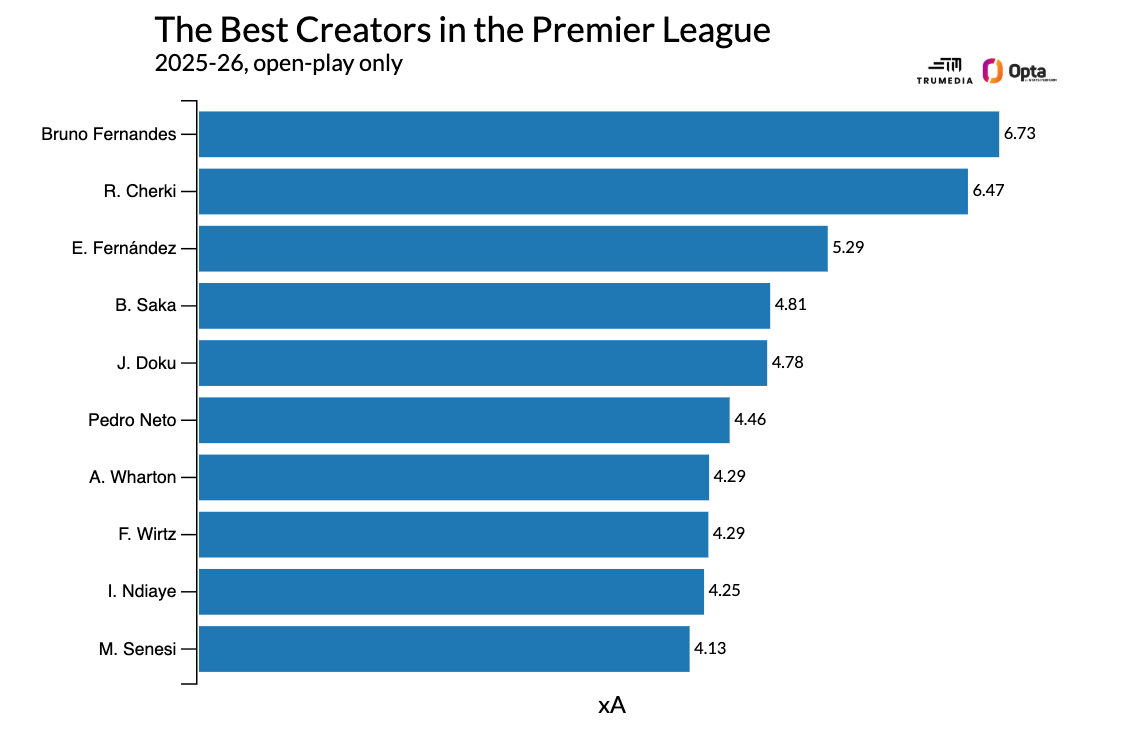
The main piece of context you need to better understand this chart is that eight of these 10 players have played at least 2,000 minutes in the Premier League this season. The other two haven’t even reached the 1,400-minute mark, and those two players play for the same time: Manchester City’s Rayan Cherki and Jérémy Doku.
5. Bukayo Saka, winger, Arsenal
You could probably say this is the first season of stagnation or regression in a career that has pretty much been on an upward trajectory from the moment Unai Emery started playing Bukayo Saka at left back. He made a leap two seasons ago up into the star level of goal creation, averaging around 0.7 non-penalty expected goals+assists per 90 minutes across 2023-24 and 2025-26.
This season, he has dropped back down 0.54, though some of that can be attributed to the league-wide trend where almost all individual attacking performance is down. And some of it is because of the issues with how Arsenal were built: There’s very little creative passing to get him the ball, especially when Martin Ødegaard is injured, and then their new starting striker, Viktor Gyökeres, just isn’t very good.
There was a world where Saka developed into the kind of attacker who would thrive despite unfavorable context, but he’s still the best attacker on the team that is still favored to win the Premier League. And even if he’s not scoring and creating, he’s always doing a little bit of everything else, too.
3. Declan Rice, midfielder, Arsenal
Last week, Gradient released what it is calling “overall grades.” It looks at each position, determines what the main requirements for that position are, weighs its various grades for each player across those facets and then puts it all together to come up with a single metric to assess player performance. Obviously, there is no one true number to assess player performance (and it knows this), but it’s still a useful exercise.
If you’ve read this specific column before, you know that I write the same thing about Declan Rice every time. Mainly: He’s good at everything. Well, now I have another number to back up that claim. He’s currently Gradient’s highest-graded player in the Premier League, at an 89.8 out of 100.
Across Europe’s Big Five leagues, only four players have grades of 90 or better: Bayern Munich‘s Harry Kane and Michael Olise, RB Leipzig‘s Yan Diomande and humanity’s version of cheese and/or wine, AC Milan‘s 40-year-old Luka Modric.
2. Erling Haaland, forward, Manchester City
If you want to be bullish on Arsenal holding off City’s looming title challenge, then take a look at this chart:
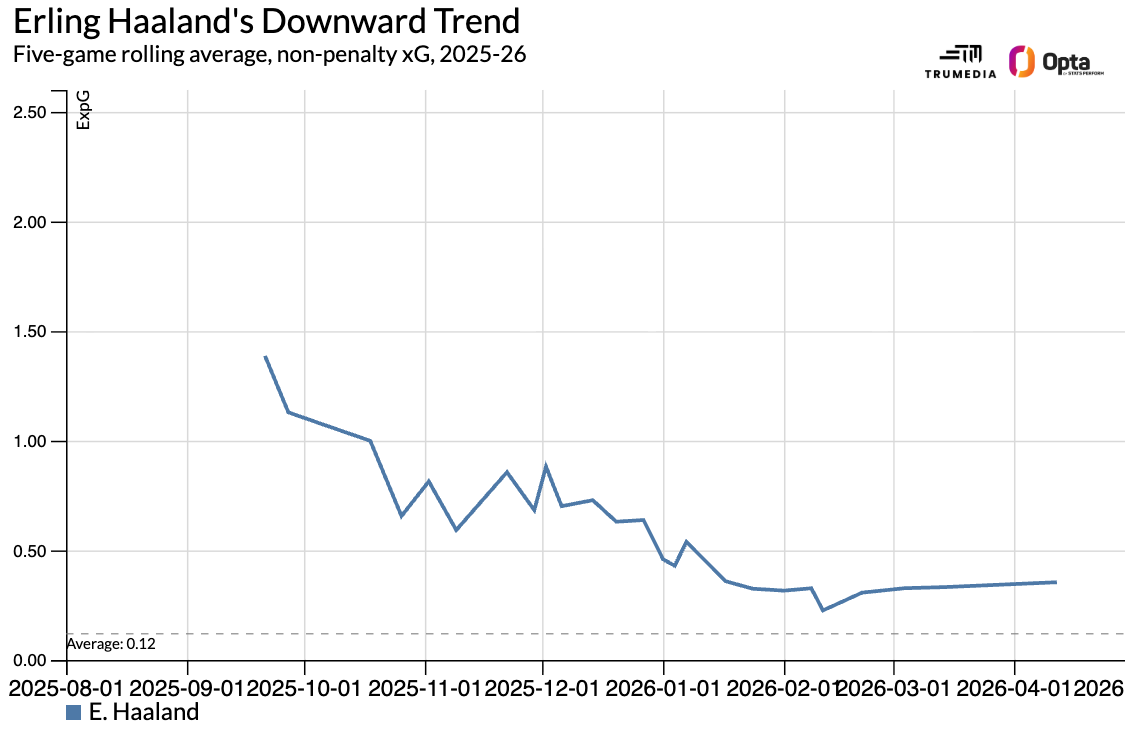
That’s how it looks when you compare the non-penalty xG for each five-game bucket of his season: Games One to Five, Two to Six and on and on. He has been a below 0.5 xG player for all of 2026. He’s averaging 0.72 xG per game for his City career.
If you want to be bullish on City catching Arsenal, then, well, Manchester City have rounded into form and started to close the gap despite the best per-game goal scorer in Premier League history going through his least-productive stretch since he came to England. This City team simply hasn’t been as good as the other City teams that have caught Arsenal, but if Erling Haaland starts playing like Erling Haaland again, then they could easily win their last seven matches.
1. Bruno Fernandes, attacking midfielder, Manchester United
He might set the assist record. He leads the league in expected assists. He leads the league — by a massive margin — in through balls completed. He’s second behind Haaland in combined non-penalty goals+assists, and among players with at least 20 starts, he’s also second behind Haaland in non-penalty goals+assists per 90 minutes.
The difference between Haaland and Bruno is twofold: 1) Haaland plays on a better team, and 2) Bruno spent half of the season playing as part of a two-man midfield.
Perhaps you could argue with the idea that he’s the best player in the Premier League, but I don’t think there’s really any argument to this: Bruno Fernandes is the most important player in the Premier League.
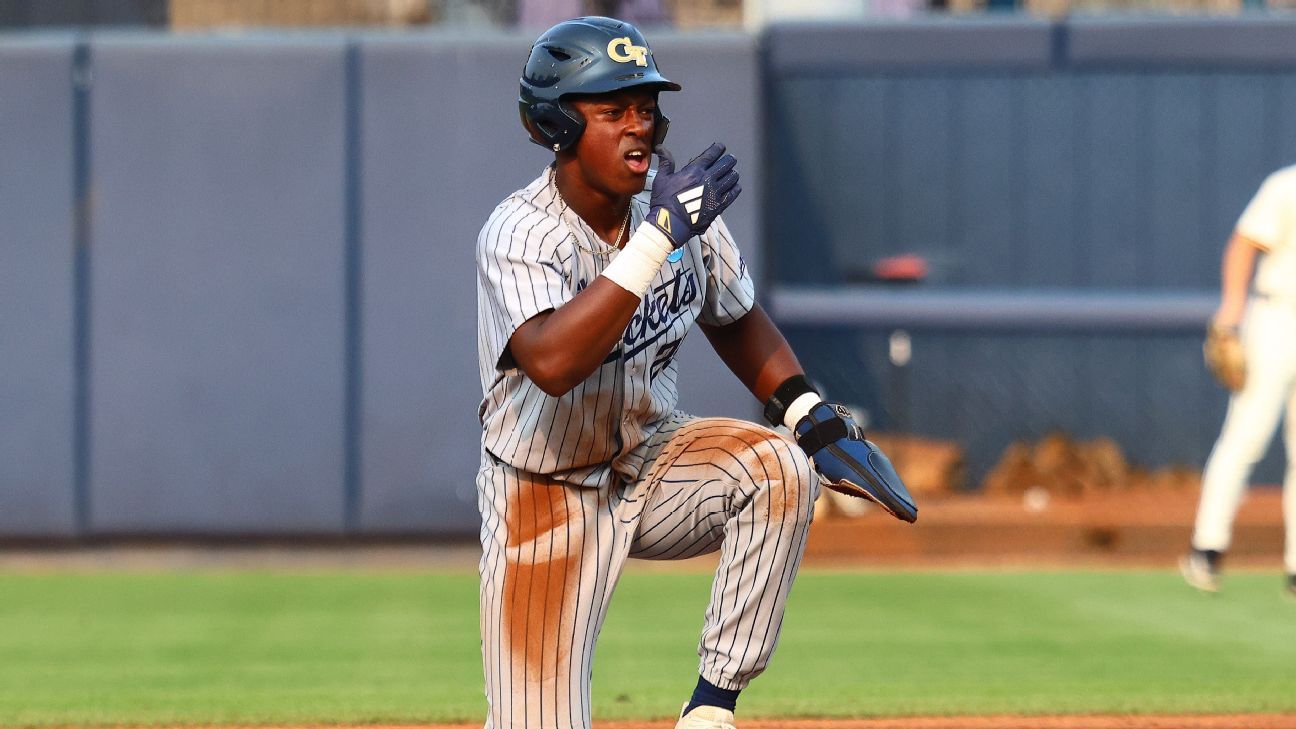
Midway through college and high school baseball seasons, the 2026 MLB draft picture is starting to come into focus.
We’re getting to the part of the spring when players are falling into consensus tiers for evaluators, and when I see MLB crosscheckers and scouting directors, they ask me when my first mock is coming out. This year’s class has a clear No. 1 player followed by a pretty clear next-best prospect and then the potential shuffling picks up at No. 3, with several college players and a few standout prep prospects all in the mix to go in the top 10 picks.
The players below were ranked using the FV (future value) system that I applied for pro prospects. Here are my preseason MLB prospect rankings to see where these players would rank if they turned pro now, though the grades will change (and generally improve as we gain more information and certainty) throughout the spring.
We’ve all waited long enough, so it’s time for a fresh rankings update and a mini-mock draft of the first 13 picks.
Jump to: Mini-mock | Draft rankings

Mini-mock draft: Projecting the first 13 picks

1. Chicago White Sox: Roch Cholowsky, SS, UCLA
This already seems to be down to Cholowsky and Grady Emerson. I think Cholowsky has a notable lead, but it isn’t a slam dunk just yet.
Since almost everyone in baseball has the same report and outlook for Cholowsky, this pick then comes down to exactly what you think Emerson’s potential is and if he’s a quick mover. Some evaluators think Emerson has higher upside and if you think he’ll also move quickly (Konnor Griffin debuted as a 19-year-old, Jackson Holliday at age 20, Kevin McGonigle at 21) then he could also look like a superior prospect in the minors within a year or so.
If he’s both things and he comes at some bonus savings vs. Cholowsky, you can logically justify picking Emerson. Some teams I’ve spoken with see this decision as close enough to really dig in and the White Sox might be one of those teams.
We’ll learn a lot more in the coming weeks; I heard a big White Sox scouting contingent, including GM Chris Getz, was in to see Emerson this week.

2. Tampa Bay Rays: Grady Emerson, SS, Fort Worth Christian HS (Texas)
This is a pretty common connection, especially in light of the Rays pick history and the industry’s read of the first pick. Some rival clubs picking in this area think the Rays will seriously consider Vahn Lackey and Jackson Flora if they get a sizable bonus savings, with those two prospects seen as the other players within the top group before things really open up.
Given the variability in evaluating high school players and how the Rays covet MLB-ready prospects, I buy the Flora/Lackey buzz, both as earnest interest and possible negotiating leverage with Emerson. I can’t imagine Cholowsky gets past this pick if he doesn’t go No. 1.

3. Minnesota Twins: Vahn Lackey, C, Georgia Tech
There’s still a bit of an empirical bias against pitchers at the top of the draft if talent seems to be similar between two players. Lackey seems to have a slight edge over Flora for most evaluators, due in large part to this, but both are common third- and fourth-ranked players on boards.
I think the Twins would take Emerson if he’s available here, I think Flora would also get a long look, and there’s some buzz Chris Hacopian would be an option here on a deal.

4. San Francisco Giants: Jackson Flora, RHP, UC Santa Barbara
The Giants would really like to get a shot at Emerson and I think they’d be happy to get Lackey or Flora, but they’re also taking a very long look at Jacob Lombard, younger brother of Yankees’ top prospect George Lombard Jr.
Lombard is polarizing in a very similar way to Ethan Holliday last year — both have notable pro fathers and brothers, big power and struggled during the summer showcase circuit — and accordingly, some teams have Lombard in the back half of the first round while others think he’s a clear fit in the top 10 or even top five. It’s safe to project that the Giants take the last of the top tier of four here, but there’s a real chance for something more intriguing.

5. Pittsburgh Pirates: Jacob Lombard, SS, Gulliver Prep HS (Florida)
This is perceived to be one of those landing spots for Lombard, along with the first spot for another toolsy prep hitter in Eric Booth Jr.
I don’t know if it’s perception or reality but after Konnor Griffin’s swing adjustment went so well so quickly, teams think the Pirates will take another prep hitter with big upside and a swing/contact question. I think this is the floor for Lackey or Flora if there’s a deal cut in the top four.

6. Kansas City Royals: Liam Peterson, RHP, Florida
Things start to open up here, as the top tier of four is almost certainly selected by now and the Royals have an extra pick at No. 30, so they could opt for an underslot deal here to spend more later. The Royals are always trying to compete and it wouldn’t surprise me if they went with a potential quick-mover on a deal at this pick to then set up more typical high school picks down the board.
Peterson has been rising of late, but his sweet spot might be a few picks after this. I think this is also the first pick in which you could see a high school pitcher (Gio Rojas or Logan Schmidt) and that would also be on a cut-rate deal.

7. Baltimore Orioles: Justin Lebron, SS, Alabama
Lebron had stealth 1-1 buzz entering the spring because of his big tools, but it was stealth because of contact questions; he’s hitting .230 in SEC play and .270 on the season.
He fits Baltimore’s style (multiple sources said he was a “great fit” at this pick as their first response to this mock) and probably shouldn’t last much beyond here or the next couple of picks. Booth also fits Baltimore’s style if Lebron goes earlier.

8. Athletics: Eric Booth Jr., CF, Oak Grove HS (Mississippi)
Booth has had a ton of heat all spring as he has added significant strength (one scouting director compared his physique to that of an SEC running back) with plus bat speed and raw power along with plus-plus foot speed.
I see Booth’s floor is No. 14 to Miami, but I think he’ll go a good bit earlier than that. This is about the juncture of the draft where the next cut of college hitters start to fit: Hacopian, Ryder Helfrick, A.J. Gracia and Drew Burress.

9. Atlanta Braves: Chris Hacopian, SS, Texas A&M
Hacopian has one of the best hit/power/position combinations in the draft class, though he’s probably a third baseman. He probably lands somewhere in the top 10 with Booth and Burress (Atlanta tried to sign him out of high school) both fitting here, too, and I think there’s a shot that a prep pitcher (again, Rojas and Schmidt) also could be a cut-rate option.

10. Colorado Rockies: Drew Burress, CF, Georgia Tech
Burress should land somewhere around picks eight to 13. Some teams have soured a bit this spring as a harsher scouting report would have Burress moving to right field with 20-homer upside at 5-foot-9 while the rosier view would point out that he has hit 51 career home runs for the Yellow Jackets and never batted below .333 in any of his three seasons. The new Rockies regime is a little hard to read, but the belief is the team will go with an accomplished college player so Peterson also makes sense.

11. Washington Nationals Ryder Helfrick, C, Arkansas
Helfrick has dramatically improved his contact rates, sliding in just behind Lackey as the second catcher expected to go in the top half of the first round.
The Nats also have a new regime entering its first draft, but the decision-makers largely came from Boston, so rival teams are expecting Washington to follow what has worked for the Red Sox in recent drafts. The bat speed of Booth and intriguing two-way potential of Jared Grindlinger could also fit that approach.

12. Los Angeles Angels: Cameron Flukey, RHP, Coastal Carolina
It’s hard to not just give the Angels a quick-moving college player given their run of pushing players quickly to the majors. Depending on how he looks in a return from a February ribcage injury, Flukey could go in the middle of the top 10 or a bit lower than this, but he is a polished potential midrotation arm regardless. Gracia, Eric Becker, Chris Rembert and rising RHP Logan Reddemann could also fit.

13. St. Louis Cardinals: Jared Grindlinger, RF/LHP, Huntington Beach HS (California)
I’ll cut things off at this pick as the group of names in contention is ballooning. Grindlinger just turned 17 and is within a few weeks of being the youngest early-round prospect in the draft (just behind Rocco Maniscalco). He’s a real first-round caliber outfielder with plus bat-to-ball ability and above-average power/speed potential, along with a pitching evaluation somewhere in the top two rounds. There is still some disagreement on this report and where he goes as Grindlinger was only seriously scouted starting this spring after he reclassified late in the process.
By drafting him, a team would basically get two elite prospects in one and probably would let him do both (with a lean toward hitting) for a couple of seasons to see how things break. That appealing risk profile means I don’t think he gets much past this pick even with the abbreviated eval period. The Cards are also tied to prep OF Trevor Condon, who is also rising up boards as he had been red-hot the last few weeks.
Top 85 MLB draft prospects
60 FV
1. Roch Cholowsky (21.3), SS, UCLA
Cholowsky is still the top prospect in the draft for the vast majority of teams. He’s an above-average hitter for average and power with a good approach and an above-average glove at shortstop who has been productive for three college seasons (1.081 OPS and 44 homers in 154 career games) after getting multimillion dollar interest out of high school in the loaded 2023 draft class.
If you were going to pick nits (scouts are as good at this as anyone), he’s not the long, lean type of athlete you’d prefer and you could argue he has a bunch of above-average to plus tools, but no plus-plus, standout ability. Dansby Swanson and Alex Bregman are the names that come up most often as comparable players. The downside for Cholowsky is basically a really solid 2-3 win player who never has that breakthrough season, but there’s legit 5-win upside, which would make him a franchise player. It’s really hard to pass on that high of a floor with perennial All-Star upside.
You don’t see this kind of prospect every year, so the top two players in this draft make it a great year to be picking really high. That said, the depth beyond that is lacking a bit, so it’s a tough break if you’re picking later in the top 10.
55 FV Tier
2. Grady Emerson (18.4), SS, Fort Worth Christian HS (TX), Texas commit
Emerson has been the top prep prospect in this draft class basically since anyone has been paying attention. The track record of that kind of prospect, especially when it’s a left-handed hitting shortstop, is quite good. Scouts have Emerson as an above-average to plus hitter with above-average to plus power, along with a solid approach and feel to get to power in games. At this age and as a shortstop, that puts him right on the borderline of future star, depending on what side of that standard report you land.
He isn’t the size of Corey Seager (Emerson is listed at 6-2, 180 pounds), but there are some evaluators who think Emerson’s upside could be a player of similar value. With how quickly polished elite high school position players can move through the minors (Griffin, Holliday, McGonigle are the three I noted above in the mock), you wouldn’t be doing your job as a scout if you didn’t take a long look at putting Emerson at the top spot on your list; you can certainly imagine how that could be a common opinion a year from now.
50 FV Tier
3. Vahn Lackey (21.0), C, Georgia Tech
This is the tier that runs roughly 40 through 120 on a minor league prospect top 100 ranking, for reference. Lackey has been a revelation this year, posting a 1.274 OPS heading into this weekend’s series with tools to match: an above-average runner with a plus arm who will stick behind the plate and has above-average power, pitch selection and bat control as a hitter.
There’s not a 70-grade tool, he’s new to being this elite, and catchers often take non-linear developmental roads, but Lackey is very easy to pick for any team no matter their preference in prospect style.
4. Jackson Flora (21.1), RHP, UC Santa Barbara
Flora was a common pick-to-click this spring because of his combination of lively stuff, clean arm action and a loose, projectable frame. He made the leap this spring with improved strike quality while still sitting 94-98 and hitting 100 mph, with an above-average changeup, and slider that’s almost a sweeper at 83-87 mph.
He could be in a big league rotation pretty quickly and every team is looking for rotation depth; Flora is also a fit for almost every team.
5. Justin Lebron (21.7), SS, Alabama
Lebron is hard to rank because he still has above-average power, plus speed and an above-average glove at shortstop (a rare combination in college) but his in-zone miss rate and overall feel to hit have continued to be below average.
Some teams look more for traits than polish in position players because they think they can teach/mold a swing and approach more than others; Lebron fits well with a team like that.
6. Chris Hacopian (21.9), SS, Texas A&M
Hacopian has a track record of strong contact and strong production with plus raw power. The hesitations are that he’s more of a third baseman than shortstop, he’s not an elite athlete, he’s older than the other college position players in this area of the draft (which empirically does matter), and his flatter swing plane means his power production doesn’t match his exit velos right now. Translation: There’s a pretty high floor but a more limited upside.
45+ FV Tier
7. Eric Booth Jr. (18.0), CF, Oak Grove HS (MS), Vanderbilt commit
8. Drew Burress (21.6), CF, Georgia Tech
9. Liam Peterson (21.1), RHP, Florida
10. Cameron Flukey (21.2), RHP, Coastal Carolina
Booth has been steadily rising all spring, with plus bat speed/raw power and plus-plus foot speed. There are two concerns: He’ll need to tweak his setup/hand move a bit (seems doable to me) and he’s patient to the point that if he’s getting pitched around (which has happened a good bit), scouts need to go back for a second day to write a report. In the game I saw him this spring, he had three walks and a hit by pitch in a five-inning run-rule game. Luckily, I got to watch him hit off of a machine in the cage for a few rounds and he fouled off a few pitches in game, but I would’ve liked to have seen more that day. Some teams see the premium tools and salivate at what player development could do, while others see risk of the unknown they’d rather avoid at a premium pick.
The next three players are much more consensus talents and reports across all 30 teams. Peterson is 6-5, has an above-average fastball/slider combo headlining a four-pitch mix, projects as a starter and has been famous to scouts for about five years. Burress has been super productive, but his swing/contact rate regressed a bit early this year, his 5-9 stature limits his power upside and he is on the center/right-field spectrum for some. Flukey is a steady starter with a plus fastball and among the best starter traits in the draft. He also has two fringy breaking balls to the eye that play up a bit due to his other abilities, and his solid changeup isn’t used much. He is expected to return from a rib cage injury next week.
45 FV Tier
There’s not a lot of quality depth to the prep hitter demographic so Lowrance and Comeau are common picks to fill that vacancy in the 20s and 30s behind the Grindlinger/Condon/Lombard/Booth group. There’s a lot of conversation about Grindlinger, Condon and Lombard as opinions on them vary widely, as mentioned in the mock draft above.
Lombard’s summer contact rate trips up some models to where he doesn’t project as a premium pick. Grindlinger simply hasn’t been scouted anywhere near as much as the others in this range and has a two-way evaluation, so teams just haven’t reached internal consensus, and Condon is a lower-variance type that teams just tend to value differently. Some whisper the name McGonigle when watching Condon.
Reddemann has been red-hot of late and seems to be the player currently filling the college pitching vacancy behind the Flora/Peterson/Flukey group with Dietz also rising (but with an injury history). Waechter and Hirschkorn seem to be the prep arms rising a bit from the jumbled group in the 30-50 area. The next tier of prep arms will often get pushed into the later rounds as overpays, but Waechter and Hirschkorn feel like players that a team will have in mind for their second pick when making an underslot first pick. The college hitter class is quite jumbled with medium-upside types that are performing well; teams aren’t thrilled at the lack of upside after pick 15 or so with all of the position players.
40+ FV Tier
Bumila is 6-8 and has been regularly up to 100 mph this spring with interesting shapes delivered from a lower slot, but there are still questions about secondaries and quality of strikes. He has thrown only a handful of times this spring but could still rise from here. Duncan is a more polished prep lefty and has also been rising of late, getting into the mid-90s and mixing in a plus changeup.
I must mention that yes, Landon is the son of Hall of Famer Jim Thome. I’ve written about Contreras this spring and will continue to because he’s polarizing with scouts in part because he’s such a fascinating scouting and development theoretical question; I’ll go into more detail on this soon. Blair is another intriguing talent who throws from a distinctive arm slot (almost sidearm) with distinctive shapes and elite control: 55⅓ innings, 38 hits, five walks, 71 strikeouts this spring. Williamson has one of the more pronounced bat wraps (coiling his arms around his head as he loads up to swing) but scouts think it’s fixable and love his potential everyday tools.
40 FV Tier
I cut it off here with the idea being this represents the full first two rounds plus comp rounds, which is 75 picks, plus a handful more to make up for the high school players I have ranked who won’t sign. This also feels around the area where you start getting lots of tough-to-sign high school players who all feel pretty similar in talent but some just aren’t being scouted anymore and opinions vary a lot from team to team.
I’m not sure what it means but somehow, there’s five LSU commits in my next 11 ranked high school players. One team gave me feedback on the last 10-15 players I have ranked and this team has two of them in the fifth round or later, then another team said I must leave them where they are because they’re both easily getting seven-figure bonuses. That’s how ranking high school players is, especially at this juncture of the spring, once you get out of the top 50 players or so.
Opinions are quite split on Maniscalco, originally a 2027 prospect who reclassified and is the youngest player in this ranking, narrowly ahead of Grindlinger. He wasn’t very good at the plate early in the spring when I and many others piled in for first looks; many teams buried him in the third round, where he’s likely not signable. Some teams are still considering him inside the top 30 picks, though, fueled by models that love young-for-the-class, switch-hitting shortstops.
It’s worth noting in this section that the automated ball-strike system (ABS) changes in the big leagues will affect the draft. Getting a raw receiver, framer, and blocker who has the athleticism to block pitches is totally fine at a higher pick. Having a plus arm is more important, but the release time and accuracy can be coached whereas arm strength cannot. So if a college catcher doesn’t call pitches and isn’t a polished defender but is an above-average athlete behind the plate and has a plus arm, teams aren’t that bothered about the finer points; some big league teams are calling pitches just like most colleges are. This generally helps Jackson, Tinney, and Brock (ranked 185th last year out of a junior college in this space), along with a sleeper name that’s below them, but rising: George Washington C Robbie Lavey.


NBA star hits back at NYC Mayor Zohran Mamdani for blaming him over expensive playoff tickets

Premier League Top 50: Ranking the best players of the season with a month to go

Gazing Into Sam Altman’s Orb Now Proves You’re Human on Tinder

-

 Tech1 week ago
As the Strait of Hormuz Reopens, Global Shipping Will Take Months to Recover
-

 Tech1 week ago
This AI Button Wearable From Ex-Apple Engineers Looks Like an iPod Shuffle
-

 Politics1 week ago
Indian airlines hit hardest after Dubai limits foreign flights until May 31
-

 Entertainment5 days ago
Palace left in shock as Prince William cancels grand ceremony
-

 Sports4 days ago
The case for Man United’s Fernandes as Premier League’s best
-

 Politics1 week ago
Chinese, Taiwanese will unite, Xi tells Taiwan opposition leader
-

 Entertainment6 days ago
Dua Lipa hits major career high ahead of wedding with Callum Turner
-
 Business4 days ago
UK could adopt EU single market rules under new legislation