

Tech
Three-layer microfluidic cooling device can remove heat from small electronics more efficiently

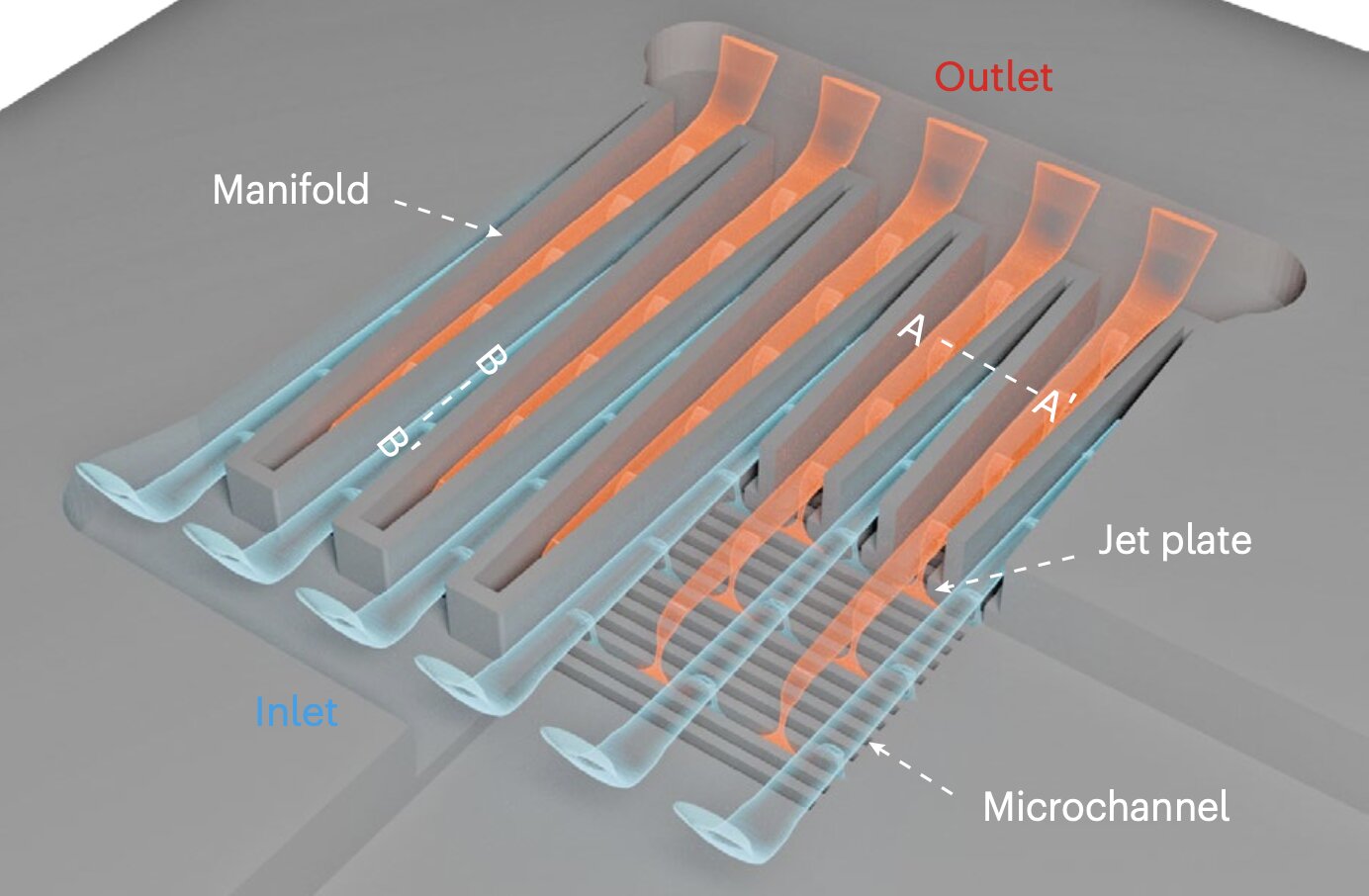
As electronic devices become increasingly powerful and compact, they can generate denser heat fluxes, or in other words, produce more heat in a smaller area. These heat fluxes raise the temperature of a device and can damage its underlying components, causing them to malfunction and, in time, even contributing to their failure.
To prevent this from happening, electronics engineers rely on thermal management systems and cooling strategies. A promising strategy to dissipate heat in smaller electronics is known as microfluidic cooling. This technique prompts the flow of fluids through microscopic channels that are built into or in the proximity of integrated circuits, to remove heat and reduce the temperature inside a device.
Researchers at Peking University, the National Key Laboratory of Advanced Micro and Nano Manufacture Technology recently introduced a new microfluidic cooling approach that could remove heat from devices more effectively and efficiently than many previously introduced strategies. This approach, outlined in a paper published in Nature Electronics, relies on a newly developed three-layer microfluidic cooling device etched into a silicon substrate.
“The miniaturization of advanced electronics can lead to high heat fluxes, which must be dissipated before they cause device degradation or failure,” Zhihu Wu, Wei Xiao and their colleagues wrote in their paper. “Embedded microfluidic cooling is of potential value in such systems, but devices are typically limited to heat fluxes below 2,000 W cm−2. We report a microfluidic cooling strategy that can dissipate heat fluxes up to 3,000 W cm−2 at a pumping power of only 0.9 W cm−2 using single-phase water as the coolant.”
The cooling device developed by Wu, Xiao and their colleagues has a three-layer structure. The first layer is comprised of a tapered manifold, which distributes water across the surface of a chip and ensures that each microchannel receives an equal amount of coolant so that a device is uniformly cooled.
The middle layer, known as the microjet layer, consists of tiny nozzles that form microjets (i.e., high-speed streams of fluid that shoot directly onto a chip’s surface), improving the transfer of heat in devices by targeting the thermal boundary (i.e., the region where heat builds up). The third and final layer is comprised of microchannels, tiny grooves etched into silicon that carry the warm coolant out of an integrated chip.
“Our approach is based on a three-tier structure that consists of a tapered manifold layer on the top, a microjet layer in the middle and a microchannel layer with sawtooth-shaped sidewalls at the bottom,” Wu, Xiao and their colleagues wrote. “The structures are etched directly into the backside of the silicon substrate using standard microelectromechanical system technology. Moreover, the coefficient of performance can reach 13,000 and dissipate a heat flux of 1,000 W cm−2 at a maximum chip temperature rise of 65 K.”
In initial tests, the new microfluidic cooling approach proposed by these researchers was found to remove heat significantly more effectively than most previously introduced strategies. In addition, the team’s three-layered device requires little pumping power (0.9 W/cm²) to cool chips and could be fabricated on a large-scale using existing manufacturing processes.
In the future, the recent work by Wu, Xiao and his colleagues could support the development of smaller electronic devices that are also durable, highly performing and energy efficient. Moreover, their proposed cooling device could soon be improved and evaluated further in tests with a wider range of small electronics.
Written for you by our author Ingrid Fadelli, edited by Gaby Clark, and fact-checked and reviewed by Robert Egan—this article is the result of careful human work. We rely on readers like you to keep independent science journalism alive.
If this reporting matters to you,
please consider a donation (especially monthly).
You’ll get an ad-free account as a thank-you.
More information:
Zhihu Wu et al, Jet-enhanced manifold microchannels for cooling electronics up to a heat flux of 3,000 W cm−2, Nature Electronics (2025). DOI: 10.1038/s41928-025-01449-4.
© 2025 Science X Network
Citation:
Three-layer microfluidic cooling device can remove heat from small electronics more efficiently (2025, October 26)
retrieved 26 October 2025
from https://techxplore.com/news/2025-10-layer-microfluidic-cooling-device-small.html
This document is subject to copyright. Apart from any fair dealing for the purpose of private study or research, no
part may be reproduced without the written permission. The content is provided for information purposes only.












Anxiety over the 2028 presidential election and the Republican ticket has officially hit the White House.
On Monday night, Trump informally polled guests at a dinner held in the White House’s Rose Garden on their preferred candidate. “Who likes JD Vance? Who likes Marco Rubio?” he said, before suggesting a Vance-Rubio ticket would be a “dream team.”
Trump’s Apprentice-style crowdwork was a moment of levity that masked the fact that over the last few days, White House aides have been confronting the difficult—and still faraway—question of who will be the Republican nominee.
The president has actually done several snap polls in recent weeks, a source familiar with the matter tells WIRED. The results have been notable, they say: When Trump polled donors at Mar-a-Lago, they favored Rubio. But when Trump recently polled a group of law enforcement officers that the White House thinks are perhaps more representative of regular voters, they favored Vance.
Vance remains the presumptive nominee, White House sources tell me, but he has not been taking anything for granted. In fact, the vice president’s top advisers started the week huddled at a retreat to discuss political strategy, the sources said.
He has also taken steps to bolster his political team, which has remained largely the same since his days as a US senator, ahead of what could be a bruising midterms for Republicans as they grapple with the politically toxic fallout of the Iran war and a House GOP spending package that earmarks $1 billion for Trump’s ballroom project, among other issues.
Vance started discussing changes to his team, including the addition of Cliff Sims as his new national security adviser and elevating Will Martin to be his deputy chief of staff, back in January, according to two sources familiar with the matter.
Sims, whose new position was announced yesterday, is widely regarded in Washington as a ruthless political operator who could bolster the vice president through his long experience in Trumpworld and close relationships with a crop of top administration officials.
Chief among them are his ties to CIA director John Ratcliffe—for whom Sims has spent the past year as an external adviser, according to multiple sources familiar with the arrangement. The sources tell me they expect Vance and Ratcliffe to work more closely together and thereby dramatically increase the vice president’s influence on national security policy.
Sims, who is not expected to start for several weeks, is also likely to start shaping the vice president’s political messaging. He previously served as a White House press aide and, later, as communications director for the office of the director of national intelligence.
Of course, the person heading up the National Security Council is none other than Rubio, who holds the title of Trump’s national security adviser in addition to secretary of state.
Chatter about Rubio’s potential as a 2028 candidate was turbocharged last week when he filled in for press secretary Karoline Leavitt to brief reporters on the Iran war. His appearance reignited a slew of news stories about whether he might run for the presidency.
“There is no secret plan to make Rubio president,” said one Rubio ally who spoke on the condition of anonymity, adding that the secretary of state did not volunteer to do the briefing, which instead came at the behest of the White House.
Still, Rubioworld has been quietly pleased about the positive coverage his briefing generated, according to people familiar with the matter. The White House then posted a clip of Rubio describing his vision for America on X, which almost resembled a presidential stump speech.

As passengers return to the US from the cruise that saw a rare hantavirus outbreak, much of the country is lacking a basic public health tool: a test to diagnose the illness in the earliest stages of infection. Nebraska may be the first state with the ability to do so.
In just a few days, a lab at the University of Nebraska Medical Center in Omaha developed its own diagnostic test for the Andes virus in anticipation of receiving 16 American passengers from the ship.
“I believe we might be the only lab in the nation that has this test available at the moment,” Peter Iwen, director of the Nebraska Public Health Laboratory tells WIRED, referring to polymerase chain reaction (PCR) testing, which was important during the Covid-19 pandemic. Its ability to detect tiny quantities of the virus before patients have full-blown symptoms makes it crucial for identifying cases quickly, getting patients prompt medical treatment, and preventing the spread of disease.
The university’s medical center is home to a highly specialized biocontainment unit designed to care for patients with severe infectious diseases that lack vaccines or treatments. Staff members previously treated patients during the 2014 Ebola outbreak and cared for some of the first Americans diagnosed with Covid in 2020.
When Nebraska was notified that it would be receiving some of the passengers, Iwen contacted the US Centers for Disease Control and Prevention to see if it had tests on hand. He learned that the CDC has the ability to run a serological test, which looks for the presence of hantavirus antibodies. But people don’t develop antibodies until they are actively sick and their body has had time to mount an immune response.
Andrew Nixon, a spokesperson for the US Department of Health and Human Services, told WIRED that the CDC has a PCR test for the Andes virus but that it’s a research test that cannot be used for patient management. Research tests are used in scientific experiments, while diagnostic tests that are meant to confirm or rule out a disease in patients need to be rigorously tested, or validated, to make sure they are capable of producing consistent results. Nixon said the agency is working on validating its PCR test.
Iwen’s lab mobilized quickly to track down the materials needed to build and validate a PCR test from scratch. They called a lab in California—a state that has previously seen hantavirus cases—but their test was for a specific strain found in the US. Andes virus has previously only been detected in South America and isn’t found in rodents native to the US.
“Tests that we have available in the US will not detect that virus that’s found in South America,” he says, noting that the Andes virus is very different genetically from the primary hantavirus strain found in the US, known as the Sin Nombre virus.
The Nebraska team reached out to Steven Bradfute, a hantavirus scientist at the University of New Mexico. Frannie Twohig, a graduate student in Bradfute’s lab, had developed an Andes virus PCR test for research purposes as part of her PhD work. Bradfute’s lab also has genetic material of the Andes virus that’s not capable of causing disease which the Nebraska lab would need to validate its test.
On Friday, Bradfute shipped the genetic material and a box of chemical reagents needed to detect the virus in blood samples overnight to Nebraska. By Saturday morning, Iwen’s team had what it needed to start assembling and validating its test.
It was enough to run about 300 tests, which took all day Saturday and Sunday, Iwen says. His team added Andes genetic material in various concentrations to samples of healthy human blood to see if their test could detect it. Then, they compared the results to control samples. The team used up about a third of its tests on the validation process and now has the capacity to conduct a few hundred tests on patient samples.

A subsea infrastructure project, Via Africa, has been unveiled to strengthen connectivity between Europe and Africa, aiming to enhance the resilience and diversity of West Africa’s international communications.
The Via Africa project will comprise a submarine cable system that will connect Europe to Africa along the Atlantic coast, and provide a subsea route alongside existing infrastructure at a time when, says the consortium, demand for cloud services, artificial intelligence (AI) workloads and international traffic is rapidly increasing across the continent.
The communications system aims to connect Europe to South Africa – including landing points in the UK, France and Portugal – with destinations along the Atlantic coastline such as the Canary Islands, Mauritania, Senegal, Guinea, Côte d’Ivoire and Nigeria. Including extensions further south, the net result will be to contribute to greater diversity and resilience of international connectivity serving Africa, by providing a different subsea route than existing infrastructure and strengthening the robustness of regional connectivity.
It will operate under a consortium model, and participating operators will be able to co-invest in the infrastructure and play a direct role in governance, deployment and future operation. By being managed as a consortium, the project is seen as enabling participating partners seeking autonomy and sovereignty to co-invest in the infrastructure and take part in its governance.
They add that such a “robust and proven” model allows investors to participate directly in the decisions regarding the design, deployment and exploitation of the system, and contribute to decisions that best meet their needs.
Major investors that have a signed a memorandum of understanding to initiate the scheme include major European telcos Vodafone and Orange Group, as well as Guilab, International Mauritania Telecom, Orange Côte d’Ivoire, Silverlinks, Senegalese operator Sonatel, and Canalink, whose business connects Africa, the Canary Islands and Europe.
The partners say they have a shared ambition to develop international connectivity, to support traffic growth and to strengthen the resilience of networks across the African continent. The initial telco and digital player partners say they are open to additional partners potentially joining the project in the future.
As part of the initial phase of the project, consortium members will jointly finance a cable route study to identify the optimal cable route that balances resilience, technical feasibility and overall economic efficiency. In parallel, the consortium is preparing the procurement process for selecting a cable supplier, marking the next step in the development of the system.
On behalf of Orange, Via Africa adds to the Medusa Submarine Cable System, designed to transform infrastructure in the Mediterranean region. Owned by African infrastructure and telecoms operator AFR-IX Telecom, and which made its first landing on European soil in October 2025, Medusa is 8,760km long, and will be the first and longest subsea cable to connect the main Mediterranean countries, providing access to telecommunications infrastructure and 16 landing points around the Mediterranean Sea.
Operationally, Medusa has two main regions: Europe and North Africa. In Europe, it has local operational branches in Ireland, Portugal, Spain, France, Italy, Greece and Cyprus. These branches hold licenses and permits. The Network Operations Centre is based in Europe. In North Africa, Medusa has agreements with local licensed operators for landing parties.
Medusa is seen as being crucial for developing the digital ecosystem of populations in North African countries, taking a significant step towards closing the digital divide between Europe and North Africa, connecting countries such as Morocco, Tunisia, Libya, Algeria and Egypt with high-capacity fibre-optic links to six European Union member states: Portugal, Spain, France, Italy, Greece and Cyprus.


Christopher Nolan explained Travis Scott casting in ‘The Odyssey’

Trump’s Inner Circle Is Already Scrambling Over the 2028 Presidential Ticket

Geena Davis on “The Boroughs” and why she’s drawn to supernatural projects

A new frontier: Identity stack evolves for agentic systems | Computer Weekly

‘Orbs,’ ‘Saucers,’ and ‘Flashes’ on the Moon: Pentagon Drops New UFO Files

India among most resilient large EMs, better placed for future global shocks; policy reforms & strong buffers help: Moody’s – The Times of India

-
 Tech5 days ago
A new frontier: Identity stack evolves for agentic systems | Computer Weekly
-
 Tech5 days ago
‘Orbs,’ ‘Saucers,’ and ‘Flashes’ on the Moon: Pentagon Drops New UFO Files
-
Business1 week ago
India among most resilient large EMs, better placed for future global shocks; policy reforms & strong buffers help: Moody’s – The Times of India
-

 Tech5 days ago
Nick Bostrom Has a Plan for Humanity’s ‘Big Retirement’
-

 Tech6 days ago
What Microsoft Executives Really Thought About OpenAI in 2018
-

 Sports5 days ago
Shaheen Afridi achieves landmark feat during opening Test against Bangladesh
-

 Fashion5 days ago
New orders in German manufacturing up 5% MoM in Mar 2026: Destatis
-

 Tech6 days ago
The Canvas Hack Is a New Kind of Ransomware Debacle