

Business
Typical new mortgage costs soar £788 a year in two weeks


Lenders have hiked rates on new deals and withdrawn products as war creates uncertainty in the markets.
Source link

Lululemon offered a weak 2026 outlook on Tuesday as tariffs, higher expenses and a dramatic proxy battle with its founder weigh on its bottom line.
The athleisure company’s guidance for both the current quarter and the fiscal year came in lower than expected on the top and bottom lines.
Lululemon is expecting first quarter sales to be between $2.40 billion and $2.43 billion, weaker than estimates of $2.47 billion, according to LSEG. It anticipates earnings per share will range between $1.63 and $1.68, also weaker than estimates of $2.07.
For the full year, Lululemon is expecting sales to be between $11.35 billion and $11.50 billion, below expectations of $11.52 billion. Earnings guidance of $12.10 to $12.30 per share was also far weaker than estimates of $12.58.
“The work is really underway in terms of our action plan, and we’re really focused on the importance of course correcting on a number of fronts,” interim co-CEO Meghan Frank told CNBC in an interview. “We’ve got a new creative director, his first line is hitting in Q1, we are seeing some green shoots, I would say, from the product in Q1 so we’re excited about some of the momentum we have on that line item. We have had some great response from some of our recent product activations, and then we’re also reducing our speed to market timeline.”
During Lululemon’s holiday quarter, the company beat estimates on both the top and bottom lines, though Wall Street had lowered its expectations for the period in recent months.
Here’s how the Vancouver-based retailer performed during its fiscal fourth quarter compared with what Wall Street was anticipating, based on a survey of analysts by LSEG:
- Earnings per share: $5.01 vs. $4.78 expected
- Revenue: $3.64 billion vs. $3.58 billion expected
The company’s net income for the three-month period that ended Feb. 1 was $586.9 million, or $5.01 per share, compared with $748.4 million, or $6.14 per share, a year earlier.
Sales rose slightly to $3.64 billion, up about 1% from $3.61 billion a year earlier.
Lululemon raised its fiscal fourth-quarter guidance during the ICR conference in Orlando earlier this year, so all eyes were on the company’s 2026 guidance following more than a year of underperformance.
The retailer, always considered a premium brand that rarely offered promotions, had been leaning on discounts to drive sales and move inventory. The company is now working to pull back that strategy this year, Frank said. Lululemon expects the move will weigh on sales in the near term, but it will bring the company back to a full-price business over time, she said.
Meanwhile, it’s seeing a number of pressures on its bottom line. Higher tariffs and the end of the de minimis exemption continue to be a major cost for the company.
This year, Lululemon expects tariffs to cost the company $380 million, up from $275 million last year, on a gross basis. Once mitigation efforts are taken into account, the net impact is expected to be $220 million in 2026, up from $213 million in 2025.
Lululemon has been negotiating with suppliers and taking other actions to reduce its exposure to tariffs, but it isn’t increasing prices to offset the added costs, especially as it looked to promotions to drive sales in recent months. The brand was already priced toward the high end of the market prior to President Donald Trump’s tariff hikes last year, leaving it with fewer tools in its arsenal to offset the duties, especially as it faces intense competition and a slowdown in the athleisure market.
Last year, the company raised prices on a select number of items. Shoppers are still responding favorably so far, but there are no plans to build on those increases for now, said Frank.
Beyond tariffs, the company is also seeing higher expenses from marketing, labor, incentives and costs related to its proxy contest with founder Chip Wilson. Wilson, Lululemon’s largest independent shareholder, has been pressuring the company to make changes to its board of directors and has criticized it for losing sight of its creative vision.
Just before releasing earnings, Lululemon announced it was adding former Levi Strauss CEO Chip Bergh to its board of directors. Bergh was not among the candidates Wilson put forward for consideration, but he does have considerable public company experience and spent around 13 years as Levi’s CEO. During his tenure with the company, Levi began pursuing a more profitable direct selling strategy and sales rose by around 30%.
As part of the announcement, Lululemon said board member David Mussafer, managing partner and chairman of private equity firm Advent, will not stand for re-election during the company’s upcoming 2026 shareholder meeting at the conclusion of his current three-year term. The announcement marks a win for Wilson, who has criticized Mussafer publicly. In a letter to shareholders last month, Wilson pointed out that Mussafer was overseeing the board’s interview process for prospective nominees at a time when he was up for election, creating a potential conflict of interest.
A source familiar with the matter said Wilson had called on Mussafer to step down from the board because he lacks independent leadership, among other issues.
Mussafer didn’t immediately respond to a request for comment.
Prior to the earnings announcement, Wilson issued a statement saying shareholders will be “critically evaluating” any claims of success or improvement from Lululemon when it released results.
“The core issue at lululemon is one the Company has struggled with for years: there is a disconnect between the Company’s creative engine and the Board’s understanding for how brand power and product excellence fuel cultural strength, margin durability and long-term shareholder value,” he said.
Lululemon declined to comment.
While parts of Lululemon’s business are still growing, it has primarily seen that expansion in China and in other international regions, which make up a fraction of overall revenue. Same-store sales in its largest region, the Americas, haven’t grown in around two years, and Lululemon is expecting another year of declines in 2026.
The company said it expects sales in the Americas to decline between 1% and 3% in 2026.
Meanwhile, sales in China are expected to grow around 20%, and the rest of the world by a mid-teens percentage.

KARACHI:
Pakistan’s dependence on remittances is growing as it seeks to finance its expanding trade deficit. One of the countries contributing to these remittances is Oman, where many Pakistani workers send valuable foreign exchange back home. Meanwhile, Oman Vision 2040 aims for long-term economic transformation, which could significantly change employment opportunities for thousands of Pakistani expatriate workers.
As Oman gradually shifts toward a more digital and knowledge-based economy, it is also tightening labour market regulations through its omanisation policy. Remittances from the Gulf region continued to dominate Pakistan’s inflows in February, reflecting the large concentration of Pakistani workers in Middle Eastern labour markets. From Oman alone, overseas Pakistanis sent $92.6 million during the month, slightly lower than the $105.6 million recorded in January, but still maintaining a steady contribution to overall inflows.
Alongside Oman, other Gulf Cooperation Council countries collectively contributed about $317.2 million, including Qatar with $102.8 million, Kuwait $77 million and Bahrain $44.8 million. Meanwhile, the two largest Gulf corridors, the United Arab Emirates and Saudi Arabia, remained the dominant sources, sending $696.2 million and $685.5 million respectively in February, underscoring the continued importance of Gulf economies for Pakistan’s remittance inflows and external account stability. The transition reflects a broader structural shift in Oman’s growth model. With non-oil activities now contributing more than 70% of the country’s gross domestic product, economic expansion is increasingly driven by sectors such as logistics, digital infrastructure, advanced services and industrial operations. As these systems become more complex, demand is expected to move from basic operational labour toward workers capable of handling data, coordinating digital platforms and operating technologically advanced systems.
For Pakistani workers, many of whom have historically been employed in construction, maintenance, logistics and technical trades, this change could gradually redefine the types of skills required to remain competitive in the Omani labour market.
Industry observers say the challenge is not the availability of technology or infrastructure, but the availability of skilled workers able to operate and manage those systems efficiently. “At a certain stage, technology stops being the constraint. People become the limiting factor,” said technology investor and infrastructure operator Matvii Diadkov, who has worked on ecosystem-level digital infrastructure deployments across logistics, e-commerce and real estate sectors in Oman and the wider region. “Systems only scale when there are enough skilled operators to run them, improve them and pass that knowledge forward,” he noted through an email communication.
Oman already has strong digital infrastructure foundations, with internet penetration exceeding 95% and nationwide mobile coverage supporting advanced services. However, information and communication technology professionals still represent only about 2-3% of the country’s workforce.
Regional benchmarks suggest that more than 40% of jobs now require at least some level of digital capability, highlighting a gap between infrastructure development and workforce readiness.
For expatriate workers, including Pakistanis, this gap may create both opportunities and risks. While specialists with strong technical or digital skills may find continued demand in areas such as engineering, healthcare and advanced system operations, mid-level operational roles could face increasing pressure as Oman prioritises employment opportunities for its own citizens. The tightening of labour market regulations is part of Oman’s broader omanisation strategy, which seeks to increase the participation of Omani nationals in private-sector jobs. Under the country’s updated labour law, companies can hire foreign workers only when suitable local candidates are unavailable, and firms may replace expatriate employees with Omani workers under localisation plans.
This policy shift is occurring alongside demographic dynamics that add further pressure to the labour market. More than half of Oman’s population is under the age of 35, while youth unemployment remains structurally higher than the national average, estimated at around 10-12%. Analysts say the future trajectory of Pakistani workers in Oman will largely depend on how quickly they can upgrade their skills to match the evolving demands of a more technologically advanced economy.
While many Pakistani migrants already work in technical fields such as engineering, electrical maintenance and healthcare, experts note that the next phase of economic transformation will require stronger capabilities in digital system operations, data management, logistics coordination and industrial automation. “Another challenge is the absence of publicly available data on the exact digital skill levels among Pakistani expatriates working in Oman, making it difficult to measure how well their training aligns with the country’s future workforce needs,” Matvii Diadkov said.
Some analysts argue that closer cooperation between Pakistan and Oman on skills development could help address the mismatch.
Potential initiatives include joint certification programmes, pre-departure technical training, digital verification of professional qualifications and sector-specific training for industries such as logistics, energy infrastructure and industrial operations.
Education specialists note that talent development in digital sectors often takes eight to twelve years to mature, meaning early investments in training and institutional partnerships could play a crucial role in determining the long-term competitiveness of Pakistan’s overseas workforce.

Business leaders call for policy stability, investor-friendly reforms to unlock investment potential
ISLAMABAD:
Prominent business leaders and policymakers highlighted Pakistan’s vast investment opportunities and emphasised the pivotal role of the real estate sector in driving economic growth at the Pakistan Investment Potential Summit held in Islamabad.
According to an official statement issued on Tuesday, the summit was hosted by President Islamabad Chamber of Commerce and Industry (ICCI) Sardar Tahir Mehmood.
Advisor to the Prime Minister on Tourism Sardar Yasir Ilyas Khan said that Pakistan possesses massive untapped investment potential, particularly in the real estate, tourism and hospitality sectors. He noted that Pakistan’s diverse natural landscapes, cultural heritage and historical treasures can significantly contribute to the national economy if properly promoted and supported with modern infrastructure.
He stressed the need to build investor confidence through consistent policies, improved facilities and investor-friendly regulations to attract both domestic and international investment.
Chief Guest Chaudhry Abdul Majeed, Chairman Faisal Town Group, said that Pakistan is a resilient and hardworking nation capable of achieving sustainable growth. He emphasised that policy stability, clarity of direction and strong private sector participation are essential for unlocking the country’s economic potential.
He added that the sector plays a vital role in employment generation and urban development while contributing significantly to economic activity and investment.


Minnesota fires women’s hockey coach Frost after 19 seasons

Kanye West makes new request to judge in Malibu mansion trial

Meta Is Shutting Down Horizon Worlds on Meta Quest

Stock market crash today (March 12, 2026): Nifty50 opens below 23,600; BSE Sensex down over 900 points on continuing US-Iran war – The Times of India

Intertextile Shanghai 2026: Fringe events spotlight market trends

What time will NASA’s 600 kg satellite crash to Earth today— 14 years after launch?

-
Business6 days ago
Stock market crash today (March 12, 2026): Nifty50 opens below 23,600; BSE Sensex down over 900 points on continuing US-Iran war – The Times of India
-
 Fashion1 week ago
Intertextile Shanghai 2026: Fringe events spotlight market trends
-
 Entertainment1 week ago
What time will NASA’s 600 kg satellite crash to Earth today— 14 years after launch?
-
 Business1 week ago
Crude oil surpasses $100: WTI up 30%, brent crude reaches $118; what it means? – The Times of India
-

 Fashion1 week ago
German brand Adidas posts 13% revenue growth in 2025
-

 Fashion7 days ago
UK’s Topshop unveils Tolu Coker capsule collection
-

 Tech6 days ago
Meta Developed 4 New Chips to Power Its AI and Recommendation Systems
-
 Fashion1 week ago
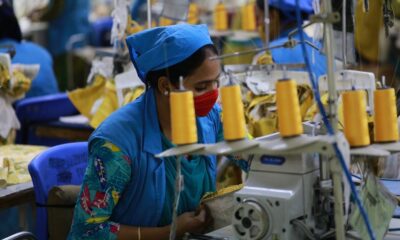
Bangladesh Brand Forum, BGMEA sign MoU to transform RMG sector