

Business
US jobs data beats expectations for second month in a row


The solid figures came despite rising gas prices and economic uncertainty sparked by the Iran war.
Source link
Business
Us Job Growth Data 2026: US adds stronger-than-expected 115,000 jobs in April despite Iran war impact – The Times of India
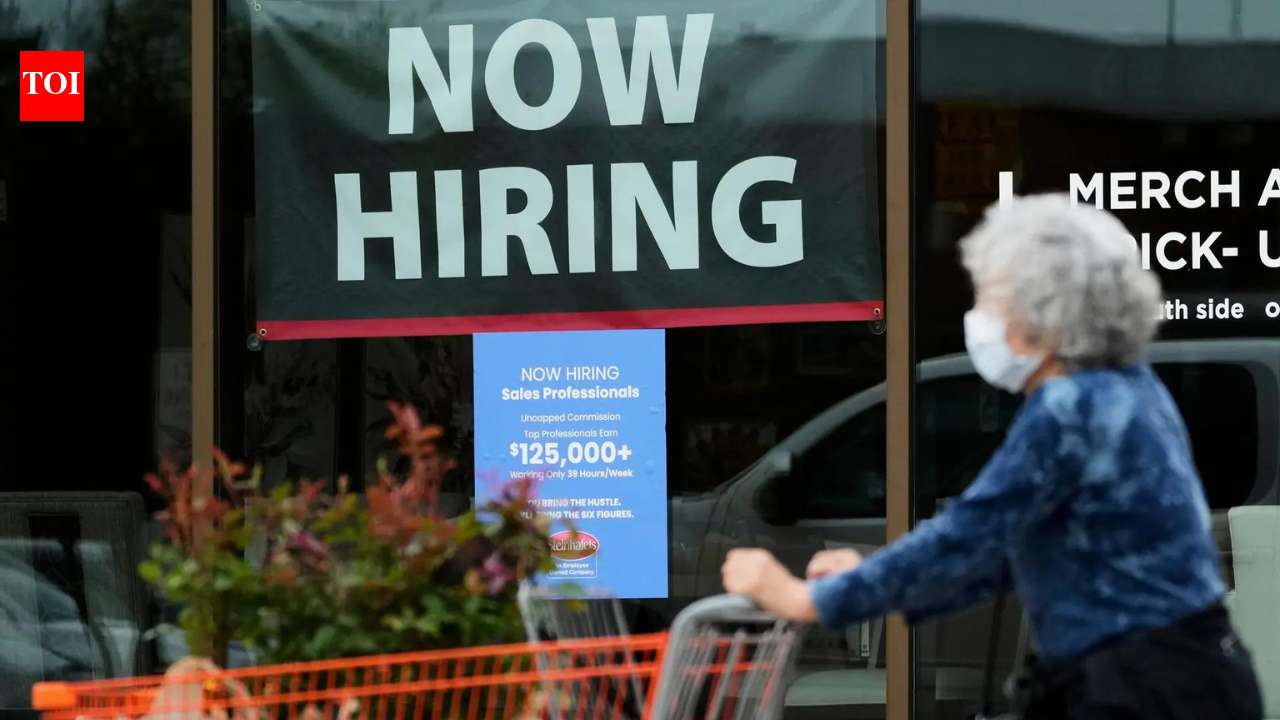
America’s employers added a stronger-than-expected 115,000 jobs in April despite economic uncertainty triggered by the Iran war, according to data released by the US labor department on Friday.The unemployment rate remained unchanged at 4.3 per cent, while hiring beat economists’ expectations of 65,000 new jobs, although it slowed from the revised 185,000 jobs added in March.The latest data suggests the US labour market has remained resilient even as the conflict in West Asia disrupted global oil supplies and pushed average US gasoline prices above $4.50 a gallon this week.“The labor market is not booming, but it is proving harder to break than many feared,” Olu Sonola, head of US economics at Fitch Ratings, said, as quoted by news agency AP.
Healthcare, transport sectors lead hiring
Healthcare companies added 37,000 jobs in April, while transportation and warehousing firms added 30,000 positions, according to the report.However, manufacturers cut 2,000 jobs during the month and have shed 66,000 jobs over the past year despite President Donald Trump’s protectionist trade policies aimed at boosting factory employment.Average hourly earnings rose 0.2 per cent from March and 3.6 per cent year-on-year, broadly aligning with the Federal Reserve’s inflation target.The labour force participation rate fell to 61.8 per cent, its lowest level since October 2021, as retirements and tighter immigration policies reduced the number of people seeking work.
Iran war and inflation concerns remain
Economists said the economy has so far weathered the impact of the Iran conflict better than expected, although risks remain if high energy prices persist.“Businesses to some extent are viewing the conflict in Iran as temporary,” Gus Faucher, chief economist at PNC, told AP. “We continue to see solid growth in consumer spending. And we’re seeing strong business investment, particularly around tech and AI.”However, Faucher warned that “the longer conflict in Iran lasts, the higher energy prices go, the longer they stay elevated the greater the drag on the economy.”The Iran war sharply disrupted shipping through the Strait of Hormuz after Iran closed the crucial route following US-Israeli strikes on February 28. The move caused oil prices to surge and raised fears of slower global economic growth.
Fed likely to hold rates steady
The stronger-than-expected jobs report is also expected to reduce pressure on the Federal Reserve to cut interest rates soon.Inflation climbed to 3.3 per cent in March, its highest level in two years, driven largely by rising fuel prices.Friday’s employment data “actually makes it less likely that we see a rate cut anytime soon,” Faucher said, adding that the Fed may prefer to focus on bringing inflation back towards its 2 per cent target before easing borrowing costs.

Millions of car finance payouts hang in the balance as the UK watchdog signalled that its compensation scheme faces further delays, changes or potential collapse ahead of legal battles.
The Financial Conduct Authority (FCA) told motor finance firms to prepare for the possible scenario that its redress scheme will not go ahead at all.
The regulatory body is facing four separate legal challenges from parties who are not happy with its plans for redress, which would result in an estimated average of £829 per payout.
The FCA said it is not clear when the case will be heard but that is unlikely to be before October.
In the meantime, it is in discussions about the “possibility of suspending some elements” of its compensation scheme, while still urging lenders to prepare for payouts.
But the regulator said it was also considering its options should parts of the scheme be quashed by the courts, including proceeding with a revised version or asking lenders to plan for a scenario where “there would be no scheme”.
This could mean lenders need to be ready to respond to complaints from car finance customers individually, rather than under the rules of an industry-wide programme set by the FCA.
“Many people will be frustrated that the legal action will delay payouts due to begin this year,” the FCA said.
“We remain committed to ensuring consumers receive any compensation owed as promptly as possible.”
The FCA set out the final details of its compensation scheme in March, which it estimated could cost the industry about £9.1 billion in total.
It had been expecting millions of claims to be paid out this year and the vast majority settled by the end of 2027.
The financial services arms of carmakers Volkswagen and Mercedes-Benz and the car finance arm of French bank Credit Agricole, as well as Consumer Voice, a group representing consumers, are asking the courts to quash the scheme, arguing the rules are unlawful.
“Between the four separate legal challenges, it is claimed in effect that the FCA’s approach to establishing the schemes has been both unduly favourable to consumers and unduly favourable to lenders,” the watchdog said.
At least one claim alleges that the FCA has breached the rights of lenders under the 1998 Human Rights Act, according to the watchdog.
Despite the uncertainty of the legal cases, the watchdog is still advising consumers to complain directly to their lender if they think they might be owed compensation, which they can do for free using a template letter on its website.
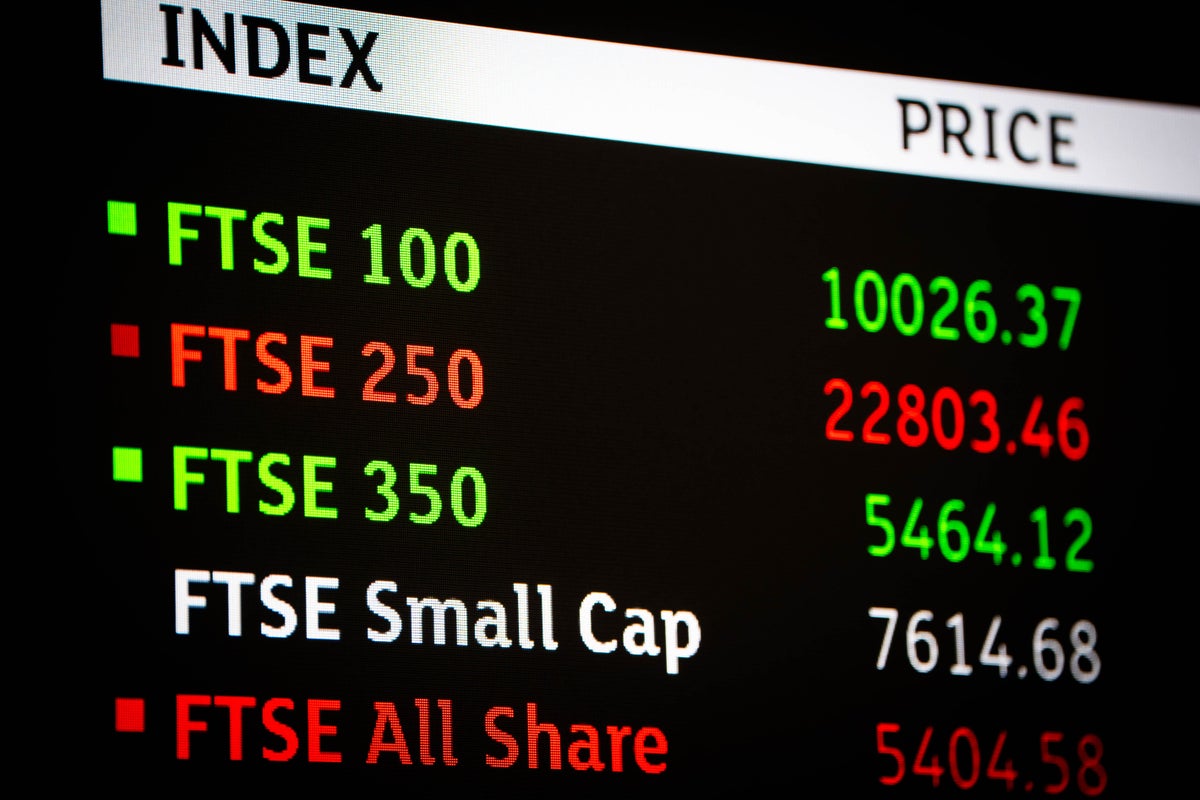
The FTSE 100 ended a losing week on the back foot as investors weighed UK local election results and fresh clashes between the US and Iran in the Middle East.
AJ Bell investment director Russ Mould said: “While officially the ceasefire between the US and Iran remains in place, an exchange of fire in the Strait of Hormuz has helped to extinguish some of the hope that a deal between the parties might be close.”
The FTSE 100 closed down 43.88 points, 0.4%, at 10,233.07. The FTSE 250 ended down 33.34 points, 0.2%, at 22,849.38, and the AIM All-Share fell 3.89 points, 0.5%, at 814.43.
For the week, the FTSE 100 fell 1.4%, the FTSE 250 rose 1.7% and the AIM All-Share advanced 2.0%.
Iranian media reported fresh “sporadic clashes” with US naval forces in the Strait of Hormuz on Friday, following a flare-up the night before, despite the ceasefire in the Gulf.
“For the last hour, sporadic clashes have taken place between the Iranian armed forces and American vessels in the Strait of Hormuz,” the Fars news agency said.
For its part, the US said its forces fired on and disabled two Iranian-flagged tankers that attempted to violate the blockade of Iran’s ports.
Nonetheless, secretary of state Marco Rubio said Washington was expecting a response from Iran on Friday to US proposals for a deal to end the conflict.
“We’re expecting a response from them today at some point… I hope it’s a serious offer, I really do,” Mr Rubio told reporters during a visit to Rome.
Brent crude for July delivery was trading at 101.49 dollars a barrel on Friday, up compared to 97.76 at the time of the equities close in London on Thursday.
The more downbeat mood in equities was reflected in Europe on Friday, where the Cac 40 in Paris ended down 1.1%, and the Dax 40 in Frankfurt ebbed 1.3%.
But US markets advanced once more after mixed economic data, with recent strong earnings continuing to underpin advances.
The Dow Jones Industrial Average was up 0.1%, the S&P 500 rose 0.7% while the Nasdaq Composite was up 1.3%.
The yield on the US 10-year Treasury widened to 4.37% on Friday from 4.36% on Thursday. The yield on the US 30-year Treasury narrowed to 4.94% on Friday from 4.95%.
US data was mixed on Friday with strong looking non-farm payrolls figures and a weak consumer confidence report.
The US economy added more jobs than expected in April, while the unemployment rate remained unchanged, according to the US Bureau of Labour Statistics.
Non-farm payrolls rose 115,000 in April, slowing from 185,000 in March, but beating 62,000 FXStreet consensus.
March’s total was revised upwards by 7,000 from 178,000, while February’s total was revised down by 23,000, meaning 156,000 jobs were shed.
The unemployment rate stayed stable at 4.3% in April, in line with consensus.
Morgan Stanley said the report will “build more confidence” in labour market stability while the Federal Open Market Committee “remains uncertain about whether higher oil prices will spill into slower growth or faster core inflation. Labuor market stability gives the Fed time to wait.”
But ING said while a second consecutive firm jobs report is a “big win” for the US economy, other labour market data is “not as firm” and consumers “certainly aren’t recognising the strength of this data point.”
Reflecting this, US consumer sentiment came in at its lowest-ever recorded level in May, according to a University of Michigan survey, with Americans battered by high prices and concerns about the Iran war.
The university’s Index of Consumer Sentiment came in at 48.2 in May, its lowest level since data collection began in 1952, and below 49.5 market consensus.
The pound firmed to 1.3623 dollars on Friday afternoon from 1.3616 on Thursday. Against the euro, sterling was little changed at 1.1568 euros from 1.1567 on Thursday.
Sterling and UK gilts held steady as markets digested the implications of heavy losses suffered by the Labour government in UK local elections.
Prime Minister Sir Keir Starmer pledged to fight on but the defeat could yet speak a leadership challenge.
On the FTSE 100, BT led the way, rising 6.6% as Goldman Sachs and JP Morgan sang its praises.
JP Morgan reiterated an “overweight” rating and raised its share price target to 310 pence from 300p.
In a research note, titled: “Entering the next leg of the re-rating journey,” JPM highlighted an improving equity free cash flow position that could support a doubling in BT’s dividend by 2030.
Goldman Sachs retained its “buy” rating and “materially” raised its mid-term dividend per share estimates.
Earlier this week, Bank of America upgraded BT, citing its hopes for an upturn in the dividend.
British Airways owner IAG closed down 2.8%, although above earlier lows, as it warned of a profit hit from rising fuel costs.
Chief executive Luis Gallego said higher fuel prices will “inevitably lead to lower profit this year than we originally anticipated.”
IAG now expects full-year fuel costs of £9 billion, including hedging positions, which would be 27% higher than £7.08 billion in 2025, and above the £7.0-7.4 billion range IAG forecast in February.
Intertek was down 2.7% as it rejected a third bid from EQT, believing it “significantly undervalues” its prospects.
Gold traded lower at 4,711.50 dollars an ounce on Friday, from 4,742.97 on Thursday.
The biggest risers on the FTSE 100 were BT Group, up 14.60p at 236.20p, Whitbread, up 88.00p at 2,410.00p, JD Sports Fashion, up 2.08p at 75.08p, Vodafone, up 2.65p at 118.65p and Entain, up 10.40p at 548.00p.
The biggest fallers on the FTSE 100 were Lion Finance, down 550.00p at 11,030.00p, Babcock International, down 47.50p at 1,052.50p, Metlen Energy & Metals, down 1.50p at 36.30p, Rolls Royce, down 39.20p at 1,219.80p and BAE Systems, down 58.00p at 1,933.80p.
Monday’s global economic calendar sees China CPI and PPI data and US home sales figures.
Monday’s local corporate calendar has half-year results from contract caterer Compass.


Extended interview: Lizzo

Trump announces three-day ceasefire between Russia and Ukraine

‘Orbs,’ ‘Saucers,’ and ‘Flashes’ on the Moon: Pentagon Drops New UFO Files

-

 Politics5 days ago
Iran weighs US reply delivered via Pakistan as Trump signals opposition to deal terms
-
 Business1 week ago
PSX plunges over 4,800 points | The Express Tribune
-

 Fashion7 days ago
US’ J.Jill, Inc. appoints Kimberly Wallengren as CMO
-

 Fashion1 week ago
Canada’s Lululemon appoints Esi Eggleston Bracey to board of directors
-

 Tech1 week ago
Almost half of UK businesses hit by cyber attacks | Computer Weekly
-

 Tech1 week ago
This Indigenous Language Survived Russian Occupation. Can It Survive YouTube?
-

 Entertainment1 week ago
David Allan Coe, country singer who wrote “Take This Job and Shove It,” dies at age 86
-
 Business1 week ago
Government hikes jet fuel prices by 5% for international airlines – The Times of India