

Business
SBP working on exchange, interest rates for stability: FinMin | The Express Tribune

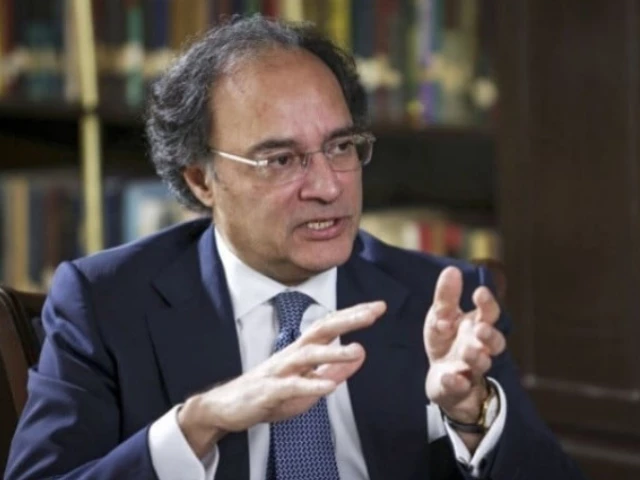
Finance Minister Muhammad Aurangzeb has stated that the State Bank of Pakistan is working on the exchange rate and interest rate, and the situation is expected to improve further.
The federal finance minister inaugurated the Job and Education Expo at the Expo Centre, Karachi, organised by the Pakistan Hindu Council. At the expo, around 120 stalls were set up by various institutions and companies for students.
Speaking to the media, Aurangzeb expressed gratitude to the organisers, saying that he had the opportunity to meet the country’s future leadership here. He noted that both public and private institutions were present at the job fair, but the absence of the corporate sector was felt.
He said that technology is the path to the future. Youth should work with their hearts and minds, and always strive for excellence.
Speaking about the Independence Day celebration of the “Marka-e-Haq,” the finance minister said that followers of all religions in the country commemorated it with great spirit.
Read: PM pushes for cashless, digital economy
He added that the corporate sector needs to step forward. Interest rate should not be made the single-point agenda.
In order to promote working capital, Pakistan must look beyond banks and include capital markets as well. He emphasised that the debt capital market also needs to be shifted to the Pakistan Stock Exchange mechanism for greater efficiency.
Aurangzeb highlighted that the circular debt in the power sector is declining, with three distribution companies (DISCOs) set to be privatised soon. He added that the government is also working to resolve circular debt in the gas sector, which has long been a burden on the economy.
On monetary policy, the minister clarified that the government has no role in setting interest rates, as this falls under the mandate of the State Bank of Pakistan. He said the exchange rate would continue to be determined by the market. Pakistan already has funding available, he noted, and the challenge now is to put those resources to effective use.
He praised Mustafa Kamal’s efforts in population control and underlined the importance of women’s economic participation, saying it could be a key driver in eradicating poverty. Aurangzeb confirmed that discussions with the World Bank regarding funding to support such initiatives have already taken place.
The finance minister said the IMF’s review mission would soon arrive in Pakistan under the ongoing 37-month programme, adding that the government remains in constant contact with the Fund. Looking ahead, he expressed optimism that by 2047 Pakistan’s economic situation would be that of a developed nation.
Aurangzeb also pointed to Pakistan’s strong anti–money laundering laws, which he said had enabled the country’s removal from the FATF grey list. He expressed confidence that Pakistan would remain off the list going forward.
Speaking on the recent rainfall damage in Khyber Pakhtunkhwa, he said his immediate priority was helping and rehabilitating affected people, while it was still too early to estimate the scale of losses.
When asked about traders’ demand for a new province, the finance minister refrained from giving a direct response.
There is no button for growth; the real thinking should be about sustainable growth. The role of the government is to provide an enabling environment. Public-private partnerships are working successfully. We are moving toward the AI world, and there is no room for doubt that we must move forward.
The finance minister said that ups and downs keep coming, but talent remains unaffected. Economic stability has now been achieved in the country.
The three major rating agencies are positive about Pakistan. The State Bank is working on the exchange rate and interest rate, and as stability increases, the situation will improve further.





Hastings set up the company in 1997, when it rented DVDs to customers and delivered by post.
Source link
Business
Trump nominates Erica Schwartz as CDC director amid turmoil around leadership, vaccine policy

Rear Admiral Erica G. Schwartz.
U.S. Department of Health and Human Services
President Donald Trump on Thursday nominated Erica Schwartz to serve as director of the Centers for Disease Control and Prevention, concluding a monthslong effort to choose a permanent leader of the embattled health agency.
Schwartz, who will have to be confirmed by the Senate, would take over the role as Health and Human Services Secretary Robert F. Kennedy Jr. oversees a string of controversial health policy changes at the agency, including an overhaul of childhood vaccine recommendations.
Schwartz served as deputy surgeon general during the first Trump administration, where she played a major role in the U.S. response to the Covid-19 pandemic. She spent more than 20 year in uniform, including as rear admiral and chief medical officer of the Coast Guard.
Dr. Jay Bhattacharya had been acting director of the CDC — a title that expired last month under federal law. That law, called the Vacancies Act, limits the amount of time an acting officer can serve in place of a Senate-confirmed official to 210 days.
Late last month marked 210 days since the most recent CDC director, Dr. Susan Monarez, was fired.
A sign sits outside of the Centers for Disease Control and Prevention (CDC) Roybal campus in Atlanta, Georgia, U.S. March 18, 2026.
Megan Varner | Reuters
She has so far been the only person to serve as a confirmed CDC director during Trump’s second term, holding the role for under a month last summer. In congressional testimony in September, Monarez said she was fired after refusing Kennedy’s demands to approve vaccine recommendations she believed lacked scientific support.
It is unclear how Schwartz’s views on vaccines or other key public health policies compare with Kennedy’s.
Also on Thursday, Trump said he chose Sean Slovenski as deputy CDC director and chief operating officer, and Jennifer Shuford as deputy CDC director and chief medical officer. Shuford, as head of the Texas Department of State Health Services, led the state’s response to a massive measles outbreak last year, and credited vaccination and testing in declaring it over.
Schwartz’s nomination comes after a tumultuous several months for the agency, which is reeling from the leadership upheaval, plummeting morale, significant staff turnover and controversial changes to U.S. vaccine policy. Ahead of leadership departures last year, staff members were shaken by a gunman’s attack on the CDC’s Atlanta headquarters on Aug. 8.
Last month, a judge blocked a critical vaccine panel’s efforts to overhaul U.S. immunization policy. That includes an effort to reduce the number of recommended childhood shots from 17 to 11.
Trust in federal health agencies has plummeted during Kennedy’s tenure as Health and Human Services secretary, according to a February poll from health policy research group KFF, with declines across the political spectrum.

Piotr Swat | Lightrocket | Getty Images
As its high-margin compounded GLP-1 business evolves, Hims & Hers Health may be finding a new opportunity in peptides.
Shares of the telehealth company jumped Thursday after HHS Secretary Robert F. Kennedy Jr. announced Wednesday that the FDA plans to convene a Pharmacy Compounding Advisory Committee meeting to review peptides for potential inclusion on the 503A bulk list, a designation that allows drugs to be compounded on an individual prescribed basis rather than mass producing.
For Hims, the bigger story is how expanding compounding for peptides could unlock new revenue streams as it directs members toward branded rather than more profitable compounded GLP-1 drugs. The telehealth company has been building toward a peptide business for years.
Peptides are short chains of amino acids — think of them as small building blocks of proteins — that are being explored for a wide range of health and wellness uses. They’re controversial because scientific evidence on their long-term safety and effectiveness is limited, and their production remains largely unregulated.
Hims & Hers made a significant move into the space in February 2025 when it acquired a California-based peptide facility. At the time, CEO Andrew Dudum called peptide demand “future-facing innovation.”
“Many use cases have yet to be launched,” said Dudum. “Peptide innovation is at the forefront of so many categories we’re excited to start offering.”
Following Kennedy’s announcement on Wednesday, Hims Chief Medical Officer Dr. Patrick Carroll applauded the news as a move away from the “gray market,” saying the goal is to bring peptide therapy into regulated, physician-led care.
“Our medical team believes certain peptide therapies hold meaningful potential in helping Americans live healthier lives, and we are actively exploring how to expand access in a way that will be aligned with FDA guidance,” Carroll said.
Leerink Partners called the news that the FDA will review peptides for the compounding list a positive outcome that could give Hims a clearer regulatory path to scale peptide therapies. Even so, the firm said it will take time for peptides to boost the company’s bottom line.
“This would not immediately translate into revenue, but would seemingly be a growth avenue that HIMS would push hard on,” said Leerink analyst Michael Cherny, who has a hold-equivalent rating on the stock and a $25 price target. It was trading around $26 a share Thursday.
For now the opportunity is still early, and clinical evidence supporting many peptide therapies is still limited.
Of the dozen peptides listed by Kennedy for consideration on the compounding bulk list, one — MK-677 — is often treated as an illegal drug when sold for human consumption. The growth hormone has also been banned by the World Anti-Doping Agency.
Other peptides on the list, such as GHK-Cu and Semax, which are used for cosmetic or cognitive enhancement, are generally viewed as less controversial, but still lack robust scientific backing.
Kennedy — who has supported many medical treatments and food options outside of those backed by mainstream science — was asked about his plans for expanding peptide therapies during a House Ways and Means Committee hearing Thursday.
“Peptides were not supposed to be regulated,” Kennedy said, arguing the Biden administration restricted the use of peptides due to safety concerns that he considers unfounded.
The FDA process is just beginning, and the July meeting will be advisory only, so change is not expected to be immediate.
Even so, investors are already focusing on what replaces GLP-1 driven growth for Hims, and peptides are emerging as one of the clearest candidates so far.


2026 NCAA gymnastics championships: Live updates from semifinals
Netflix co-founder Reed Hastings to step down as chairman

N.J. governor: FIFA should pay extra train costs to MetLife for World Cup

-

 Entertainment1 week ago
Queen Elizabeth II emotional message for Archie, Lilibet sparks speculation
-

 Tech1 week ago
Azure customers up in arms over ‘full’ UK South region | Computer Weekly
-

 Tech1 week ago
As the Strait of Hormuz Reopens, Global Shipping Will Take Months to Recover
-

 Fashion1 week ago
CII submits 20-pt agenda to Indian govt to back firms hit by Iran war
-

 Tech1 week ago
This AI Button Wearable From Ex-Apple Engineers Looks Like an iPod Shuffle
-

 Politics7 days ago
Indian airlines hit hardest after Dubai limits foreign flights until May 31
-

 Entertainment4 days ago
Palace left in shock as Prince William cancels grand ceremony
-

 Politics6 days ago
Chinese, Taiwanese will unite, Xi tells Taiwan opposition leader