

Fashion
A distinctly eclectic Paris Fashion Week featuring Leonard, Giambattista Valli, and Vetements

Published
October 4, 2025
Paris Fashion Week entered its fifth day with an especially intense programme. In particular, the womenswear ready-to-wear shows for Spring/Summer 2026 revealed designers’ pursuit of freshness and lightness. Leonard Paris and Giambattista Valli were prime examples. Vetements, for its part, opted for provocation.
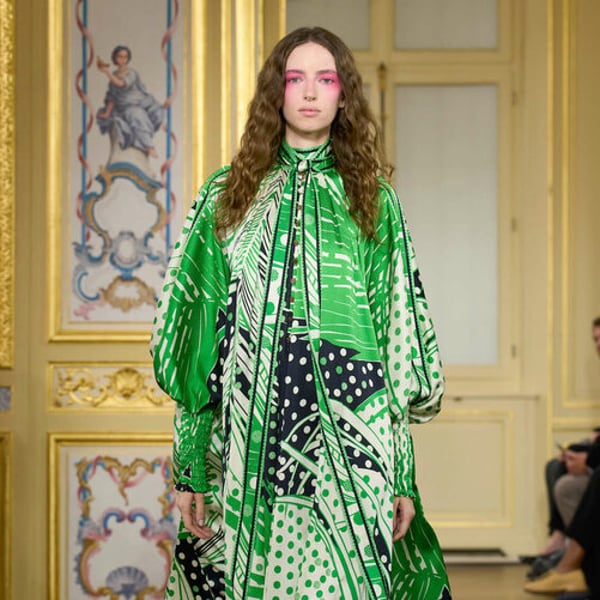
Leonard Paris jetted off to California, channelling Hollywood and Beverly Hills, for a festive summer that promises to be scorching. The wardrobe conceived by German designer Georg Lux leaned into evening and cocktail dressing, with fluid minidresses and long, diaphanous gowns cut from airy silks. The pieces floated, at times seeming suspended, rippling with each step in a whisper of intangible fabrics.
“I was inspired this season by muses such as Faye Dunaway and Jerry Hall, but also by the drawings of Puerto Rican fashion illustrator Antonio Lopez,” confided the creative director backstage, who welcomed guests to the elegant private mansion in the 16th arrondissement, where the house has been based since 2018. Clearly, his collection looked as much to the seventies jet set as to Hollywood’s golden age, with draped, diva-worthy, sequinned gowns.
More than ever, prints took centre stage, from Californian palms lifted from the house’s 1980s archives to the Art Deco floral theme developed by Leonard during the 1970s, along with a new red-and-orange poppy motif found on cotton-poplin dresses, but also painted onto a jacket and a transparent recycled-plastic bag, or worked into enamelled metal earrings. And flowers of every shape and in every shade ran through this richly varied collection.
Next summer’s wardrobe is all about volume, with draping, generous balloon sleeves, puffed silhouettes and flared dresses. A few “cricket club”-style striped looks and masculine blazers and suits provide contrast, though they remained thoroughly glamorous, crafted in greige twill embroidered with gold sequins and rhinestones.

Giambattista Valli welcomed guests into the salons of his house, a stone’s throw from the Opéra on Boulevard des Capucines. Baskets brimming with fruit and wildflowers lined the catwalk. The tone was set, as the Italian couturier celebrated nature in all its splendour, infusing his collection with an ingenuous candour.
With their colourful headscarves, blouses and ample petticoats or culottes, or their white lace apron dresses, the models evoked peasant women returning from the fields, or shepherdesses from old tales in search of Prince Charming. Some outfits were strewn with bucolic motifs: flowers, bouquets, fruit, clovers and butterflies.
Natural materials such as linen and cotton dominated, bringing a touch of authentic simplicity to the whole via little dresses, jackets and shorts suits decorated with hand-painted flowers in the manner of Dutch masters such as Vermeer, whose still lifes inspired Giambattista Valli this season.
Ruffles multiplied like petals in delicate dresses with billowing, airy volumes. They come in the colours of summer fruits: peach, raspberry, lemon, cherry, strawberry and plum. Lightness prevailed with shot taffeta and, above all, organza—whether embroidered cotton organza, ruched silk organza or crinkled iterations.

After taking over a McDonald’s on the Champs-Elysées in June 2019, Vetements returned to show on the world’s most beautiful avenue, this time taking over a concrete basement formerly occupied by an Adidas store. In the dim light, a silhouette descended the stairs to cross what looked like a squalid garage, its ceiling interlaced with neon tubes. Face masked by a nylon stocking, the first model appeared in leather trousers and boots, wearing a white T-shirt with a swastika crossed out by a prohibition sign.
For its return to the catwalks after sitting out last season, the brand is looking to make an impact. But its message was, to say the least, muddled. After this opening manifesto look, what followed was a sexist show in which all the women who stepped onto the catwalk were systematically undressed at the back, while the men were not subjected to the same treatment—save for one model whose jeans turned into transparent plastic at the rear, revealing a very chaste pair of white boxer shorts.
Fashion has often explored front/back construction in clothing, but here the experimentation left observers unconvinced. Whether in slip dresses or a tight skirt with a T-shirt, a suit, a printed dress, a severe straight grey skirt, or even a candy-pink ballgown, seen from behind the women were reduced to mere sex bombs, buttocks and legs on full display, covered only in couture tights and sometimes tight shorts or thigh-high boots.
At the back, in fact, garments morphed into high-cut bodysuits, while long dresses were shortened and skirts were either merely tacked at the front without being properly worn, or systematically unbuttoned at the back. Even the classic tweed suit was subverted, the skirt replaced by a pair of tweed briefs—also, of course, high-cut. Elsewhere, trench coats and overcoats open at the back or are stripped of fabric, revealing the lining, as with certain jackets worn by the men.
Two looks, strapped with an enormous cushion—airbag-style—fixed to the front at pelvis level, prompted questions. At the end of the show, coup de théâtre. A final model, dressed in an elegant black crinoline gown entirely open at the back, crossed the catwalk in tears, seeming to buckle under the pain. What was the message here? That this was, in fact, a denunciation of women as objects and of their hypersexualised image? Of the excesses of social media?
By trying too hard to conceptualise, Guram Gvasalia, who took over as the brand’s creative director in 2021 (he succeeded his brother Demna, who left for Balenciaga and is now at the helm of Gucci), risks losing his way.
This article is an automatic translation.
Click here to read the original article.
Copyright © 2025 FashionNetwork.com All rights reserved.









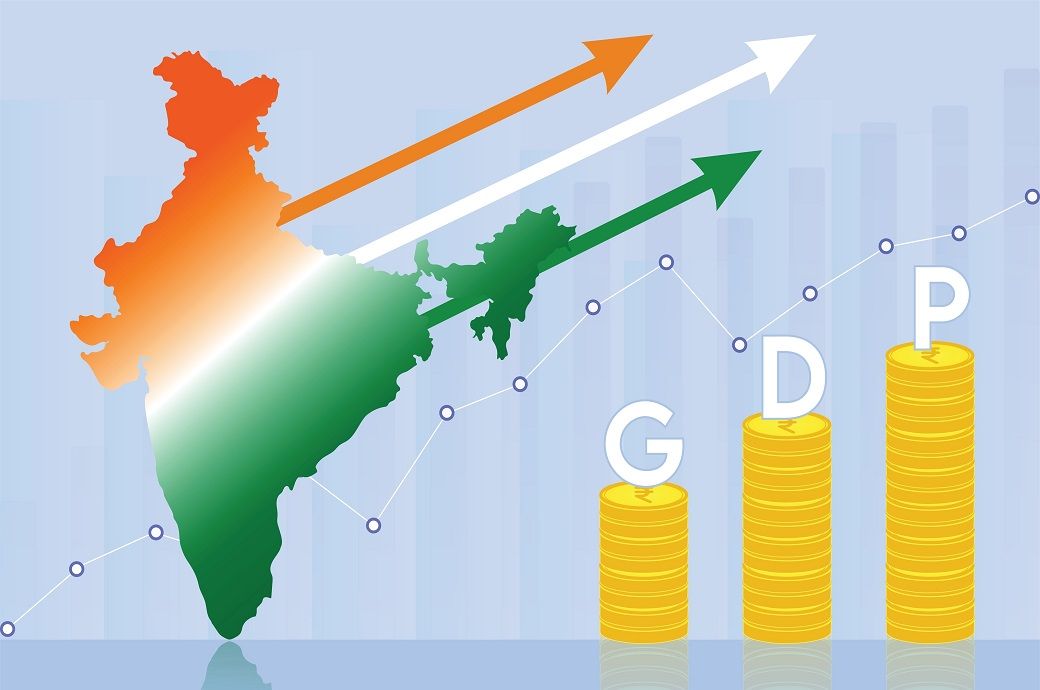
Nominal GDP, or GDP at current prices, is estimated to grow at 8.6 per cent to reach ₹345.47 trillion in FY26 against ₹318.07 trillion in 2024-25.
India’s real GDP is estimated to grow at 7.6 per cent to ₹322.58 trillion (~$3.54 billion) in FY26 compared to the first revised GDP estimate of ₹299.89 trillion for FY25 (7.1 per cent growth).
It released the new series of annual and quarterly national accounts estimates with FY23 base.
Real GVA is projected to grow at 7.7 per cent to reach ₹294.40 trillion in FY26 against ₹273.36 trillion in FY25.
Real gross value added (GVA) is projected to grow at 7.7 per cent to reach ₹294.40 trillion in FY26 against ₹273.36 trillion in FY25 (a 7.3-per cent growth rate).
Nominal GVA is estimated to grow at 8.7 per cent to hit ₹313.61 trillion during FY26, against ₹288.54 lakh crore in 2024-25.
Robust economic performance in FY26 is primarily on account of robust real growth observed in the second quarter (8.4 per cent) and third quarter (7.8 per cent).
The manufacturing sector has been the major driver of resilient performance of the economy the consecutive three fiscals after rebasing, a release from the ministry said.
Both private final consumption expenditure and grossed fixed capital formation exhibited more than 7-per cent growth rate in FY26.
Fibre2Fashion News Desk (DS)

The transition marks the formal handover of executive leadership to President and CEO Keun-Chang (Kevin) Yoon, reinforcing management continuity while preserving the founder’s long-term strategic vision.
Misto Holdings founder Gene Yoon has transitioned to honorary chairman in a planned leadership succession, formally handing executive control to president and CEO Kevin Yoon.
The founder, who expanded the group through the FILA global trademark acquisition and the takeover of Acushnet, will continue guiding long-term strategy as the rebranded Misto focuses on governance and sustainable growth.
Gene Yoon founded the business that would become Misto Holdings in the early 1990s, introducing the FILA brand to the Korean market and later leading a series of transformative transactions. In 2007, the company acquired the global FILA trademark rights through a leveraged buyout, followed by the 2011 acquisition of Acushnet Company, owner of the Titleist and FootJoy brands. The transaction was among the largest cross-border deals in Korea’s consumer sector at the time and significantly expanded the group’s global footprint.
Under his leadership, the company evolved into a multi-brand global portfolio spanning sportswear, golf equipment and apparel, generating approximately USD 3.08 billion in annual revenue.
As Honorary Chairman, Gene Yoon will remain closely engaged with the company, providing guidance on long-term strategy and global portfolio development while supporting management from a broader strategic perspective.
The leadership transition marks a new chapter under President and CEO Kevin Yoon, who has spent nearly two decades in senior roles across the group’s global operations, building deep operational and strategic expertise.
The company’s 2025 rebranding to “Misto” underscores its evolution into a global brand house focused on disciplined capital allocation, enhanced shareholder returns and sustainable long-term growth.
“Building on the founder’s legacy, our priority is to expand our global portfolio, strengthen governance and deliver sustainable value creation,” said Kevin Yoon, President and CEO of Misto Holdings.
Note: The headline, insights, and image of this press release may have been refined by the Fibre2Fashion staff; the rest of the content remains unchanged.
Fibre2Fashion News Desk (RM)


India’s real GDP estimated to grow 7.6% in FY26 under new base FY23

Trump says US won’t intervene in Islamabad-Kabul conflict

South Korea’s Misto Holdings completes planned leadership transition

-

 Tech1 week ago
A $10K Bounty Awaits Anyone Who Can Hack Ring Cameras to Stop Sharing Data With Amazon
-
 Business1 week ago
US Top Court Blocks Trump’s Tariff Orders: Does It Mean Zero Duties For Indian Goods?
-
 Fashion1 week ago
ICE cotton ticks higher on crude oil rally
-

 Tech1 week ago
Donald Trump Jr.’s Private DC Club Has Mysterious Ties to an Ex-Cop With a Controversial Past
-

 Entertainment1 week ago
The White Lotus” creator Mike White reflects on his time on “Survivor
-

 Politics6 days ago
Pakistan carries out precision strikes on seven militant hideouts in Afghanistan
-
 Business7 days ago
Eye-popping rise in one year: Betting on just gold and silver for long-term wealth creation? Think again! – The Times of India
-

 Politics1 week ago
US Supreme Court strikes down Trump’s trade tariff measures