

Tech
Augmented reality tool could teach old robots new tricks

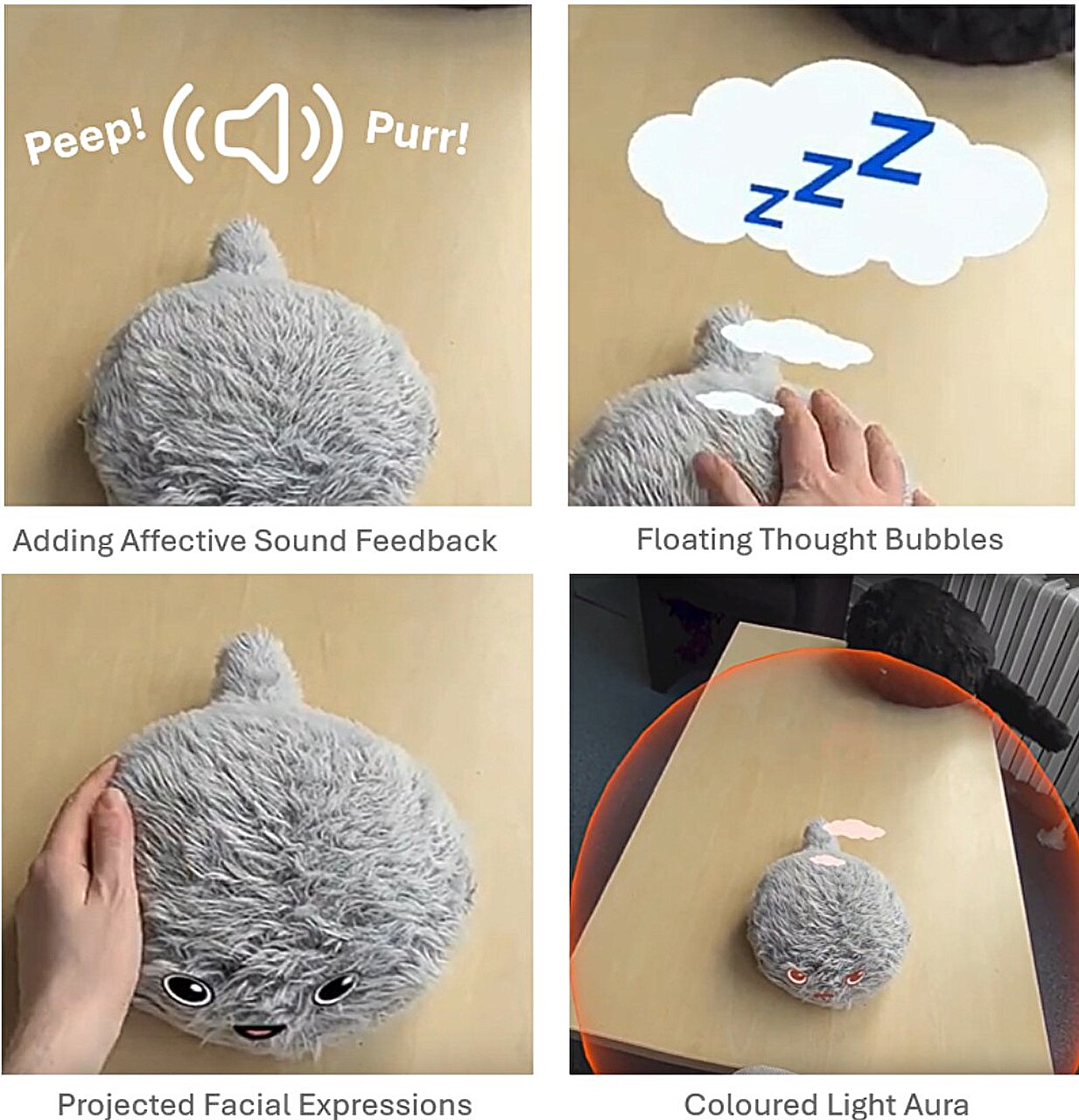
Researchers from Scottish universities have developed an innovative way to breathe new life into outdated robot pets and toys using augmented reality technology.
They have prototyped a new software system that can overlay a wide range of new virtual behaviors on commercially available robot pets and toys that are designed to look like animals and mimic their actions.
The system, called Augmenting Zoomorphic Robotics with Affect (AZRA), aims to address the shortcomings of the current generation of these “zoomorphic” robots, which often have very limited options for interactivity.
In the future, AZRA-based systems could enable older robot pets, and even previously non-interactive toys like plush dolls, to provide experiences which are much closer to those provided by real animal companions.
The richer experiences AZRA enables could help provide more pet-like experiences for people who are unable to keep real animals for reasons of health, cost or restrictions on rental properties.
When users of the AZRA system wear augmented reality devices like Meta’s Quest headset around their robot pets and toys, it projects a sophisticated overlay of virtual facial expressions, light, sound and thought bubbles onto the toy’s surfaces and surroundings.
AZRA is underpinned by a sophisticated simulation of emotions based on studies of real animal behavior. It can make robots seem more convincingly “alive” by imbuing them with moods that fluctuate unpredictably and can be affected by the touch or voice of their owner.
Eye contact detection and spatial awareness features means it knows when it is being looked at, and touch detection enables it to respond to strokes—even protesting when it is stroked against its preferred direction. It can request attention when ignored, or relax peacefully when sensing its owner is busy with other activities.
The system can also adjust the enhanced pet’s behavior to better suit their owners’ personality and preferences. If users are high-energy and playful, the robot slowly adapts to become more excitable. In quieter households, it becomes more relaxed and contemplative.
The team say their research could also help cut down on electronic waste by reducing the likelihood of robot pets and toys being disposed of after their owners become tired of them.
The development of AZRA will be presented as a paper at the 34th IEEE International Conference on Robot and Human Interactive Communication (RO-MAN 2025) in the Netherlands on 26th August.
Dr. Shaun Macdonald, of the University of Glasgow’s School of Computing Science, is the paper’s lead author and led the development of AZRA. He was initially inspired to develop the system after receiving a less-than-inspiring gift.
He said, “I was given a little robot pet that had a very basic set of movements and potential interactions. It was fun for a few days, but I quickly ended up losing interest because I had seen everything it had to offer.
“I was a bit disappointed to realize that, despite all the major developments in technology over the last 25 years, zoomorphic robots haven’t developed much at all since I was a child. It’s all but impossible to build a relationship with a robot pet in the way you might with a real animal, because they have so few behaviors and they become over-familiar very quickly.
“As a researcher in human-computer interaction, I started to wonder whether I could build a system which could overlay much more complex behaviors and interactions on the toy using augmented reality. Being able to imbue older robots and pets with new life could also help reduce the carbon footprint of unwanted devices by keeping them from landfill for longer.”
Dr. Macdonald used a simple off-the-shelf zoomorphic pet, the Petit Qoobo, as the basic real-world platform on which to overlay the augmented reality elements during the development of the system.
Guided by previous research into the emotional needs of dogs, Dr. Macdonald developed Zoomorphic Robot Affect and Agency Mind Architecture, or ZAMA. ZAMA provides the AZRA system with a kind of artificial emotional intelligence, giving it a series of simulated emotional states which can change in response to its environment.
Rather than simple stimulus-response patterns, the system provides the augmented reality pet with an ongoing temperament based around combinations of nine personality traits, including “gloomy,” “relaxed” or “irritable.” It has daily moods that fluctuate naturally, and a long-term personality which develops over time through interactions with its owner.
It simulates desires for touch, rest, food, and socialization which are subtly randomized each day. When its needs aren’t met, the AR robot will actively seek interaction, displaying emojis and thought bubbles to communicate what it wants.
The researchers are already working to explore the future potential of the technology, including participatory studies where volunteers can interact with the robot and then adjust its emotional parameters in real-time to explore what feels natural versus artificial in robot behavior.
Dr. Macdonald added, “AZRA turns a robot from being a device that I almost entirely choose to interact with into a device which can engage me in interaction itself. It feels more like me and another entity attempting to interact and communicate, rather than me make-believing almost all of that interaction myself.
“One of the main advantages of this system is that we don’t have a fixed ‘this is how this should work’ approach. What we have is a really great development test bed where we can try different ideas quickly and see what works. As AR glasses become more mainstream, this could become a way to breathe new life into existing robots without having to replace them entirely.”
Citation:
Augmented reality tool could teach old robots new tricks (2025, August 20)
retrieved 20 August 2025
from https://techxplore.com/news/2025-08-augmented-reality-tool-robots.html
This document is subject to copyright. Apart from any fair dealing for the purpose of private study or research, no
part may be reproduced without the written permission. The content is provided for information purposes only.










Service provider Blackbox Hosting has consolidated storage from two full racks down to just 8U of rack space following migration to Everpure FlashArray hardware. The move has allowed the provider to deliver “sovereign” cloud services with a 10:1 data reduction ratio and an 85% reduction in power utilisation.
Blackbox Hosting evolved over 14 years from a single rack to supporting more than 1,500 virtual machines (VMs), and has datacentre capacity at Canary Wharf with a secondary site in Slough.
The company operates a fully managed, sovereign (see box) model for major software suppliers including Iris Software Group, which supports payroll and financial management for approximately 60% of UK academies.
Blackbox previously relied on HPE 3PAR 8400 all-flash arrays. However, as the hardware approached end-of-life, the company faced mounting challenges.
“Support renewal costs were significant, and we had issues with HPE support,” said Matthew Burden, CEO at Blackbox Hosting. “We had a power supply failure in a DR site, and despite a four-hour SLA [service-level agreement], it took nearly two weeks to replace. They also began charging for firmware updates that were previously included.”
The 3PAR environment was cumbersome, said Burden, and required two full racks of hardware to manage the company’s near-petabyte scale.
When it looked for a more performant and dense alternative, Blackbox turned to Pure Storage, which recently rebranded as Everpure.
High density; ‘one-second’ RPO
Blackbox has deployed a range of Pure Storage FlashArray models across its two datacentres to support its active-passive high-availability design.
The deployment includes two FlashArray//X50 R3s, two X50 R4s, and two FlashArray//C20 units for file clusters.
The hardware supports predominantly Hyper-V and VMware VMs, running 90% Windows-based workloads, primarily SQL Server, plus Linux servers.
The transition from 3PAR to Pure has seen a dramatic consolidation of physical space. “We went from two entire racks filled with disks to two 4U boxes,” said Burden. “Our total provisioned storage is 998TB and we get a total reduction of 10:1. 3PAR had deduplication, but not compression on SSDs.”
Beyond space savings, the disaster recovery (DR) capabilities have seen a massive upgrade. Previously, the company’s recovery point objective (RPO) was limited to 15 minutes. “With Pure Storage, it is one second,” said Durden. “We replicate all 1,500 VMs to our backup datacentre. For a customer with 1,000 VMs, we can spin those up for quarterly testing and they are only one second out from live data.”
Performance and sustainability
The shift to non-volatile memory express-based flash has also provided a significant boost to the provider’s green credentials. Sustainability reports generated via Pure’s Evergreen dashboard show an 85% saving in power utilisation compared with the legacy HPE environment.
For the end users – which include major corporate energy, finance and transport organisations – the benefit is felt in application speed. “We’ve had clients with huge databases that were always slow with previous providers,” said Justin Field, commercial director at Blackbox. “They can pull data significantly faster now, which is a big play for us when competing against hyperscalers.”
Burden also highlighted the “zero-touch” operational simplicity of the new arrays. “The older arrays were very cumbersome; you had to know exactly what you were doing,” he said. “The Pure web interface is very simple, which makes the operational side much easier. Plus, with Evergreen, we don’t have to pull arrays out for upgrades. We can just put in new controllers as scale increases.”

A national housing shortage is straining finances and communities across the United States. In Massachusetts, at least 222,000 homes will have to be built in the next 10 years to meet the population’s needs. At the same time, there are numerous challenges in traditional construction. There’s a shortage of skilled construction workers. Most projects involve multiple contractors and subcontractors, adding complexity and lag time. And the construction process, as well as the buildings themselves, can be a major source of emissions that contribute to climate change.
Reframe Systems, co-founded by Vikas Enti SM ’20, uses robotics, software, and high-performance materials to address these problems. Founded in 2022, the company deploys microfactories that bring housing fabrication and production closer to the regions where the homes are needed. The first homes designed and manufactured in Reframe’s first microfactory have been fully built in Arlington and Somerville, Massachusetts.
Enti’s experiences in MIT System Design and Management (SDM) shaped the company from its start. “Learning how to navigate the system and finding the optimal value for each stakeholder has been a key part of the business strategy,” he says, “and that’s rooted in what I learned at SDM.”
Better tools for system-level problems
Enti applied to SDM’s master of science in engineering and management while he was working at Kiva Systems, overseeing its acquisition by Amazon and transformation into Amazon Robotics. He found that the SDM program’s fundamentals of systems engineering, system architecture, and project management provided him with the tools he needed to address system-level problems in his work.
While he was at MIT, Enti also served as an associate director for the MIT $100K Entrepreneurship Competition, which offers students and researchers mentorship, feedback, and potential funding for their startup ideas. He realized that “there isn’t a single formula for how businesses start, or how long it takes to get them started,” he says, which helped shape his plans to start his own business.
Enti took a leave of absence from MIT to oversee the expansion of Amazon Robotics in Europe. He returned and completed his degree in 2020, writing his thesis on developing technology that could mitigate falls for elderly people. This instinct to use his education for a good cause resurfaced when his daughters were born. He wanted his future business to address a real-world problem and have a social impact, while also reducing carbon emissions.
Growing housing, shrinking emissions
Enti concluded that housing, with immediate real-world impact and a significant share of global carbon emissions, was the right problem to work on. He reached out to his colleagues Aaron Small and Felipe Polido from Amazon Robotics to share his idea for advanced, low-cost factories that could be deployed quickly and close to where they were needed. The two joined him as co-founders.
Currently, the microfactory in Andover, Massachusetts, produces structural panels, with robotics completing wall and ceiling framing and people completing the rest of the work, including wiring and plumbing. Eventually, Reframe hopes to automate more of the building process through further use of robotics. The modular construction process allows for reduced waste and disruption on the eventual home site. And the finished homes are designed to be energy-efficient and ready for solar panel installation. The company is set to start work soon on a group of homes in Devens, Massachusetts.
In addition to the Andover location, Reframe is setting up in southern California to help rebuild homes that were destroyed in the area’s January 2025 wildfires. The company’s software-assisted design process and the adjustability of the microfactories allows them to meet local zoning and building codes and align with the local architectural aesthetic. This means that in Somerville, Reframe’s completed buildings look like modernized versions of the neighboring three-story buildings, known locally as “triple-deckers.” On the other side of the country, Reframe’s design offerings include Spanish-style and craftsman homes.
“Housing is a complex systems problem,” Enti says, explaining the impact SDM has had on his work at Reframe. The methods and tools taught in the integrated core class EM.412 (Foundations of System Design and Management) help him tackle systems-level problems and take the needs of multiple stakeholders into account. The Reframe team used technology roadmapping as they devised their overall business plan, inspired by the work of Olivier de Weck, associate head of the MIT Department of Aeronautics and Astronautics. And lectures on project management from Bryan Moser, SDM’s academic director, remain relevant.
“Embracing the fact that this is a systems problem, and learning how to navigate the system and the stakeholders to make sure we’re finding the optimal value, has been a key part of the business strategy,” Enti says.
Reframe Systems is set to continue learning through iteration as they plan to expand their network of microfactories. The company remains committed to the core vision of sustainably meeting the country’s need for more housing. “I’m grateful we get to do this,” Enti says. “Once you strip away all the robotics, the advanced algorithms, and the factories, these are high-quality, healthy homes that families get to live in and grow.”
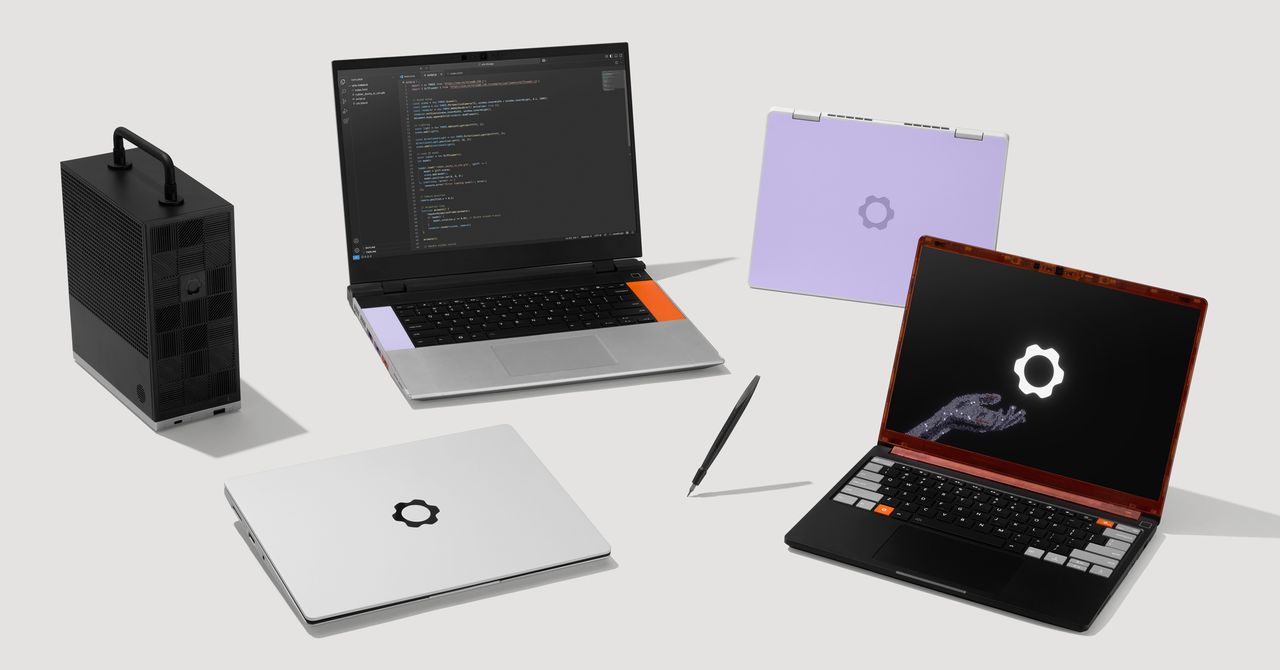
Framework, the company that makes laptops designed for optimal repairability, announced a new version of its main product, a 13-inch screen laptop. It’s called the Framework Laptop 13 Pro, and it has far better battery life, a touchscreen, a haptic touchpad, and is fitted with Intel processors.
At an event in San Francisco today, Framework CEO Nirav Patel showed off the company’s new tech, opening with a joke about making Framework AI—something the company is very much not doing. Framework’s whole thing, after all, is aiming to give users control over the physical tech they use.
“That industry is fighting for you to own nothing, and they own everything,” Patel said about the AI industry. “We’re fighting for a future where you can own everything and be free.”
Framework used the event to detail other updates coming to its 16-inch laptop. It also showed off previews of an official developer kit and a wireless keyboard for controlling your rig from the couch.
Framework 13 Pro
As the name implies, the 13 Pro is a step up from the company’s last version, the Framework 13. It’s also pricier, starting at $1,199 for a DIY Edition that requires assembling the computer yourself. Pre-built units start at $1,499 but can be upgraded with more features. Framework says it will start shipping the 13 Pro in June.
Framework’s signature move for its products is the ability to take the thing apart. The 13 Pro is made with that ethos in mind, so its parts can be easily swapped out, upgraded, or replaced. Four Thunderbolt 4 interfaces let you pick which ports (USB-C, HDMI, etc.) you want and then choose where to place them. Framework says it planned the laptop with cross-generation compatibility in mind, so current Framebook 13 laptop owners will be able to use new 13 Pro parts like the mainboard, display, and battery, and put them into their existing machine.
The big changes in the guts of the 13 Pro come from Framework’s shift away from using an AMD processor to Intel’s Core Ultra Series 3 processors, which Framework described in its press release as “just insanely efficient.” That efficiency, along with a bigger battery, translates to more than 20 hours of battery life while streaming 4K Netflix videos, at least that’s the claim. That’s almost 12 hours longer than the Framework 13.

Courtesy of Framework

Courtesy of Framework


Why Guardiola’s legacy could exceed Ferguson’s, Wenger’s, Klopp’s

UK’ John Lewis appoints Jacqui Markham as new creative head of fashion

Tori Spelling pays emotional tribute to late ex Patrick Muldoon

-

 Fashion6 days ago
France’s LVMH Q1 revenue falls 6%, shows resilience amid Iran war
-

 Sports1 week ago
The case for Man United’s Fernandes as Premier League’s best
-
 Business1 week ago
UK could adopt EU single market rules under new legislation
-

 Entertainment7 days ago
Is Claude down? Here’s why users are seeing errors
-
 Business1 week ago
Delta Air Lines unveils first new Delta One suite in premium cabin arms race
-

 Fashion1 week ago
Asia claims largest share of markets on Kearney FDI Confidence Index
-

 Sports7 days ago
PSL 11: Peshawar Zalmi win toss, opt to field first against Quetta Gladiators
-

 Tech7 days ago
The Deepfake Nudes Crisis in Schools Is Much Worse Than You Thought