

Sports
Barnwell picks five NFL teams set to decline: Who could miss the playoffs entirely?

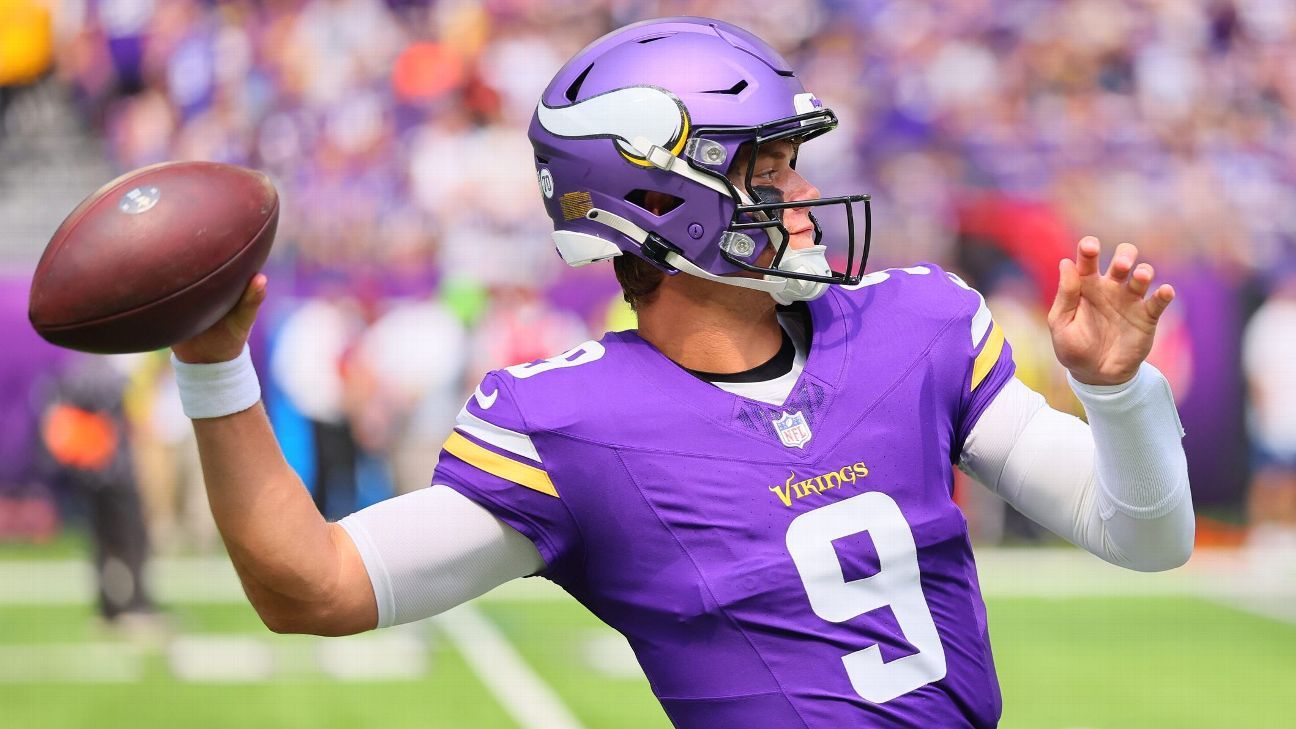
I’ve been looking forward to this column for months. On Monday, I published my annual look at the five teams most likely to improve in the upcoming NFL season. In the years I’ve been writing that column, those teams have improved 31 of 38 times, or more than 81% of the time.
Each year, I also break down the teams that are most likely to decline. This column has had a virtually identical success rate; after last year, it’s 30 for 38. It went 3-2 last year, correctly pegging the Ravens (who dropped from 13-4 to 12-5), Giants (6-11 to 3-14) and Browns (11-6 to 3-14) as teams that would lose more games.
The two that defied my predictions will stick in my mind for a while. The Steelers defied the odds again, maintaining their 10-7 record. They’re responsible for two of those eight times in which a team didn’t decline, and the Steelers came within one win of doing it a third time in 2022. Spoiler: They’re not on my list below.
The other team did a little more than maintain its record from the previous season. The Eagles did not decline from their 11-6 mark in 2023. They went 14-3, then followed that by blitzing through the NFC playoffs and blowing out the Chiefs in Super Bowl LX. When I ranked the top 25 teams of the past 25 years earlier this offseason, I put the 2024 Eagles at No. 4. After their early-season bye, they were comfortably the league’s best team.
So, what did I miss? A massive improvement in their underlying level of play, driven by better players and coaching. This column uses 2024 data and underlying metrics to estimate each team’s true level of performance. Though every team makes offseason changes, history tells us the information from the previous season helps predict what will happen in the year to come.
Subscribe: ‘The Bill Barnwell Show’
More: Predicting teams that will win more games
The Eagles’ changes turned out to be more impactful than almost any in recent memory. It’s rare for a team to land a player in free agency who becomes a first-team All-Pro. General manager Howie Roseman signed two — running back Saquon Barkley and linebacker Zack Baun. After cornerback was a major problem in 2023, Roseman used his first two picks in the draft on Quinyon Mitchell and Cooper DeJean. I wrote last year that rookie cornerbacks often struggle in their debut seasons, which is true, but often doesn’t mean always. Mitchell and DeJean were stars, with the Eagles morphing from one of the league’s worst defenses by EPA per play during their 2-2 start to the league’s best once DeJean entered the lineup in the slot.
The Eagles also made strong upgrades at coordinator, as Vic Fangio and Kellen Moore were excellent. Throw in some of the league’s second-healthiest season by adjusted games lost, a 7-2 record in one-score games and the fifth-easiest schedule, and it was a special campaign.
Should I have seen that coming? Maybe. Barkley was going from what might have been the league’s worst situation for running backs to arguably its best, although the concern for him has usually been health, not ability. He was a revelation last season. Fangio and Moore had essentially been fired from their prior jobs, but Fangio was excellent with the Bears and 49ers, and the Eagles were a disaster with Matt Patricia as defensive coordinator by the end of 2023. I thought they could be better on defense but didn’t expect them to be the league’s best for most of the season. They had one of the league’s easiest projected schedules, which I shouldn’t have discounted. If you saw Baun turning into the league’s most productive linebacker, well, I suspect there are quite a few NFL teams that would like to hire you.
Of course, the Eagles were also in the decline column in 2023, when they dropped from 14-3 to 11-6 and then got blown out in the postseason. (Guess which season I heard more about on social media.) The same data that was unreliable and got Philadelphia utterly wrong in 2024 raised concerns about its health and defense and suggested it would have “10 to 12 wins” in 2023.
Being right in 2023 doesn’t make me any less wrong about 2024, but it reinforces how difficult it is to project the season ahead. The Browns and Eagles had the same record in 2023. Data is often helpful in trying to make predictions, but it’s no match for a team adding four Pro Bowl-plus players and dramatically improving its play. All I can do is tip my cap.
Jump to a team:
Chiefs | Colts
Commanders | Lions | Vikings


Record in 2024: 15-2
Point differential in 2024: plus-59
2024 record in games decided by seven or fewer points: 10-0
Projected strength of schedule, via ESPN’s FPI: Sixth toughest in NFL
Two years after the Vikings became the first team in league history to go 9-0 in games decided by seven points or fewer, the Chiefs took things a step further. Andy Reid’s team was an unprecedented 10-0 in one-score games last season. And as always, while there are situations in which a late score can make a game look closer than it actually was, the Chiefs really were getting opponents to slip on banana peels and knock themselves out at the most opportune times. Let’s relive just how narrow so many of Kansas City’s victories were:
-
In the season opener, a Lamar Jackson touchdown pass to Isaiah Likely as time expired seemed to extend the game. As the Ravens were about to line up for a two-pointer, a review found that Likely was out of bounds by half of a toenail, ending the contest.
-
The following week, the Chiefs faced a fourth-and-16 with 48 seconds left against the Bengals, only to be bailed out by a 29-yard pass interference penalty on rookie safety Daijahn Anthony. (Before the conspiracy theorists weigh in, keep in mind that a 21-yard conversion on the prior fourth-and-6 was wiped off by an illegal hands to the face penalty on Chiefs tackle Wanya Morris.) The penalty set up a game-winning field goal from 51 yards out by Harrison Butker.
-
In Week 3, defending a five-point lead in the fourth quarter, the Chiefs came up with two red zone stops on consecutive drives to stop the Falcons, including a controversial no-call on what looked to be pass interference against Kyle Pitts.
-
Six weeks later, a Baker Mayfield two-minute drill produced a touchdown pass with 30 seconds to go. Unlike the Ravens in Week 1, Tampa Bay coach Todd Bowles elected to kick an extra point and send the game to overtime, where the Chiefs won the coin toss and marched downfield for a touchdown.
-
The following week, the Broncos were in position to seal a statement victory over their divisional rivals, but Leo Chenal blocked a 35-yard field goal attempt that would have won the game for Denver, handing the Chiefs a 16-14 win.
-
In Week 12, the Panthers drove downfield for a game-tying touchdown and two-pointer, aided by a pair of pass interference penalties on Kansas City. With 1:46 to go, a Patrick Mahomes 33-yard scramble got the Chiefs into range for a short field goal to win at the buzzer.
-
In Week 13, the Chiefs somehow survived a pair of Raiders drives to hold onto a two-point lead in the fourth quarter. Daniel Carlson missed a 58-yard field goal that would have given Las Vegas the lead with 2:21 to go, and after a Kansas City three-and-out took just 14 seconds off the clock, the Raiders drove into position for another field goal, only to lose the ball on an aborted shotgun snap with 14 seconds left.
-
In Week 14, after a Cameron Dicker field goal gave the Chargers a two-point lead with 4:39 to go, Mahomes & Co. converted three consecutive third downs to drive downfield and eat up the clock. Then, a Matthew Wright field goal bounced off the uprights and in, clinching a ninth consecutive division title.
A pair of seven-point victories over the Chargers and Raiders weren’t quite as close. Maybe it’s unfair to include the Panthers game when Carolina never had the ball with a chance to tie the game or take the lead. There’s no guarantee the Buccaneers or Ravens would have converted their two-pointers, or that the Raiders or Broncos would have hit their field goals to win their respective games. Maybe it’s not fair to treat these games as some collective combination of Chiefs magic and spectacular luck.
And yet, at the same time, you really have to blindly believe to treat this as proof of a dominant team turning on the gas when it most needed it. Was it Mahomes and the offense coming up with key plays at the exact right time? Some weeks, yes. Against the Ravens, Falcons, Bucs, Panthers and Raiders, though, the Chiefs had a chance to chew up the clock and seal victories with first downs but couldn’t sustain their drives, handing the ball back to the opposing team. Most of those drives were three-and-outs.
1:42
Why Stephen A. says the Chiefs’ road back to the SB is hard
Stephen A. Smith discusses the improved AFC teams and why the Chiefs have a harder route to return to the Super Bowl than the Eagles.
Was it Steve Spagnuolo’s opportunistic defense closing the door with a well-timed blitz or big play, as Kansas City did against the Bills in the AFC title game? Again, only sometimes. The Chiefs blew late leads on defense against the Bucs and Panthers and came within an inch of doing so against the Ravens. The Falcons drove twice into the red zone and were let down by a missed call in the end zone that would have given them first-and-goal on the 1-yard line. The Broncos converted three third downs to get into field goal range before the Chenal block. Las Vegas quarterback Aidan O’Connell converted five straight passes to get into field goal range before the bungled exchange. That isn’t the résumé of a great defense shutting down teams when the game’s on the line, even if the results ended up looking good for Kansas City.
Do the Chiefs have a psychic hold late in games on the rest of the league? Depends on when you look. They went 8-0 in one-score games in 2021 and 10-0 in those same contests last season. In Mahomes’ other seasons as the starter, they went 25-17 in those one-score contests with him on the field, including a 3-4 mark in 2023. That total — 43-17 — is a spectacular record in one-score games, but even treating Mahomes as an outlier relative to the rest of the league (and I’m willing to believe that possibility), 10-0 is impossibly unsustainable.
The Chiefs had the point differential of a 10.2-win team, owing in part to a 38-0 loss to the Broncos in Week 18 when Mahomes and virtually every other star took most (or all) of the game off. Remove that game and the Chiefs went 15-1 with a 10.7-win point differential. Every other 14-plus win team since 1989 had a point differential of 100 points or more, with their average point differential coming in at 190 points per 17 games. Kansas City had a point differential of plus-59.
The 2024 Chiefs finished the season with the largest gap between their actual record and Pythagorean expected record of any team since 1989, coming in just ahead of the 2022 Vikings. The 30 teams with the largest gap between those two figures over that time span declined by an average of 3.2 wins per 17 games. They went from outperforming their Pythagorean expectation by 3.2 wins to just 0.1 wins per team the following season. In other words, for the vast majority of these teams, they weren’t able to defy what history tells us about point differential for more than one season.
Could the Chiefs be the exception? Of course. Mahomes is the best quarterback of his generation. There’s significant talent on both sides of the ball, and the brain trust of Reid and Spagnuolo are back. The Chiefs spent all of last season dealing with a turnstile at left tackle, a problem they believe they’ve solved after signing Jaylon Moore and drafting Josh Simmons in Round 1. They didn’t have wideout Rashee Rice for most of the season after a knee injury in September, and Isiah Pacheco‘s fractured fibula neutered the run game. They converted just under 54% of their red zone trips into touchdowns, the worst rate they have posted in a single season during the Mahomes era. As we saw with the Eagles last season, one way to defy what the numbers suggest is to massively improve your underlying level of play.
Even if the Chiefs improve on a play-by-play basis, there’s a huge gap between the team they were a year ago and what their record suggested. The left side of their line is a huge question mark between tackle and guard, where Kingsley Suamataia might settle after flaming out at tackle. They lost an underrated veteran in safety Justin Reid, who was one of the league’s best tacklers during his time in Kansas City. Rice is likely to miss time with a potential suspension, and tight end Travis Kelce took a major step backward in his age-35 season. Opposing kickers hit a league-low 81.8% of their kicks against Kansas City in 2024, including misses and blocks at the most inopportune times. Can the Chiefs really count on that again?
Of course, all of this isn’t to suggest the Chiefs will be anything short of a Super Bowl contender. They were on this very list before the 2021 season, when they fell from 14-2 to 12-5. That team came within a few yards of making it back to the Super Bowl. Twelve wins and another deep playoff run seem like a reasonable expectation for this team, too.

Record in 2024: 14-3
Point differential in 2024: plus-100
2024 record in games decided by seven or fewer points: 8-1
Projected strength of schedule, via ESPN’s FPI: Fourth toughest in NFL
After mentioning the 2022 Vikings in the Chiefs’ conversation, perhaps it’s only fitting that Minnesota returns as the next team on this list. The 2022 Vikings were one of the more obvious candidates I’ve ever seen for decline, as they went 13-4 while being outscored by three points. That team finished 28th in DVOA, suggesting they were, on a snap-by-snap basis, one of the league’s worst teams. They were immediately bounced from the playoffs at home by a Giants team that ranked 23rd by the same metric.
The 2024 Vikings were different. For one, they were much better. They went 14-3 with the league’s seventh-best DVOA. They played the ninth-toughest schedule. The 2022 Vikings were passengers on defense, with coordinator Ed Donatell fielding one of the most confusingly passive units in recent memory. The 2024 Vikings were the league’s most entertaining and perhaps its most aggressive defense, throwing everything from Cover-0 blitzes to drop-eight coverages from the same pre-snap looks and confounding opposing quarterbacks in the process.
The Vikings went 8-1 in one-score games last season. If they had done that after the 2022 season, Kevin O’Connell would be lauded as the game management wizard of his generation. Instead, they went 4-8 in one-score games between those two seasons, and while things might have been different if Kirk Cousins had stayed healthy, four of those losses came in the first five weeks, when Cousins was on the field. O’Connell is still an excellent coach, but he’s probably not going to win 88% of his close games again.
Let’s talk about that defense. Can the Vikings keep their level of play up? While acknowledging they have a great front seven and an excellent coordinator, I’d be a little nervous. They led the league in turnovers (33) and were second in turnover rate (16.6% of opposing drives), trailing only the Bills. Defense is more difficult to sustain than offense, and successful defenses built around high turnover margins are even tougher to maintain from year to year. The Bills were able to do that between 2023 and 2024, but the other teams directly below them in turnover rate two years ago were the 49ers, Bears, Cowboys, Ravens and Saints, none of whom were able to sustain their takeaway rate in 2024. Their defenses all took a meaningful step backward.
That’s not a one-year trend, either. Looking at 2000 to 2023 and the teams that ranked in the top five in turnovers per drive — as the Vikings did a year ago — just 17% of those teams finished in the top five again the following season. Their average rank in turnover rate was 15th. Minnesota could certainly field an excellent defense again, but it probably won’t lead the league in turnovers.
Are there reasons to think the Vikings will simply field better defensive talent? I’m not sure. They were the league’s fifth-healthiest defense a year ago by adjusted games lost, per the new FTN Football Almanac, and they fielded the league’s oldest defense on a snap-weighted age basis. In fact, with the league’s fifth-oldest offense, they were the league’s oldest team on a play-by-play basis. That isn’t inherently disqualifying, but it’s a reality of where they were with their roster construction.
The Vikings were able to get very good play from three veteran cornerbacks in Byron Murphy, Stephon Gilmore and Shaq Griffin. Gilmore and Griffin are gone, so they will be younger at the position, but the players replacing the three veterans haven’t been great elsewhere. Isaiah Rodgers was buried on the depth chart in Philadelphia, while Jeff Okudah and Tavierre Thomas have bounced around the league with limited results. Minnesota is better-equipped to handle the departure of starting safety Cam Bynum, who left as part of the various free agent exchanges the Colts and Vikings made this offseason, but it’s fair to say the expectations for the secondary have to be below what Vikings fans saw last season.
They’ll try to make up for it on the front end, where they … got older by importing two new defensive tackles on the wrong side of 30. Jonathan Allen and Javon Hargrave were both stars earlier in their career, but they combined to play just 11 games last season because of injuries. Allen and Hargrave are big swings, and general manager Kwesi Adofo-Mensah has generally done excellent work in free agency, so there are reasons to be optimistic the Vikings’ front will be even more devastating than it was in 2024.
Adofo-Mensah upgraded the interior of the offensive line, too, bringing in Ryan Kelly and Will Fries from Indianapolis before using his first-round pick on guard Donovan Jackson. The interior line has been a weakness seemingly since the Steve Hutchinson days, so I can’t take any issue with the idea of upgrading those spots. In practice, they should be better than the Ed Ingrams and Garrett Bradburys of the world, but Fries is coming off a broken leg, while Kelly is 32 and hasn’t been the same player he was during his peak seasons. The Vikings also get back left tackle Christian Darrisaw after he suffered a season-ending torn ACL and MCL in midseason last year.
1:10
Why Damien Woody trusts Kevin O’Connell
Damien Woody explains why he expects Kevin O’Connell to get the best out of J.J. McCarthy with the Vikings.
The most notable player returning from injury is quarterback J.J. McCarthy. He’ll take over for Sam Darnold, who ranked 14th in Total QBR last season. While Darnold averaged nearly 8.0 yards per attempt in a resurgent performance, he threw 12 interceptions, fumbled eight times and took sacks on more than 8% of his dropbacks. The Vikings were tied for the fourth-most drives in the league, which inflated some of his cumulative stats, both good and bad.
One way for the Vikings and McCarthy to overcome any sort of turnover-induced dip on defense would be to simply protect the ball more reliably. They ranked 18th in turnover rate on a drive-by-drive basis, and they scored just two touchdowns across the 45 drives in which Darnold took at least one sack. They seem set to move toward more of a rotation at running back after Aaron Jones fumbled five times last season. If McCarthy protects the football and takes drive-destroying sacks less often, Minnesota could improve by avoiding negative plays more often.
The Vikings are a pretty unique team. The age of their roster and the moves they have made suggest they’re trying to win right now, but they have what essentially amounts to a rookie quarterback leading the way. And while we normally associate debuting quarterbacks with subpar teams and young rosters, McCarthy is taking over a 14-win team, something I’m not sure has ever happened in the modern era. I’m not expecting a dropoff below .500 like the one we saw in 2023, but a record more in line with their 11.1-win point differential from 2024 would make sense.

Record in 2024: 12-5
Point differential in 2024: plus-94
2024 record in games decided by seven or fewer points: 8-2
Projected strength of schedule, via ESPN’s FPI: Seventh toughest in NFL
The Commanders join the Chiefs as teams that succeeded after being on last year’s most likely to improve list but are tabbed most likely to decline this season. Washington made one of the biggest single-season leaps in recent league history, improving from four wins in 2023 to 12 last season. Then, the Commanders beat the Bucs and Lions in the playoffs before running out of steam in the NFC title game against the Eagles.
Though I was optimistic about the Commanders last season, I thought they would win around eight games and didn’t expect them to make a deep playoff run. Last season, they fixed their biggest problem from the previous season, creating turnovers. The Commanders jumped from a minus-14 turnover margin in 2023 to plus-one last season, though that mostly occurred by dramatically cutting their turnovers on offense.
I hesitated comparing last year’s Commanders with the 2023 Texans, but that turned out to be a great comp in many ways. The Texans accelerated their rebuild by surrounding a talented young quarterback who cut down on the team’s giveaways with a defensive-minded coach and one of the league’s older rosters. In 2024, though they still won the AFC South, they stagnated a bit; the offseason improvements didn’t click, there weren’t many young players (other than Will Anderson Jr. and the secondary) who became impact contributors, and they relied too much on their young quarterback to bail them out. Houston was still good, but it didn’t take the next step many expected.
We might see the same productions from the Commanders, who fielded the league’s seventh-oldest team last season on a snap-weighted age basis, despite quarterback Jayden Daniels and cornerback Mike Sainristil being wildly impressive in their debut seasons. Getting little out of the draft picks from the Ron Rivera era, general manager Adam Peters covered up holes throughout the roster by adding a bevy of veteran free agents, similar to what Nick Caserio did in Houston. There’s nothing wrong with that philosophy. Peters should be lauded for hitting on edge rusher Dante Fowler Jr., safety Jeremy Chinn, linebacker Frankie Luvu and center Tyler Biadasz, but some of those free agents are gone, and linebacker Bobby Wagner, 35, and tight end Zach Ertz, 34, are in their mid-30s.
Peters has also made aggressive trades to add veterans, and though there’s understandable logic behind those moves, they came at a cost to the Commanders. The deal for cornerback Marshon Lattimore didn’t deliver much last season. Offensive tackle Laremy Tunsil was brought in from the Texans, and Peters made a move with his former team to acquire wideout Deebo Samuel from the 49ers. Washington had just three top-200 picks in April’s draft as a result, and it will again field one of the league’s oldest teams. That means there aren’t a ton of young players on this roster who might improve in 2025.
The Commanders need those players because they might not have the same fortune they had in 2024. They were the league’s fifth-healthiest team by adjusted games lost, ranking among the six healthiest offenses and defenses. That doesn’t include Sam Cosmi, who was Washington’s best lineman for most of 2024 before he suffered a torn ACL in the postseason. It’s unclear whether he’ll be healthy enough to start the season on the active roster.
The Commanders went 8-2 in one-score games and enjoyed more incredible moments than some teams have in a decade. That record doesn’t even include the 86-yard touchdown pass Daniels threw to Terry McLaurin with 21 seconds left against the Cowboys in a game the Commanders eventually lost by eight points. (I don’t treat eight-point margins as one-score games because teams can’t win the game on a single drive and to allow for comparisons between now and the pre-2-point conversion era. If you prefer to consider eight points as a one-score game, the Commanders went 8-4 in those contests.)
Washington’s wildest victory, of course, was decided on the Hail Mary that snatched victory away from the Bears, seemingly sending Chicago into a tailspin. That was the most dramatic of the Commanders’ narrow wins, but it wasn’t the only unlikely or impossibly close triumph:
-
In Week 2, with the score tied at 18, Malik Nabers dropped a fourth-down pass that would have given the Giants a first down with 2:04 to go. The Commanders would have had the two-minute warning and all of their timeouts to stop the Giants, but New York would have been in position to kick a field goal to take the lead, if not score a touchdown. Instead, Daniels hit Noah Brown for a 34-yard gain two plays later, and Washington kicked a game-winning field goal.
-
In Week 15, Spencer Rattler threw a touchdown pass to Foster Moreau with no time remaining, bringing the Saints within one point. Interim coach Darren Rizzi (correctly) went for two and the win, but Rattler’s pass was broken up for a Commanders victory.
-
The following week, after Daniels’ interception late in the fourth quarter of a three-point game, the Eagles were in position to close out the game. Facing a third-and-5 with 2:07 to go, a wide-open DeVonta Smith dropped a pass that would have allowed the Eagles to run the clock down within 30 seconds and drain the Commanders of their timeouts. Instead, Philadelphia kicked a field goal to go up five, and Daniels marched Washington downfield with one timeout for a game-winning touchdown.
-
In Week 17, the Commanders allowed a late touchdown drive to Michael Penix Jr. to tie the score. After a three-and-out, the Falcons drove back into field goal range for the potential winning kick, but backup kicker Riley Patterson missed a 56-yard attempt as time expired. The Commanders won the coin toss and scored a touchdown on the only drive of overtime.
-
And finally, in Week 18, Marcus Mariota ran for 33 yards on a fourth-and-1 with 33 seconds to go to extend the game against Dallas before hitting McLaurin for a touchdown pass with six seconds left, earning Washington a 23-19 victory.
Is Daniels devastating when defenses give him an opportunity to win the game in the fourth quarter or overtime? Absolutely. Was he lucky to get so many opportunities after drops by the other team and missed field goal attempts at inopportune times? Of course. And when teams scored late and made their 2-point conversions to take the lead — as the Bears did with 27 seconds left in Washington — there was even more magic waiting from the rookie sensation. It’s tough to see Daniels getting that many opportunities again, even if he’s up to the task of succeeding when he does.
1:11
What is holding up Terry McLaurin’s contract talks with the Commanders?
Adam Schefter discusses if the Commanders can reach an agreement on Terry McLaurin’s contract.
There’s one more thing that is incredibly important to the 2024 Commanders and is unlikely to recur: what they did on fourth down. Coach Dan Quinn and offensive coordinator Kliff Kingsbury should be lauded for leaning into the strength of their team and staying aggressive on fourth down, but the results were almost unprecedented. When they needed a fourth-down conversion, Daniels came through more often than anybody could expect.
During the regular season, the Commanders went 20-of-23 on fourth downs, good for an 87% conversion clip. That was 14 percentage points better than any other team last season. ESPN has fourth-down data going back to 2000, and no team has gone for it on fourth down more than 10 times in a season and converted more often than Washington did in 2024.
The Commanders scored 115 points on drives after converting at least one fourth down, the most by any team over that span. Given how conservative teams were on fourth down before attitudes changed about analytics over the past decade, I would strongly suspect no team has scored more points from its fourth-down approach in NFL history than the 2024 Commanders.
Daniels & Co. will give opposing defenses pause on fourth downs, but asking them to convert at historically high rates is too much. That was a special season, and assuming Daniels stays healthy, the Commanders should be in the mix for a playoff berth again. But it will be something closer to a consolidation year than the next step toward greatness in the DMV.

Record in 2024: 8-9
Point differential in 2024: minus-50
2024 record in games decided by seven or fewer points: 7-4
Projected strength of schedule, via ESPN’s FPI: 13th easiest in NFL
Admit it: If you aren’t a fan of the franchise, did you know the Colts won eight games last season? With conversations about them dominated by the Anthony Richardson discussion, it feels like they were one of the league’s worst teams. In reality, they weren’t great, but they were within one game of a winning record. They had the point differential of a 7.3-win team, which means they outperformed their underlying performance by just under one victory; that’s not usually a team I would target here.
And yet, if you look at those eight wins more closely, it’s hard to feel like the Colts were on the same level with, say, the Cardinals or Falcons. The Colts beat the Steelers, but their other six wins came against teams with a combined record of 32-87. Six of their eight wins came over teams that finished with one of the 10 worst records, including a sweep over the Titans and victories over the Patriots and Jaguars. If they had swept the Jags or beaten the Giants late in the season, they could have ridden multiple wins over the league’s worst teams to a winning record.
One of the privileges of playing in the AFC South is facing relatively easy opponents annually. By my schedule metric, which considers point differential by opponents in games not involving the Colts, Indy faced the league’s fourth-easiest schedule. That’s up to only 13th this season, per FPI, but if the Jags or Titans take a step forward, the Colts might have to face a league-average slate.
It’s not just which teams they played, but when the Colts played them and who was the opposing quarterback. Though they were dealing with their own quarterback situation each week, they avoided the opposing team’s preferred signal-caller more often than just about any other team. I track how often each team faces opposing No. 1 quarterbacks. Last season, just over 36% of pass attempts by opposing quarterbacks against Indianapolis came from QBs who likely weren’t their team’s preferred option if everybody was available. That included:
Four of the Colts’ eight wins came against backup quarterbacks, including their only two victories of the season against competitive teams. There’s no way to ensure they will face something short of their opposing team’s preferred option 35% of the time next season, and they weren’t very good against preferred starting quarterbacks.
The Colts might respond that their quarterback play will be better. It’s becoming increasingly difficult to see a path forward with Richardson. After adjusting for era, he had the worst completion percentage for any quarterback with 200 attempts or more in a season in NFL history, topping Akili Smith, Tim Tebow and Ryan Leaf. Richardson’s average pass traveled farther than any other passer last season, which helps explain some of the completion issues, but we don’t see quarterbacks miss as many receivers as he did.
Richardson led the league in yards per completion (14.4), which explains why his yards per dropback were 19th, ahead of Patrick Mahomes and Bo Nix. Richardson threw interceptions on 4.5% of his dropbacks, though, and even when factoring in his impact as a scrambler and on designed runs, Total QBR ranked him 27th in the league.
The quarterback just ahead of him in 26th? That was Daniel Jones. Though Jones might offer safer hands and a better interception rate, that comes with a lack of upside. He ranked 34th in yards per dropback last season, topping only Caleb Williams and Deshaun Watson. Jones’ 6.1 yards per attempt ranked 35th. And though Richardson’s athleticism allows him to avoid sacks, Jones has an 8.5% sack rate across six pro seasons. Sacks are better than interceptions, but they’re still drive-killers.
The other problem with this duo: Neither has a great track record for health. Richardson missed most of his rookie season because of a shoulder injury, then missed time in 2024 because of hip and back ailments (in addition to his midseason benching). He was reportedly battling shoulder soreness during OTAs before dislocating a finger on a hit earlier this preseason. It’s tough to project a full season for him, even if he were up to the challenge performance-wise.
0:45
Holder: Tyler Warren looks ‘fantastic’ at Colts camp
Stephen Holder breaks down how Colts first-round draft pick TE Tyler Warren is looking fantastic at Colts training camp.
Unfortunately, Jones has an even bigger list of injuries. He has torn his ACL, suffered a season-ending neck injury and missed games because of multiple hamstring and ankle issues. Leaving aside his season-ending run on the bench with the Vikings, he missed 22 of 90 possible games since taking over as the starter in New York early in the 2019 season. He has completed one healthy year in six pro campaigns: 2022, which was his only above-average season as a passer.
It feels like the Colts will be cycling between quarterbacks this season because of injuries or subpar play. They’re down two starters on the offensive line after Ryan Kelly and Will Fries signed with the Vikings, with Tanor Bortolini and Matt Goncalves likely earning promotions.
The Colts can exceed expectations in two ways. One is getting better-than-expected play at quarterback. It’s possible they get the 2022 version of Jones, or that Richardson takes an enormous leap forward. But are either of those scenarios very likely? (Note: The Colts named Jones the starter on Tuesday morning.)
The other is improving their defense, where they led the league in missed tackles by a considerable margin last season. General manager Chris Ballard made some good offseason moves to address a long-suffering secondary, signing Charvarius Ward and adding Cam Bynum. Both have been above-average tacklers. Moving on from safety Julian Blackmon and linebacker E.J. Speed could be addition by subtraction, in terms of missed tackles.
Swapping out Gus Bradley for creative former Bengals defensive coordinator Lou Anarumo should also be a positive, although the veteran coordinator couldn’t coax much out of the Cincinnati defense after a run to the Super Bowl in 2021. With more starting quarterbacks on the way and questions about what the Colts can offer under center, there are too many scenarios where they struggle to make it back to eight wins.

Record in 2024: 15-2
Point differential in 2024: plus-222
2024 record in games decided by seven or fewer points: 7-2
Projected strength of schedule, via ESPN’s FPI: Second toughest in NFL
Unlike their 15-win counterparts in the AFC, the Lions have a much stronger case to be considered something close to a dominant team, at least based on how they played in the regular season. They beat teams by an average of more than 13 points per contest and had one of the 10 best point differentials per game since 1989. Six of the nine teams that finished with better point differentials than the 2024 Lions made it to the Super Bowl.
The Lions went 7-2 in one-score games, but again, they weren’t as reliant on narrow victories as the Chiefs. Detroit needed a late field goal to avoid a loss to the Vikings and kicked some more as time expired to break ties against the Texans and Packers, but they also had a handful of one-score games that looked close only because of late touchdowns in garbage time by the opposing offense.
And though the Lions were eliminated at home in a 45-31 loss to the Commanders in the divisional round, Detroit fans have a legitimate, significant excuse: Some of them were being called out of the stands to play cornerback against Jayden Daniels. The Lions were down virtually all of their significant pass rushers and multiple starting defensive backs by game’s end. Coordinator Aaron Glenn kept the defense afloat without Aidan Hutchinson and Alim McNeill by repeatedly turning the blitz meter higher and higher, but the Lions finally broke against a very good offense. They couldn’t survive turning the ball over five times with a defense in tatters.
Every year, something I hear from fans is that there’s some element of their team that can’t be worse than it was a year ago. Usually, that isn’t true. One of the few exceptions I’m considering is the health of the Detroit defense. Glenn’s unit ranked last in adjusted games lost. It was the sixth-most-injured defense of the past 25 seasons. The Lions will be healthier on defense this season, which could lead to them being better than last season.
The missing piece of information, as the FTN Football Almanac notes, is what happened on the other side of the ball. While everyone rightly noticed the Lions’ defense was an injured wreck, the Lions’ offense was spectacularly healthy. Detroit had the league’s second-healthiest offense in 2024. Depending on who you consider to be starters, its top 11 players missed just 10 games last season: Three from left tackle Taylor Decker, three more by running back David Montgomery, and one each from guard Graham Glasgow, center Frank Ragnow, tight end Sam LaPorta and guard Kevin Zeitler.
The Lions finished 25th in combined AGL; they should be healthier this season, but more injuries on offense likely will offset some of the improvements on defense. They’re already down defensive lineman Levi Onwuzurike and cornerback Ennis Rakestraw, both of whom are out for the season.
The other reason for concern about the offense looms in the middle of the line. While the Lions have great tackles in Decker and superstar Penei Sewell, the interior of their line is suddenly an obvious place for opposing teams to attack. They lost Jonah Jackson last year and replaced him with a solid veteran in Zeitler, who left for Tennessee in the offseason. Ragnow, a four-time Pro Bowler, unexpectedly retired at 29.
Now, the Lions are moving around players. They used a second-round pick on Tate Ratledge and intended to move him to center, but several days into camp, they shifted him back to guard and pushed Glasgow to center. The new starter at left guard will be Christian Mahogany, a 2024 sixth-round pick who looked promising in two spot starts last season, but that was alongside Ragnow, one of the league’s best centers. Coach Dan Campbell and general manager Brad Holmes deserve some benefit of the doubt based on their success, but it’s fair to be nervous that a line with two inexperienced starters and three players in new spots will take some time to jell, if not struggle notably.
That’s a real concern because keeping Jared Goff unbothered and free to operate within the pocket has been essential. Every quarterback gets worse under pressure, but Goff has bigger splits than any other passer. Over the past three seasons, he leads all quarterbacks in Total QBR (78.2) when opposing defenses don’t get home with pressure. When they do, his 17.6 QBR is 28th. If the Lions can’t handle interior pressure, teams will give Goff fits. Keep in mind that the Bears (Grady Jarrett) and Vikings (Javon Hargrave and Jonathan Allen) added veteran defensive tackles with pass-rush bite this offseason.
There’s also uncertainty about whether the Lions will have as many answers from their coaching staff after losing Glenn and Ben Johnson to head coaching gigs elsewhere. Campbell brought back John Morton from Denver as his offensive coordinator and promoted linebackers coach Kelvin Sheppard as the defensive coordinator. It’s admirable to see a coach promote from within, and Johnson wasn’t a household name before he emerged as the league’s hottest coordinator over the past two years, but the bar here on both sides of the ball is extremely high.
1:15
Why Stephen A. expects the Lions will make another deep playoff run
Stephen A. Smith explains why he would take the Lions over the Rams in the NFC this season.
The vast majority of coordinators don’t do a good enough job to earn head coaching opportunities elsewhere, especially if they haven’t been a head coach before. The 2023 Eagles are an example of a team that lost both of its coordinators, promoted from within on one side of the ball (Brian Johnson), added someone it respected on the other (Vic Fangio disciple Sean Desai) and fired both before the start of the next season. I’m not saying that’s about to happen in Detroit, but it’s only realistic to believe the Lions will struggle to get the same caliber of game planning and adjustments that Johnson and Glenn delivered weekly from a pair of relatively inexperienced coordinators.
Also, Detroit’s schedule will be tough, but that’s nothing new for the Lions; they faced the league’s sixth-toughest slate a year ago, so moving up to its second-toughest schedule shouldn’t be overwhelming. Eleven of their 17 games come against teams that made it to the playoffs in 2024, and while that can be an outdated measure of which teams could be tough by the time we get through 2025, nine of their games are against teams FPI projects to be playoff teams in 2025, a list that doesn’t include the Vikings and Steelers.
FPI is arguably more pessimistic about the Lions than I expect most people would believe. Though the model gives them the fifth-highest playoff odds, it believes Detroit has a 35% chance of missing the playoffs, likely because of the stiff competition in the division. I’d be shocked if the Lions became this year’s 49ers and missed the postseason, but I’d expect Detroit to settle back in the 12-win range after last season’s two-loss campaign.
NEWYou can now listen to Fox News articles!
The New England Patriots were supposed to be “mid,” as Rob Gronkowski told Fox News Digital, but instead, they looked like the Pats of yesteryear.
New England stunned the football world with a 14-3 record and going all the way to the Super Bowl, led by second-year quarterback Drake Maye.
Sure, New England perhaps benefited from an easy schedule in the regular season, and in the playoffs, they faced Jarrett Stidham instead of Bo Nix. The Super Bowl was not pretty, as they took a beating from the Seattle Seahawks.
CLICK HERE FOR MORE SPORTS COVERAGE ON FOXNEWS.COM
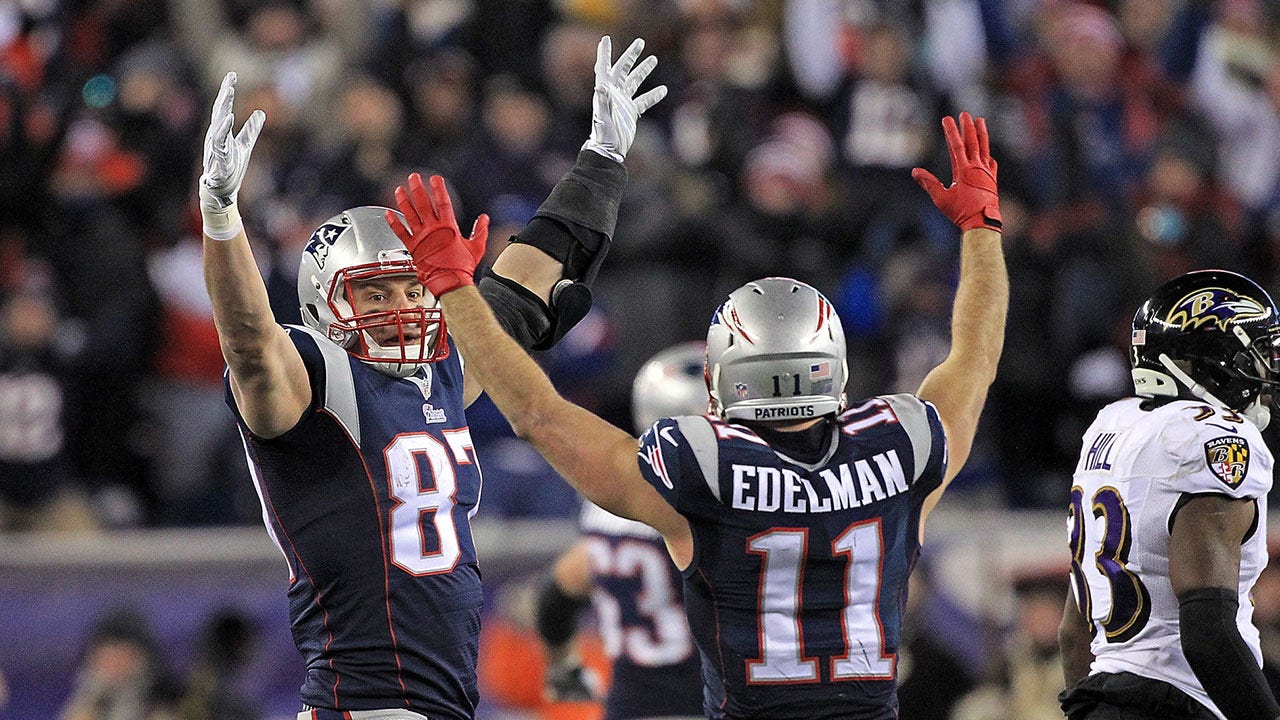
New England Patriots wide receiver Julian Edelman raises his hands in celebration with tight end Rob Gronkowski after throwing a touchdown pass to wide receiver Danny Amendola during the third quarter of the NFL divisional playoff football game at Gillette Stadium on Saturday, Jan. 10, 2015. (Matt Stone/MediaNews Group/Boston Herald via Getty Images)
But Gronkowski and one of his former teammates do not believe the 2025 Pats were any sort of fluke.
“What the New England Patriots did this season was incredible. And they’re just going to keep on building on that from here on and going into next year, I’m sure they’re going to be making the playoffs on a consistent basis now,” Gronk told Fox News Digital. “That’s the expectation. They got the quarterback, they got the coach, they got the ownership, they got the foundation now, and you’re going to see them competing at a high level every single year now, which is great for Patriot fans.”
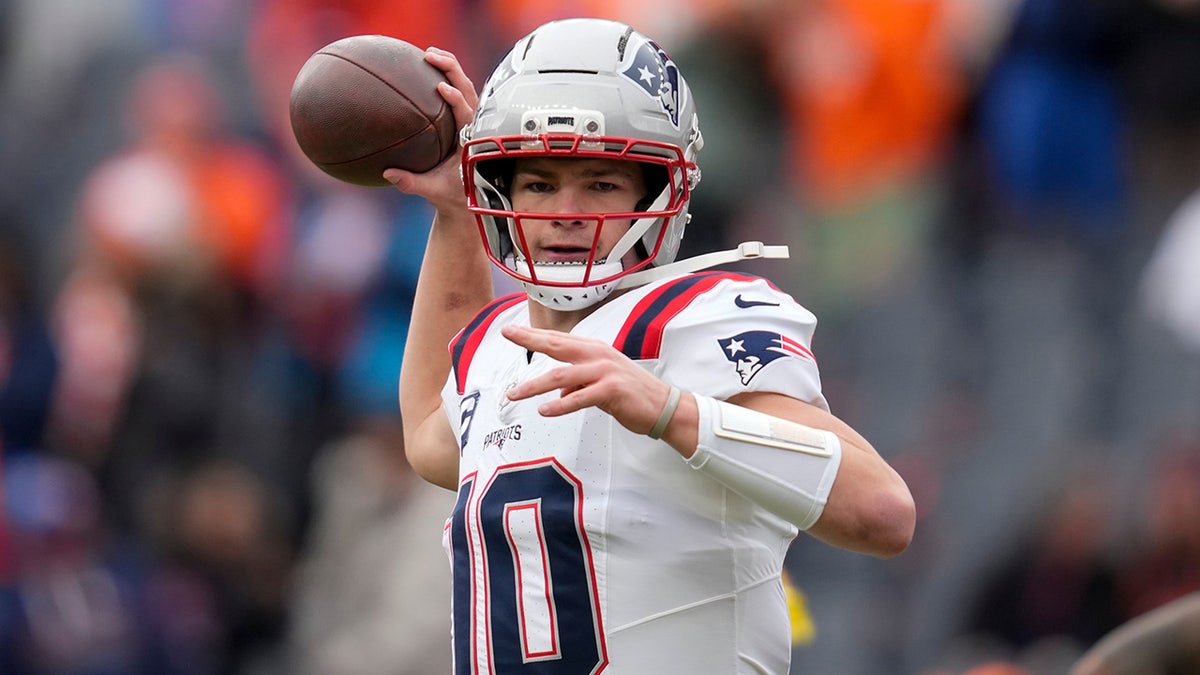
New England Patriots quarterback Drake Maye (10) warms up prior to the AFC Championship NFL football game against the Denver Broncos, Sunday, Jan. 25, 2026, in Denver. (AP Photo/Ashley Landis)
The Patriots have simply built the next generation of success, and Gronkowski sees the same in Infiniti and their newly-released QX65. Gronk and Julian Edelman were on hand at Grand Central Terminal in New York for the unveiling.
KYLIE KELCE REVEALS HER ‘DOS AND DON’TS’ OF TALKING TO POSTPARTUM WOMEN: ‘OH, I’M SO SERIOUS’
“I’ve always been about showing up at big moments and putting in the work behind the scenes, and that’s what stood out to me with the Infiniti. They’re really being intentional about how they move forward and what they’re building next. That’s how you got to be as a football player, as an athlete, you got to be very intentional and in order to stay at the top of your game and be able to compete at a top level. And that’s what Infiniti is doing.”
“I was fortunate enough in my career to play in a lot of big moments, and that’s exactly what you see with the Infiniti,” Edelman added. “How they are so detailed and have a purpose for everything that they do. When you look at the design of the car, the back, the interior’s spacious, very detailed. I mean, it’s just something that’s been so cool. It’s been a fun experience.”
Edelman, too, is “very confident” that the new-look Pats are here to stay.
“Anytime you got a head coach, a quarterback, an owner, and a GM working together and unison, it seems like every free agent they signed had a big moment, big role on the team. There was a lot of great things that happened.”
Edelman did warn Patriots fans to temper expectations just a bit and not expect another 14-win season. However, he does expect a more sound product on the field.
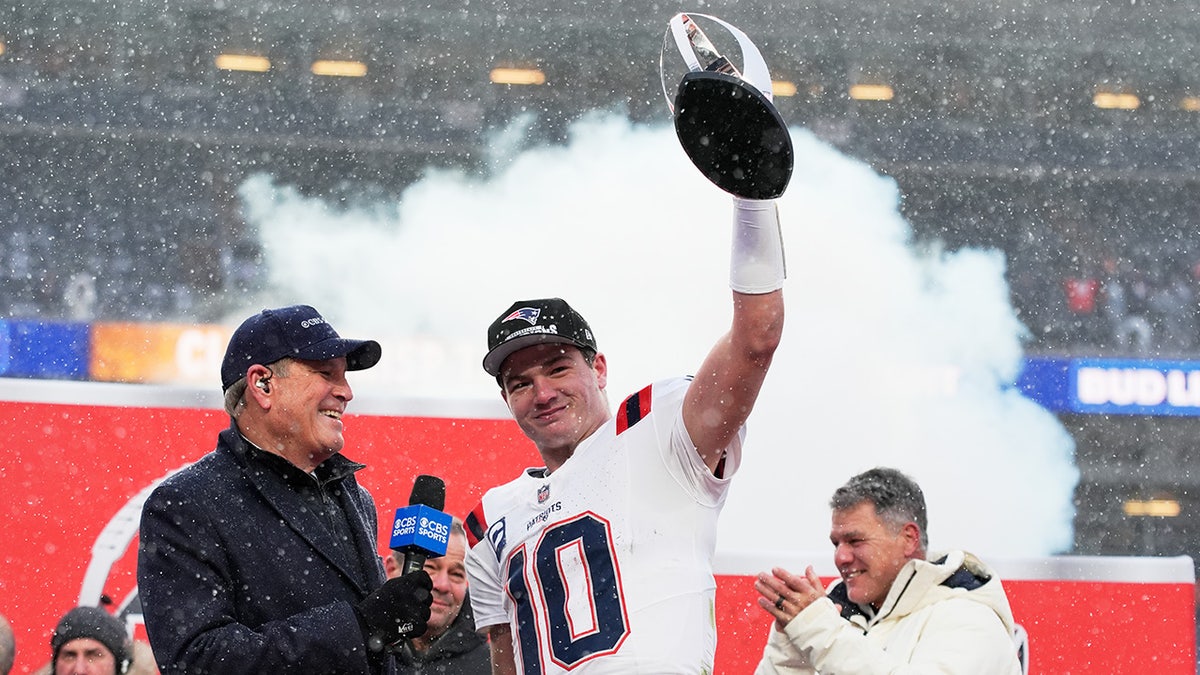
New England Patriots quarterback Drake Maye celebrates with the AFC championship trophy after the AFC championship game between the Denver Broncos and the New England Patriots in Denver, Colorado, on Jan. 25, 2026. (AP Photo/John Locher)
CLICK HERE TO GET THE FOX NEWS APP
“it’s time on task. You know, time on task with the quarterback. Get him ready with the offensive line, getting that offensive line kind of fixed up and get them working together more. I mean, they’re a young group. So I’m really excited for the Patriots this year,” he said.
“I think they’re for real. They may go out and not have as many wins, but I think they’re going to be a better football team this year.”
Follow Fox News Digital’s sports coverage on X, and subscribe to the Fox News Sports Huddle newsletter.
Sports
Alex Vesia, Dodgers pitcher who lost infant daughter, gets standing ovation after scoreless return to mound
NEWYou can now listen to Fox News articles!
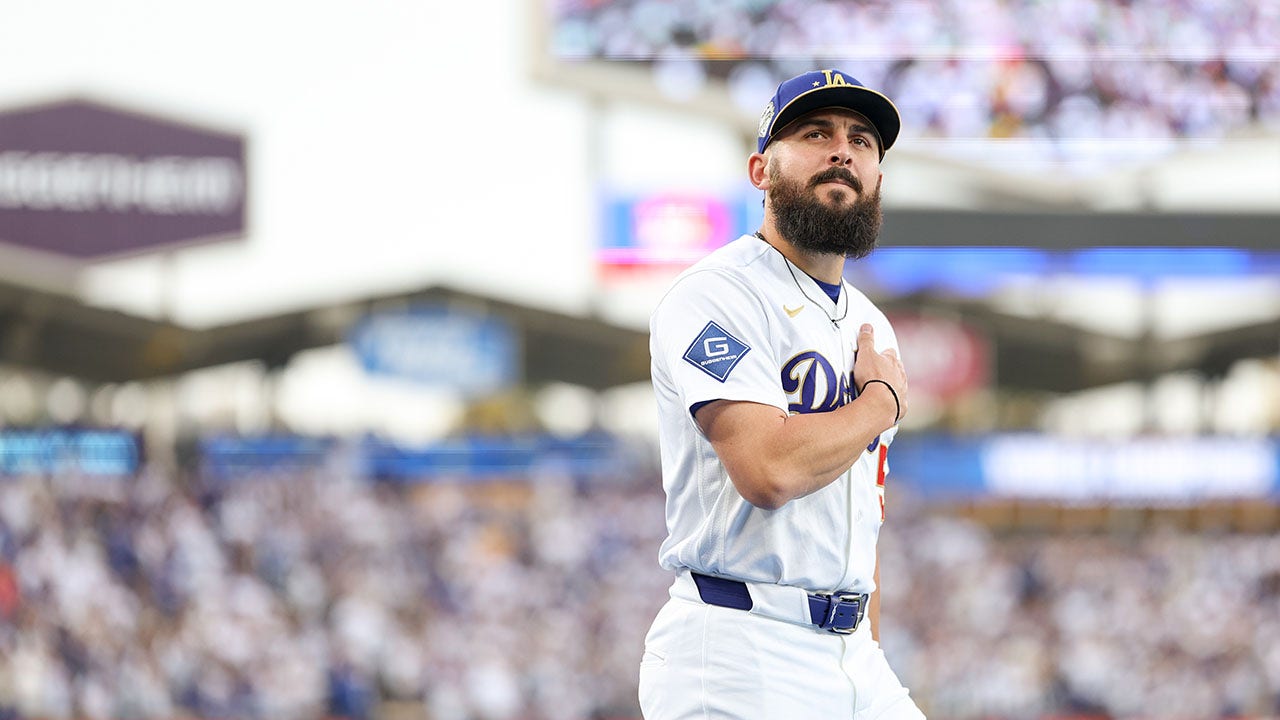
Perhaps for the first time in 2026, Alex Vesia felt some normalcy on Friday night.
The Los Angeles Dodgers pitcher made his return to the pitcher’s mound in his first Major League outing since his infant daughter died just five days after she was born.
Before the World Series, the left-hander left the team to deal with a “deeply personal matter” and did not pitch in the Fall Classic.
CLICK HERE FOR MORE SPORTS COVERAGE ON FOXNEWS.COM
Los Angeles Dodgers relief pitcher Alex Vesia celebrates after the seventh inning of a baseball game against the Arizona Diamondbacks, Friday, March 27, 2026, in Los Angeles. (AP Photo/Mark J. Terrill)
Days after the Dodgers won the World Series, he and his wife announced their infant daughter had died.
Vesia returned to the team during spring training and then entered the Dodgers’ game against the Arizona Diamondbacks in the seventh inning of a 4-4 tie.
It was quite the spot for Vesia to return, but given his 2.36 ERA over the last two seasons, it was no sweat. He left a runner stranded on second base and kept the D-Backs scoreless en route to the team’s 5-4 win over their division rival.
Vesia let out a yell and pointed toward the Dodgers’ family section while getting a standing ovation from the crowd.
Vesia was wearing a customized pink glove with his daughter’s name, Sterling Sol, stitched on it, along with her birthday and his wife’s first initial, K for Kayla, embroidered on the glove’s ring finger.
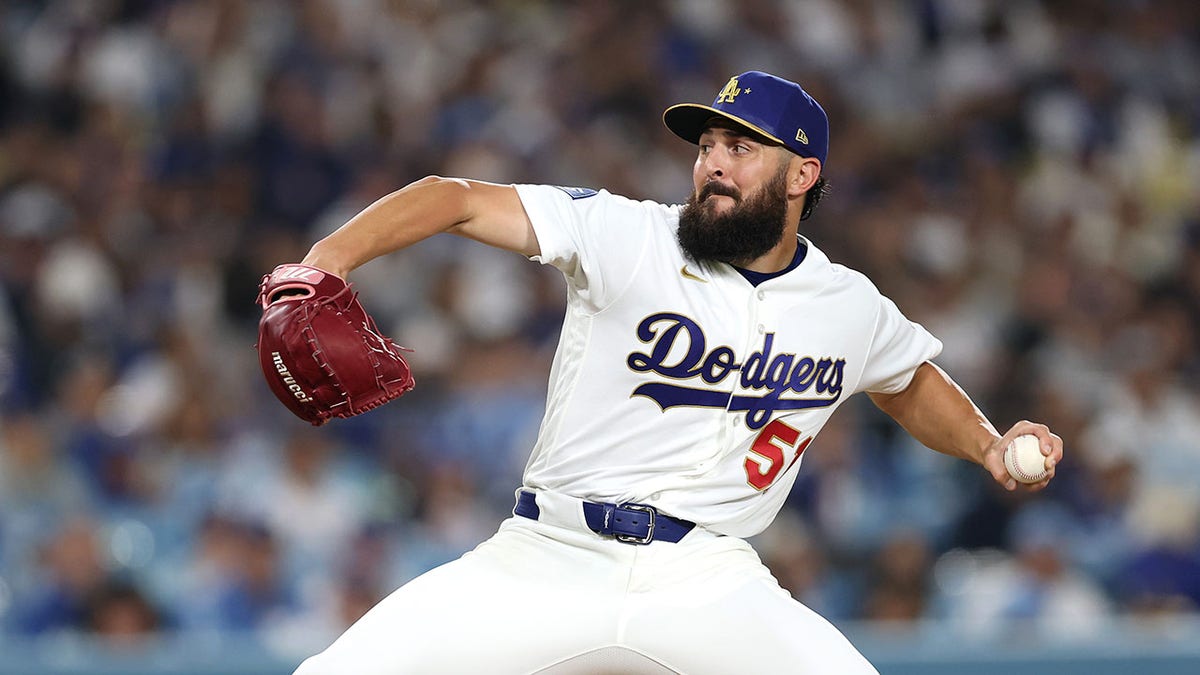
Alex Vesia of the Los Angeles Dodgers pitches against the Arizona Diamondbacks during the sixth inning at Dodger Stadium on March 27, 2026, in Los Angeles, California. (Luke Hales/Getty Images)
DODGERS PITCHER’S WIFE LIVES THROUGH ‘BITTER SWEET’ OPENING DAY MONTHS AFTER INFANT DAUGHTER’S DEATH
“What I would give to have my Sterling girl here, carrying her in my heart always,” Kayla said in an Instagram post earlier this week to celebrate a “bitter-sweet” opening day.
Sterling passed between Game 2 and Game 3 when the series was tied at one game apiece. During the Fall Classic, relievers from the Toronto Blue Jays wrote Vesia’s jersey number, 51, on their hats.
In his first news conference of the year in spring training, Vesia called his wife “the strongest person that I know” and “a support system for me every bit as much as I am for her.”
“Life can change in an instant. For us, 10 minutes is all it took,” Vesia said in February. “Sterling Sol was the most beautiful girl in the world. We got to hold her, change her diaper, read to her and love her. Our time together was far too short. Kay and I will keep those precious moments and memories to ourselves.
“Stepping away from the team, the brothers that I go to war with every day, was difficult, but it was also an easy decision because my family needed me. We still watched every pitch of the World Series, and for us in so many ways, that was a light in our darkness.
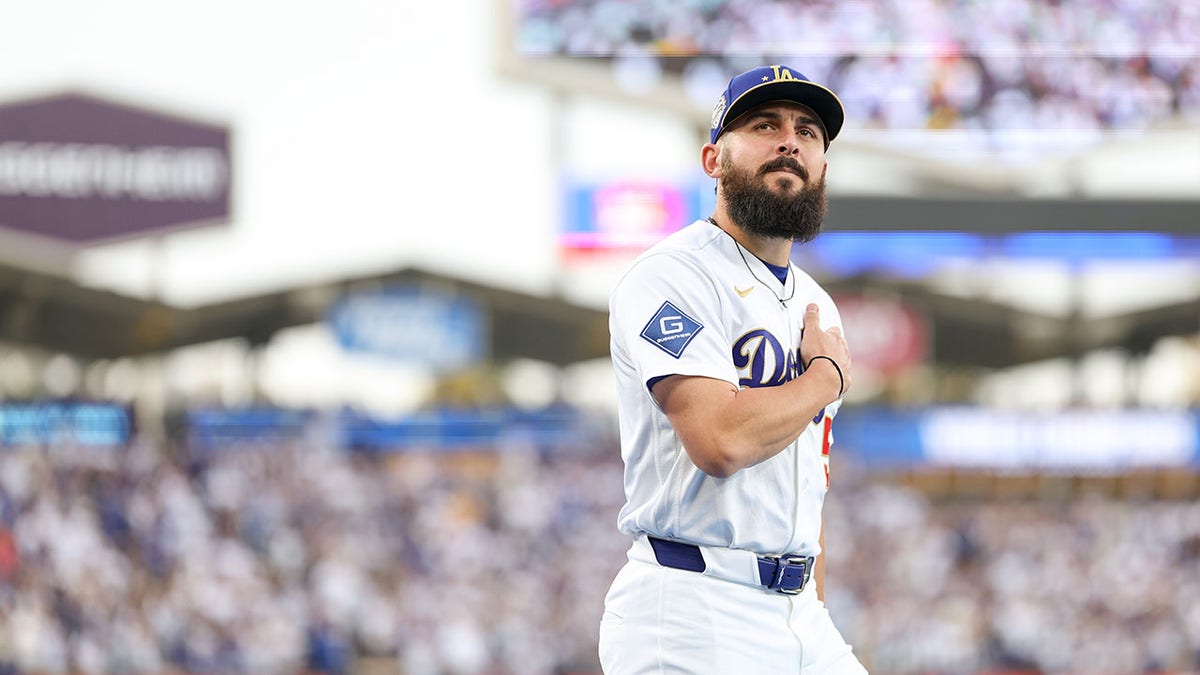
Alex Vesia of the Los Angeles Dodgers thanks the crowd during the 2025 Back-to-Back World Champions Ring Ceremony prior to the game between the Arizona Diamondbacks and the Los Angeles Dodgers at UNIQLO Field at Dodger Stadium on Friday, March 27, 2026, in Los Angeles, California. (Jessie Alcheh/MLB Photos via Getty Images)
CLICK HERE TO GET THE FOX NEWS APP
“I was not prepared to not bring my baby girl home, but we’re carrying her with us every day. It’s been hard, but we’re doing OK.”
The back-to-back reigning World Series champions are 2-0 to start the MLB season.
Follow Fox News Digital’s sports coverage on X, and subscribe to the Fox News Sports Huddle newsletter.
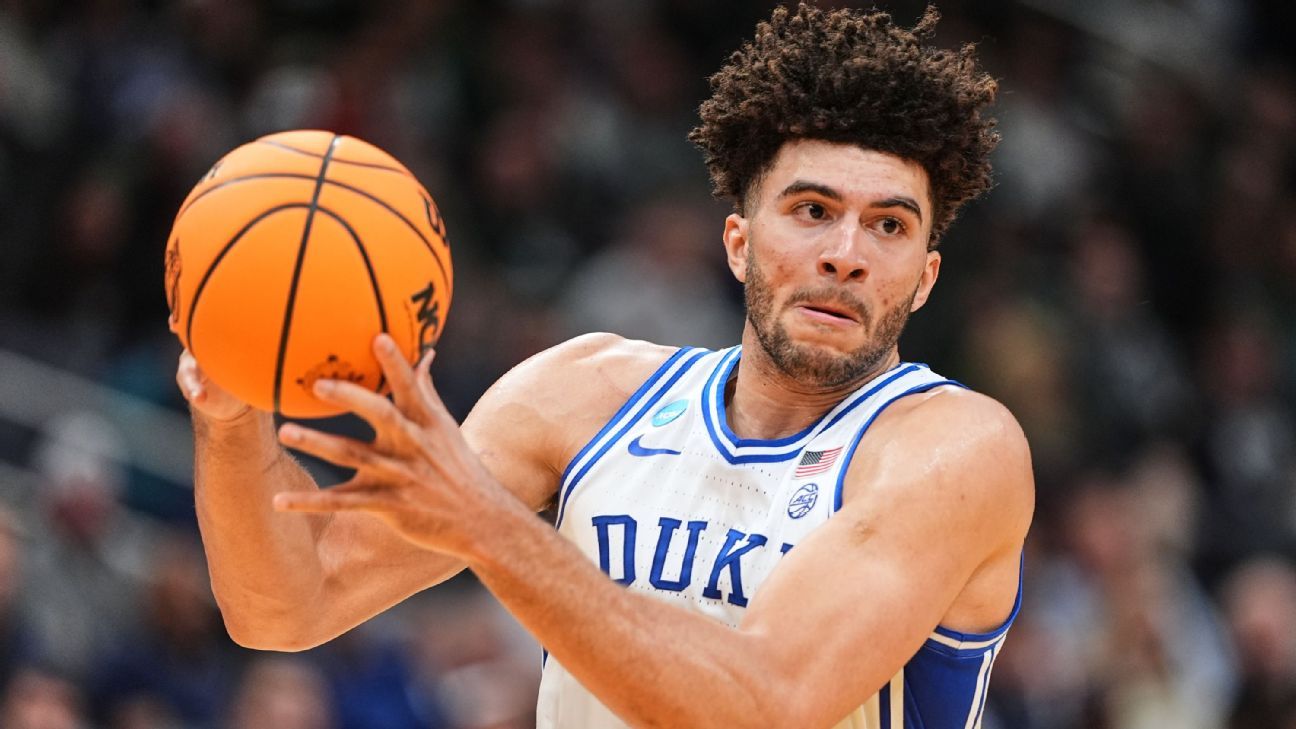
Five months into the 2025-26 season, only eight teams remain. Each team has a chance to go to Indianapolis to play in the Final Four, provided it wins one more game.
At the start of the campaign, many would have believed all of these programs had a chance to play in the penultimate weekend of the season — with the exception of 9-seed Iowa. But it might have been difficult to believe the way they all got here.
Duke played through major injuries to advance to the Elite Eight. Arizona is there without a singular star, but a team full of selfless standouts who can all lead the Wildcats in scoring on any night. Michigan has three players who are 6-foot-9 or taller in the starting rotation — a contrast to the small-ball era so many within the game have touted. Illinois is led by a freshman who was overlooked on the recruiting circuit and several European talents.
Then, there are those Hawkeyes — a team that was 3-7 in its last 10 games entering the NCAA tournament but has reached the Elite Eight for the first time in 39 years.
The truth is, however, that there’s a lot of chalk among the last eight teams. A ton of resilience, too. Let’s rank the squads in the Elite Eight.
All times Eastern
How the regional finals were set

1. Arizona Wildcats
Original seed: No. 1 (West)
Tournament results: Def. No. 16 Long Island 92-58 (first round); def. No. 9 Utah State 78-66 (round of 32); def. No. 4 Arkansas 109-88 (Sweet 16)
Arizona has been chasing greatness all season. The Wildcats not only handed John Calipari the worst NCAA tournament loss of his career in Thursday’s lopsided Sweet 16 win over Arkansas, but it was also the first time a team (Arizona) had 60 paint points and 30 free throws in a single NCAA tournament game since 2000, per ESPN Research. But that dominant effort against the SEC tournament champion is only new if you haven’t been watching college basketball. The Wildcats shot 50% from inside the arc in their season-opening win over Florida. They beat Alabama — one of the best offensive teams in America — by 21 points in December, with the Tide recording just 99 points per 100 possessions. There was a 23-point victory over Kansas in February and a 16-point triumph over Iowa State days later. The Wildcats have made a lot of statements to support the case that they’re the team to beat, the team that could be the last one standing because of its ability to play a complete game: Arizona is fourth in adjusted offensive efficiency and third in adjusted defensive efficiency. It’s also difficult for opponents to know who to target because of their depth. Veteran Jaden Bradley? Freshman star Brayden Burries? Freshman star Koa Peat — who, after a strong start to the season, faced a rough patch — is averaging 16.6 points through three NCAA tournament games.
Up next: vs. Purdue (Saturday, 8:49 p.m., TBS/truTV)

2. Michigan Wolverines
Original seed: No. 1 (Midwest)
Tournament results: Def. No. 16 Howard 101-80 (first round); def. No. 9 Saint Louis 95-72 (round of 32); def. No. 4 Alabama 90-77 (Sweet 16)
Three years ago, Dusty May didn’t want to leave Florida Atlantic because life was good in Boca Raton. He lived a few miles from campus and rode his bike to work every day. But the opportunity to lead a Big Ten powerhouse was too much to pass up, and he accepted the Michigan job in 2024. Even then, he didn’t leave it all behind. There’s a tie between the 2022-23 Owls, who made a run to the Final Four, and this year’s Wolverines, who are a win away from the school’s first run to the Final Four since 2018: interior defense. May’s FAU squad held opponents to a 46.6% clip in the paint, one of the top marks in America that season, per Synergy Sports. His Michigan team this season is clocking in at 48.9% in that metric. In Friday’s Sweet 16 win, it held Alabama — which entered the game ranked top three in offensive efficiency — to just 31 shots, 23 of which were 3-pointers. That’s a by-product of May’s suffocating interior defense, a staple of his best teams. And it’s proof the Wolverines aren’t just tough around the rim on defense; they make opponents think twice about trying to score in the post in the first place.
Up next: vs. Tennessee (Sunday, 2:15 p.m., CBS)

3. Illinois Fighting Illini
Original seed: No. 3 (South)
Tournament results: Def. No. 14 Penn 105-70 (first round); def. No. 11 VCU 76-55 (round of 32); def. No. 2 Houston 65-55 (Sweet 16)
Illinois proved with Thursday’s Sweet 16 win against Houston that it can reach a level on offense even the best defenses in America can’t stop. A 17-0 run early in the second half created separation between the two teams, with the Cougars spending the rest of the game trying to close the gap. David Mirkovic and Keaton Wagler became the first freshman teammates to record double-doubles in the NCAA tournament since freshmen became eligible for to play in the postseason in the 1972-73 season, per ESPN Research. But while Illinois’ offensive strength has been its most appealing quality, Brad Underwood’s team is a true national title contender because of its ability to stall opposing teams. Since the start of the Big Ten tournament, the Illini have been a top-25 defensive team nationally, per BartTorvik. They’re also eighth in the country in adjusted defensive efficiency and seventh in adjusted offensive efficiency since the start of the NCAA tournament. Those are important metrics to consider. Eight of the past 10 national champions were ranked top 11 in both categories. If balance is the ticket to a title, Illinois is in a good spot.
Up next: vs. Iowa (Saturday, 6:09 p.m., TBS/truTV)

4. Duke Blue Devils
Original seed: No. 1 overall (East)
Tournament results: Def. No. 16 Siena 71-65 (first round); def. No. 9 TCU 81-58 (round of 32); def. No. 5 St. John’s 80-75 (Sweet 16)
The close call against St. John’s wasn’t anything the Blue Devils hadn’t experienced: Remember the clutch effort late in a one-point win over Florida? Being tied with Michigan State near the two-minute mark not long after that? They had two tougher than expected games against Florida State in the regular season and in the ACC tournament. There was the battle with Michigan in Washington, D.C, too. Free throws sealed a win over Virginia in the ACC tournament title game. A first-round tussle with 16-seed Siena and a slow start against TCU in the second. The one constant through all of these tough games has been Cameron Boozer. He dominated at the high school, AAU and now the collegiate level. He provides his team with confidence in the most desperate situations and has the Blue Devils equipped to get through tough times — even if it’s someone else stepping up. Against the St. John’s in Friday’s Sweet 16 game, Caleb Foster somehow thrived (11 points on 5-for-7 shooting after halftime), despite having suffered a broken foot 20 days ago. Isaiah Evans (25 points) was brilliant. Maliq Brown (four blocks) did more to disrupt this game defensively than he’ll get credit for. And Cameron Boozer (22 points, 10 rebounds, three assists) was just Cameron Boozer. Nobody gets afraid on this team when adversity hits.
Up next: vs. UConn (Sunday, 5:05 p.m., CBS)

5. Purdue Boilermakers
Original seed: No. 2 (West)
Tournament results: Def. No. 15 Queens University 104-71 (first round); def. No. 7 Miami 79-69 (round of 32); def. No. 11 Texas 79-77 (Sweet 16)
Few coaches in college basketball have suffered the amount of basketball heartbreak as Matt Painter. In 2009-10, star Robbie Hummel suffered a season-ending injury late in the season that cost the Boilermakers a chance to compete for a national title. In 2019, former Purdue star Carsen Edwards scored 42 points and still couldn’t beat eventual champion Virginia in overtime. Painter once again reached the national title game in 2024 with Wooden Award winner Zach Edey — but ran into the bulldozer known as UConn on its way to its second straight national title. None of those Purdue squads, however, were as hot as this current crew. During the Boilermakers’ seven-game winning streak, Braden Smith is averaging 9.5 assists and Trey Kaufman-Renn looks like an All-American again while averaging 17.8 points. The group is second in adjusted offensive efficiency (60% from inside the arc, 38% from the 3-point line) during this stretch. And now Painter will have another shot at getting over the hump.
Up next: vs. Arizona (Saturday, 8:49 p.m., TBS/truTV)

6. UConn Huskies
Original seed: No. 2 (East)
Tournament results: Def. No. 15 Furman 82-71 (first round); def. No. 7 UCLA 73-57 (round of 32); def. No. 3 Michigan State 67-63 (Sweet 16)
Men’s college basketball has had a multitude of legendary coaches over the 60-plus years since John Wooden led UCLA in the 1960s and ’70s. Mike Krzyzewski won five national titles. Roy Williams retired with three. Rick Pitino has two rings with two different teams. Bill Self and Billy Donovan have a pair of championships. Hurley has a real chance to win his third national championship in four years, which would be an unprecedented feat in the modern history of the sport and a greater challenge than anything Wooden ever faced during his time. Because Hurley’s chasing this third title with a third different roster. The team that held off Michigan State on Friday night in the Sweet 16 does not resemble the teams he had in 2023 or 2024. Alex Karaban is the only holdover from those back-to-back title teams. There’s still a significant similarity between all three groups: They were all better when they played a free-flowing style, executed great defense and pushed the pace. It’s how the 2026 Huskies achieved an early double-digit lead over the Spartans and overcame a sloppy stretch in the second half. They also proved that, even with their recent lack of efficiency (they entered Friday ranked 74th in adjusted offensive efficiency since March 1), they can outlast and attack any opponent to advance.
Up next: vs. Duke (Sunday, 5:05 p.m., CBS)

7. Tennessee Volunteers
Original seed: No. 6 (Midwest)
Tournament results: Def. No. 11 Miami (Ohio) 78-56 (first round); def. No. 3 Virginia 79-72 (round of 32); def. No. 2 Iowa State 76-62 (Sweet 16)
It’s no secret that Texas decided Rick Barnes hadn’t kept up with the times and that the game had left him behind when the school fired him in 2015. His dismissal came after a string of first-weekend exits and a seven-year gap between his Elite Eight appearances. But when he accepted the Tennessee job that same year, Barnes — who has been a head coach since 1987 — didn’t change his philosophy. He has always believed smart shots, suffocating defense at every spot on the floor and a bruising approach to rebounding were the keys to victory and long-term success. He has coupled that attitude with a recognition that playmakers win games at the highest level. He found Dalton Knecht and Chaz Lanier in the transfer portal in back-to-back years. This year, his Vols are the top offensive rebounding team in America. Nate Ament is a projected lottery pick. Maryland transfer Ja’Kobi Gillespie has been Barnes’ most reliable addition. The formula has resulted in Tennessee’s third consecutive Elite Eight appearance.
Up next: vs. Michigan (Sunday, 2:15 p.m., CBS)

8. Iowa Hawkeyes
Original seed: No. 9 (South)
Tournament results: Def. No. 8 Clemson 67-61 (first round); def. No. 1 Florida 73-72 (round of 32); def. No. 4 Nebraska 77-71 (Sweet 16)
The 3-point line was introduced in Division I men’s basketball in the 1986-87 season by the NCAA’s rules committee. It was a wild idea at the time, from Ed Steitz, a member of the committee, whose research suggested it could revolutionize the game. That season, the Hawkeyes attempted 382 3-pointers — and made 39% of them. They went 5 for 11 from beyond the arc in their 93-91 Sweet 16 victory against Oklahoma that season. They’re now back in the Elite Eight for the first time in 39 years because they rediscovered the power of the 3. Ben McCollum’s group has already taken 818 shots from beyond the arc this season. Since March 11, nearly 50% of its field goal attempts have been 3s. It has made 37.4%, a top-40 mark nationally. Yes, the Sweet 16 win over Nebraska on Thursday was the result of the Hawkeyes’ resilience and second-half defense. But really, the only way they stayed close in the game was because of those 3s (13-for-30, 43%) — the same way the last Iowa team won this round.
Up next: vs. Illinois (Saturday, 6:09 p.m., TBS/truTV)


Patriots’ Super Bowl appearance was no fluke, team legends say: ‘They’re for real’

Middle East crisis: Jubilant FoodWorks reports some Domino’s outlets affected by LPG shortage – The Times of India

Alex Vesia, Dodgers pitcher who lost infant daughter, gets standing ovation after scoreless return to mound

-
 Business1 week ago
Flipkart group CFO to leave co amid IPO plans – The Times of India
-

 Fashion1 week ago
China’s textile & apparel exports surge 17% to $50 bn in Jan-Feb 2026
-

 Sports1 week ago
Rating Adidas’ 2026 World Cup away shirts: Argentina, Spain, Mexico and more
-

 Sports1 week ago
American Conference Commissioner Tim Pernetti thanks Trump for Army-Navy game executive order
-
Tech1 week ago
The Corsair 4000D RS PC Case Keeps Your System Cool
-

 Tech1 week ago
Gamers Hate Nvidia’s DLSS 5. Developers Aren’t Crazy About It, Either
-

 Tech1 week ago
‘Uncanny Valley’: Nvidia’s ‘Super Bowl of AI,’ Tesla Disappoints, and Meta’s VR Metaverse ‘Shutdown’
-
 Business4 days ago
Property Play: Home flippers see smallest profits since the Great Recession, real estate data firm says