

Tech
Cracks in flexible electronics run deeper than expected: Study points to potential fix

From health monitors and smartwatches to foldable phones and portable solar panels, demand for flexible electronics is growing rapidly. But the durability of those devices—their ability to stand up to thousands of folds, flexes and rolls—is a significant concern.
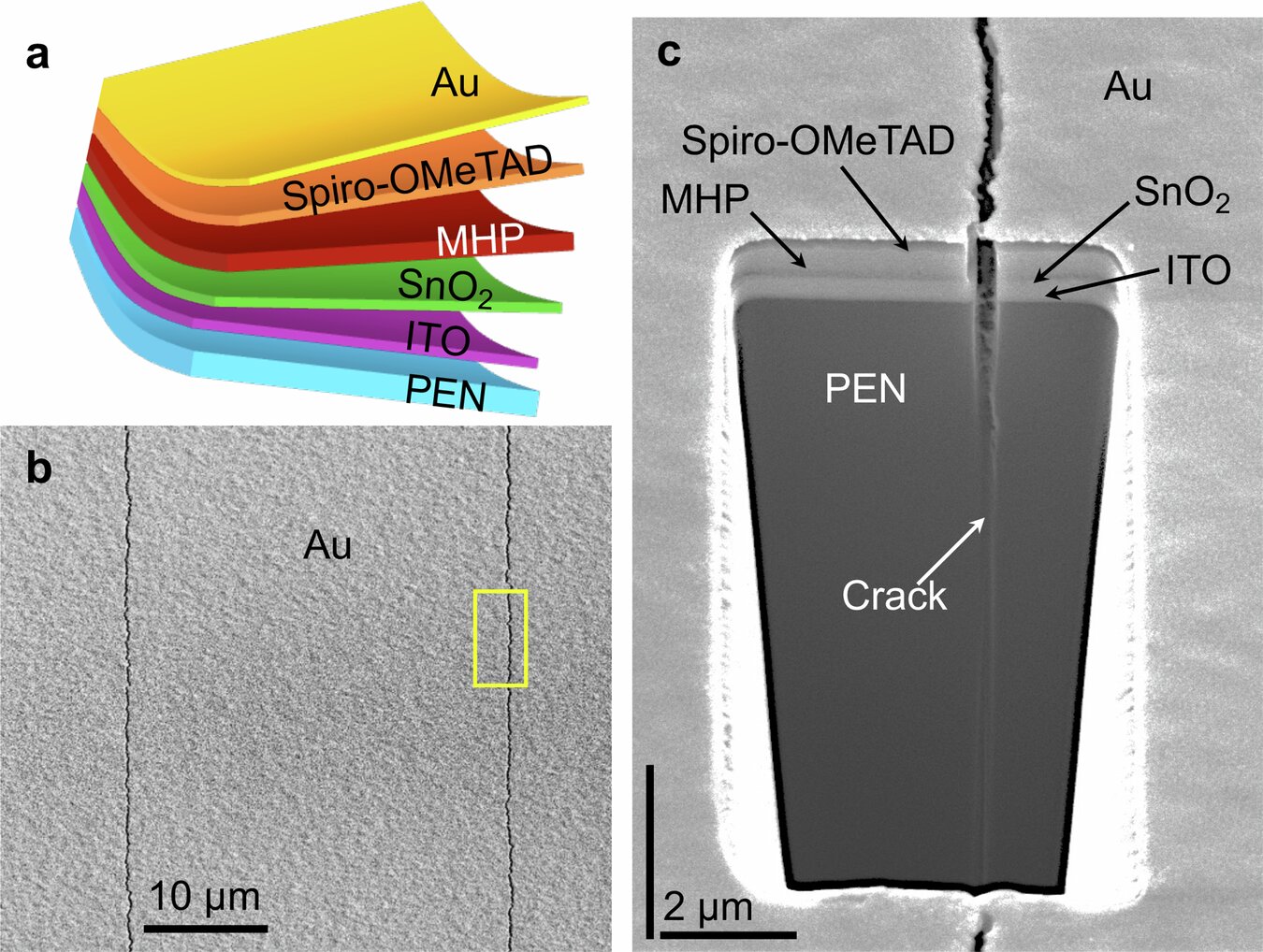
New research by engineers from Brown University has revealed surprising details about how cracks form in multilayer flexible electronic devices. The team shows that small cracks in a device’s fragile electrode layer can drive deeper, more destructive cracks into the tougher polymer substrate layer on which the electrodes sit. The work overturns a long-held assumption that polymer substrates usually resist cracking.
“The substrate in flexible electronic devices is a bit like the foundation in your house,” said Nitin Padture, a professor of engineering at Brown and corresponding author of the study published in npj Flexible Electronics. “If it’s cracked, it compromises the mechanical integrity of the entire device. This is the first clear evidence of cracking in a device substrate caused by a brittle film on top of it.”
The layers used in flexible electronics have specific jobs. The top layer conducts electricity across the surface to keep the device running. That layer is usually made of special ceramic oxide materials because they are transparent and also good conductors, which is essential for things like display screens, sensors and solar cells. But ceramics are brittle and prone to cracking, so the substrate’s job is to add some toughness. Substrates are generally made from polymer materials that are highly flexible and resist cracking.
While using these materials to make flexible solar cells, Anush Ranka, a postdoctoral researcher at Brown who performed the work as a Ph.D. student in materials science, became increasingly curious about the mechanism by which fatigue can degrade performance. He decided to take a closer look at the cracking processes.
For the study, Ranka made small experimental devices using various types of ceramic electrodes and polymer substrates. He then subjected them to bending tests and used a powerful electron microscope to examine the cracks. In places where he found cracks in the ceramic layer, he used a focused ion beam—a kind of nanoscale sandblaster—to etch away the ceramic and reveal the substrate directly beneath a ceramic crack.
The work showed that cracks in the ceramic layer often drive deeper cracks into the substrate. The effect occurred across ceramic and polymer combinations, suggesting this is a common—and surprising—failure mechanism in flexible electronics.
Once cracks form deep in the polymer, the researchers say, they become permanent structural defects. With repeated bending, these cracks widen, misalign or fill with debris, which then prevents the ceramic crack faces from reconnecting. That causes electrical resistance to increase and device performance to degrade.

Working with Haneesh Kesari, a Brown engineering professor who specializes in theoretical and applied mechanics, and solid mechanics Ph.D. student Sayaka Kochiyama, the researchers analyzed this cracking problem. They showed that a mismatch in the elastic properties of the two layers was driving the deep cracking phenomenon in the substrate. Understanding the cracking mechanism led the team toward a potential fix: Adding a third layer of material between the ceramic and the substrate that mitigates the elastic mismatch.
“We created a design map that identified hundreds of polymers that—with the correct thickness—could potentially mitigate this elastic mismatch and prevent cracking in a wide range of electrode-substrate combinations,” said Padture, who leads Brown’s Initiative for Sustainable Energy. “Using this design map, we were able to choose a specific polymer for the third layer and experimentally demonstrate the feasibility of our approach.”
The researchers are hopeful that the design diagram will make for more durable devices. Just as important, however, is the discovery that cracks do indeed affect polymer substrates—a fact that was not apparent before this research.
“We’re essentially solving a problem people didn’t know they had,” Padture said. “We think this could significantly improve the cyclic life of flexible devices.”
More information:
Anush Ranka et al, Cracking in polymer substrates for flexible electronic devices and its mitigation, npj Flexible Electronics (2025). DOI: 10.1038/s41528-025-00470-z
Citation:
Cracks in flexible electronics run deeper than expected: Study points to potential fix (2025, September 9)
retrieved 9 September 2025
from https://techxplore.com/news/2025-09-flexible-electronics-deeper-potential.html
This document is subject to copyright. Apart from any fair dealing for the purpose of private study or research, no
part may be reproduced without the written permission. The content is provided for information purposes only.










Forgive me for starting with a cliché, a piece of finance jargon that has recently slipped into the tech lexicon, but I’m afraid I must talk about “moats.” Popularized decades ago by Warren Buffett to refer to a company’s competitive advantage, the word found its way into Silicon Valley pitch decks when a memo purportedly leaked from Google, titled “We Have No Moat, and Neither Does OpenAI,” fretted that open-source AI would pillage Big Tech’s castle.
A few years on, the castle walls remain safe. Apart from a brief bout of panic when DeepSeek first appeared, open-source AI models have not vastly outperformed proprietary models. Still, none of the frontier labs—OpenAI, Anthropic, Google—has a moat to speak of.
The company that does have a moat is Nvidia. CEO Jensen Huang has called it his most precious “treasure.” It is not, as you might assume for a chip company, a piece of hardware. It’s something called CUDA. What sounds like a chemical compound banned by the FDA may be the one true moat in AI.
CUDA technically stands for Compute Unified Device Architecture, but much like laser or scuba, no one bothers to expand the acronym; we just say “KOO-duh.” So what is this all-important treasure good for? If forced to give a one-word answer: parallelization.
Here’s a simple example. Let’s say we task a machine with filling out a 9×9 multiplication table. Using a computer with a single core, all 81 operations are executed dutifully one by one. But a GPU with nine cores can assign tasks so that each core takes a different column—one from 1×1 to 1×9, another from 2×1 to 2×9, and so on—for a ninefold speed gain. Modern GPUs can be even cleverer. For example, if programmed to recognize commutativity—7×9 = 9×7—they can avoid duplicate work, reducing 81 operations to 45, nearly halving the workload. When a single training run costs a hundred million dollars, every optimization counts.
Nvidia’s GPUs were originally built to render graphics for video games. In the early 2000s, a Stanford PhD student named Ian Buck, who first got into GPUs as a gamer, realized their architecture could be repurposed for general high-performance computing. He created a programming language called Brook, was hired by Nvidia, and, with John Nickolls, led the development of CUDA. If AI ushers in the age of a permanent white-collar underclass and autonomous weapons, just know that it would all be because someone somewhere playing Doom thought a demon’s scrotum should jiggle at 60 frames per second.
CUDA is not a programming language in itself but a “platform.” I use that weasel word because, not unlike how The New York Times is a newspaper that’s also a gaming company, CUDA has, over the years, become a nested bundle of software libraries for AI. Each function shaves nanoseconds off single mathematical operations—added up, they make GPUs, in industry parlance, go brrr.
A modern graphics card is not just a circuit board crammed with chips and memory and fans. It’s an elaborate confection of cache hierarchies and specialized units called “tensor cores” and “streaming multiprocessors.” In that sense, what chip companies sell is like a professional kitchen, and more cores are akin to more grilling stations. But even a kitchen with 30 grilling stations won’t run any faster without a capable head chef deftly assigning tasks—as CUDA does for GPU cores.
To extend the metaphor, hand-tuned CUDA libraries optimized for one matrix operation are the equivalent of kitchen tools designed for a single job and nothing more—a cherry pitter, a shrimp deveiner—which are indulgences for home cooks but not if you have 10,000 shrimp guts to yank out. Which brings us back to DeepSeek. Its engineers went below this already deep layer of abstraction to work directly in PTX, a kind of assembly language for Nvidia GPUs. Let’s say the task is peeling garlic. An unoptimized GPU would go: “Peel the skin with your fingernails.” CUDA can instruct: “Smash the clove with the flat of a knife.” PTX lets you dictate every sub-instruction: “Lift the blade 2.35 inches above the cutting board, make it parallel to the clove’s equator, and strike downward with your palm at a force of 36.2 newtons.”

After three people died on a cruise ship struck by a hantavirus, authorities are actively tracking down 29 people who had left the ship. They’re trying to trace the spread of the virus. It’s a long, arduous, global process to find and notify people who might be at risk of infection.
Hey, wasn’t there supposed to be an app for that?
Contact-tracing apps were a global effort starting in 2020 during the Covid-19 pandemic. Enabled by phone companies like Apple and Google, contact tracing was designed to use Bluetooth connections to detect when people had come in contact with someone who had or would later test positive for Covid and report as much. It didn’t do much to solve the spread of the pandemic, but tracking the virus became more effective at least. The same process wouldn’t go well for the hantavirus problem.
“There is no use of apps for this hantavirus outbreak,” Emily Gurley, an epidemiologist at Johns Hopkins University, wrote in an email response to WIRED. “The number of cases are small, and it’s important to trace all contacts exactly to stop transmission.”
On a smaller scale of infection like this, officials have to start at the source (an infected individual), then go person-by-person, confirming where they went and who they might have come into contact with. Data collected by apps from a broad swath of devices would not be anywhere close to accurate enough to give a good idea of where the virus might have hitchhiked to next.
Contact tracing on a wider scale, like, say, a global pandemic, is less about tracking the individual infections and more about understanding what parts of the population might be affected, giving people the opportunity to self-quarantine after exposure. But that depends on how people choose to respond, and how the technology is utilized by public emergency systems. During the Covid pandemic, contact-tracing via apps tended to work better in more carefully managed European countries, but did not slow the spread in the US.
Making devices accessible to that kind of proximity information has also brought all sorts of concerns about privacy, given that the technology would require always-on access to work properly. Contact tracing also struggled to maintain accuracy, and in some cases could be providing false negatives or positives that don’t help further real information about the spread of the virus.
Especially in the case of something like the Hantavirus, where every person on that cruise ship can theoretically be directly tracked and contacted, it’s better to do that process the hard way.
“During small but highly fatal outbreaks, more precision is required,” Gurley wrote.

There’s another type of digital scam to be aware of, as per the BBC. It’s called “reservation hijacking.”
The name gives you a clue as to how it works. Essentially, scammers use details about a booking you’ve placed (perhaps with a hotel or airline) to trick you into sending money somewhere you shouldn’t.
While this type of scam isn’t brand new, a recent data breach at Booking.com has raised the risk of people being caught out. With data about you and your reservation, a far more convincing setup can be put in place—why wouldn’t you believe that someone purporting to be an employee from a spa you’ve got a reservation with is telling the truth about who they are, especially if they know the dates of your trip, your phone number, and your email address?
According to Booking.com, no financial information was exposed in the April 2026 hack. However, names, email addresses, phone numbers, and booking details have been leaked. The travel portal says affected customers have been emailed about the heightened risk of scams, so that’s the first thing to check for when it comes to staying safe.
Minimizing the risk of getting scammed by a reservation hijack involves many of the same security precautions you may already be following, and just being aware that this is a way you might be targeted will make a difference.
How Reservation Hijacks Work
We’ve already outlined the basics of a reservation hijack, but it can take several forms. As with other types of scams, it tends to evolve over time. The basic premise is that someone will get in touch with you claiming to be from a place you have a reservation with, whether it’s a car rental company or a hotel.
The scammers will try to pull together as much information as they can on you and your booking. Sometimes they’ll target employees of the place you’ve got the reservation with in order to get access to their systems, and other times they may take advantage of a wider data breach (as with the recent Booking.com hack).
They might also get information through other means. Maybe they’ve somehow got access to your email, or to some of your social media posts (where you’ve shared your next vacation destination and a countdown of how many days are left to go). Don’t be caught out if you find yourself speaking to someone who knows a lot about your travel plans.


India’s Raymond Lifestyle’s FY26 income tops $743 mn for 1st time

CUDA Proves Nvidia Is a Software Company

German firm E.On to buy rival Ovo to create one of Britain’s largest suppliers

-

 Politics1 week ago
Iran weighs US reply delivered via Pakistan as Trump signals opposition to deal terms
-

 Fashion1 week ago
US cotton export sales show strong recovery, Upland rise 36%
-

 Sports1 week ago
Sajid Ali Sadpara summits world’s fifth-highest peak
-

 Tech7 days ago
DHS Demanded Google Surrender Data on Canadian’s Activity, Location Over Anti-ICE Posts
-
 Business1 week ago
Heineken to invest £44.5m in hundreds of pubs creating 850 jobs
-
 Business1 week ago
Government notifies FDI changes on China funds – The Times of India
-
 Business1 week ago
UK airlines to be allowed to cancel flights in advance over fuel shortages
-

 Fashion1 week ago
Middle East conflict clouds India’s FY27 GDP forecast of 7-7.4%: Govt