

Business
European carriers pause some shipments to U.S. as they prepare for end of ‘de minimis’ exemption


An aerial view of a cargo ship being loaded with shipping containers at the Port of Baltimore in Baltimore, Maryland, on August 7, 2025.
Jim Watson | Afp | Getty Images
Postal carriers across Europe are planning to suspend some shipments to the U.S. as the nations prepare for the end of a longstanding trade rule.
Certain shipments from Germany, Spain, France, Belgium, Sweden, Denmark, Finland, Norway and Switzerland are due to be paused in the coming days and weeks after President Donald Trump signed an executive order ending the century-old “de minimis” exemption.
The trade policy, sometimes referred to as a “loophole,” has allowed shipments valued under $800 to enter the U.S. virtually duty-free. The practice is set to end for imports from around the globe on Friday following Trump’s executive order.
The de minimis exemption for goods coming from China and Hong Kong, which have long accounted for the bulk of those shipments, ended in May.
The suspensions will impact shipments valued under $800, and largely exclude gifts and letters. Most of the countries said they have to pause shipments because their systems weren’t built for the new requirements and they’re unsure how to properly process the shipments under the new rules.
In a Friday statement, German-based international shipping company DHL said Deutsche Post and DHL Parcel Germany will no longer be able to accept and transport parcels destined for the U.S. It said “key questions remain unresolved, particularly regarding how and by whom customs duties will be collected in the future, what additional data will be required, and how the data transmission to the U.S. Customs and Border Protection will be carried out.”
Customers will still be able to ship goods via DHL Express, which is more expensive.
National post offices in Spain, France and Belgium issued similar notices.
In a news release, Spain’s national post office Correos said it learned of the detailed requirements necessary to comply with the executive order on Aug. 15 and hasn’t had enough time to change its systems.
“This situation forces Correos, along with all postal operators that manage shipments destined for the United States, to substantially modify their processes and increase shipment controls to implement the new customs requirements, significantly impacting international postal logistics and e-commerce flows,” Correos said, adding the suspension took effect on Monday.
It said it is working to resume the shipments “as quickly as possible.”
Belgium’s post office said it was suspending shipments beginning on Saturday while France’s La Poste said shipments would be suspended beginning on Monday.
Meanwhile, Finland’s post office Posti stopped accepting goods bound for the U.S. on Saturday but later added it could no longer accept gifts or letters either because “several airlines have now refused to transport any postal items to the United States.”
The carriers said they expect the suspensions to be temporary. The pauses could delay some shipments, but are not expected to affect most international commerce.
Larger retailers, both domestic and international, don’t tend to use the de minimis exemption that often because they ship their goods via containers to U.S. warehouses and pay tariffs on the goods. Two major exceptions are Temu and Shein, which popularized the use of de minimis and relied on it for the bulk of their shipments to U.S. consumers. Since de minimis ended for goods shipped from China, demand has fallen for Shein and Temu as prices have risen.
The suspended shipments are expected to impact smaller orders from Americans who are shopping from smaller European businesses directly.



Experts say Mythos potentially has an unprecedented ability to identify and exploit cybersecurity weaknesses.
Source link
Business
Anthropic’s new AI model exposes fresh risks, flaws for cybersecurity, IT services – The Times of India
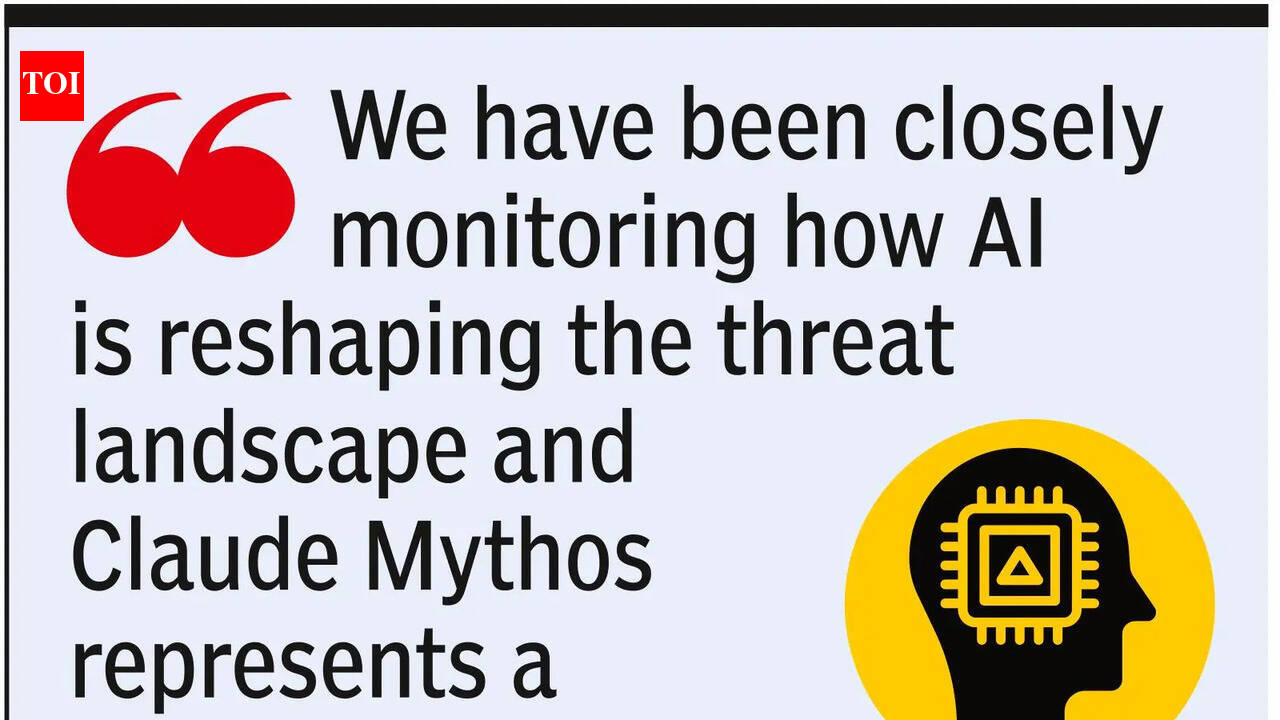
New Delhi: A powerful new AI model is forcing govts, banks, and technology firms to rethink the rules of cybersecurity – and in India, the stakes may be even higher.Claude Mythos, developed by Anthropic, has demonstrated the ability to autonomously detect and exploit software vulnerabilities, including flaws that have persisted for decades. Early tests revealed that the model could identify long-standing weaknesses and simulate complex, multi-step cyberattacks, prompting the company to restrict its wider release. Anthropic CEO Dario Amodei highlighted the shift, noting that AI systems are now capable of finding vulnerabilities “that humans have missed”, a signal of how quickly the cybersecurity landscape is changing.US Treasury Secretary Scott Bessent reportedly convened a meeting with top bank executives – including leaders from JPMorgan Chase, Goldman Sachs, Citigroup, BoA, and Morgan Stanley – to assess the risks posed by such advanced AI systems.That concern is not theoretical. According to Jaydeep Singh, GM for India at Kaspersky, the emergence of such systems represents a turning point not just for security professionals, but for everyday users. “We have been closely monitoring how AI is reshaping the threat landscape, and Claude Mythos represents a moment that every user, not just the cybersecurity industry, needs to understand,” Singh said.The dual-use nature of AI is at the heart of the concern. The same capability that strengthens defences can just as easily be weaponised. “The same capability that finds a 27-year-old vulnerability in hardened infrastructure is the capability that, in the wrong hands, turns every unpatched system into an open door,” Singh added.Cybersecurity firm Check Point Software Technologies echoed the warning. Sundar Balasubramanian, MD, India and South Asia, for Check Point, says, AI is “dramatically lowering the barrier to entry for cyber attackers,” enabling even less-skilled actors to identify and exploit vulnerabilities. He added that defensive tools can be repurposed offensively, compressing the traditional gap between attackers and defenders. Jayant Saran, partner, Deloitte India, described this as a “changed reality,” where organisations must prepare for risks that were previously invisible. He called AI a “double-edged sword…that cannot be reversed,” highlighting an accelerating race between those securing systems and those attempting to break them.In India, the risks are amplified by scale. From UPI to banking and govt platforms, millions depend on digital infrastructure – much of it built on legacy systems. These systems are often slower to patch, harder to monitor, and lack continuous threat intelligence, creating what Saran called an “asymmetric risk exposure.” Singh pointed out that this gap is especially critical in India, where legacy infrastructure serves hundreds of millions.Beyond cybersecurity, ripple effects could reach financial markets. Analysts say models like Mythos could automate parts of software development, testing, and security – core functions of IT services industry. While disruption may be gradual, labour-intensive outsourcing models could face pressure, while firms embracing AI may benefit.

Firms say digital twins make staff more productive, but are they a potential legal minefield?
Source link


Italy’s apparel export-import plunge after positive trend in 2025
Finance ministers and top bankers raise serious concerns about Mythos AI model
Anthropic’s new AI model exposes fresh risks, flaws for cybersecurity, IT services – The Times of India

-

 Entertainment1 week ago
Queen Elizabeth II emotional message for Archie, Lilibet sparks speculation
-

 Tech1 week ago
Azure customers up in arms over ‘full’ UK South region | Computer Weekly
-

 Tech1 week ago
As the Strait of Hormuz Reopens, Global Shipping Will Take Months to Recover
-

 Fashion1 week ago
CII submits 20-pt agenda to Indian govt to back firms hit by Iran war
-

 Tech1 week ago
This AI Button Wearable From Ex-Apple Engineers Looks Like an iPod Shuffle
-

 Politics7 days ago
Indian airlines hit hardest after Dubai limits foreign flights until May 31
-

 Entertainment4 days ago
Palace left in shock as Prince William cancels grand ceremony
-
Uncategorized1 week ago
[CinePlex360] Please moderate: “Trump considers