

Business
Fed cuts rate but future easing uncertain

Danielle KayeBusiness reporter
 Reuters
The US Federal Reserve has lowered interest rates for the third time this year, even as internal divisions create uncertainty about additional cuts in the coming months.
The central bank said on Wednesday it was lowering the target for its key lending rate by 0.25 percentage points, putting it in a range of 3.50% to 3.75% – its lowest level in three years.
But policymakers disagree about how the Fed should balance competing priorities: a weakening job market on the one hand, and rising prices on the other.
The Fed’s economic projections released on Wednesday suggest one rate cut will take place next year, although new data could change this.
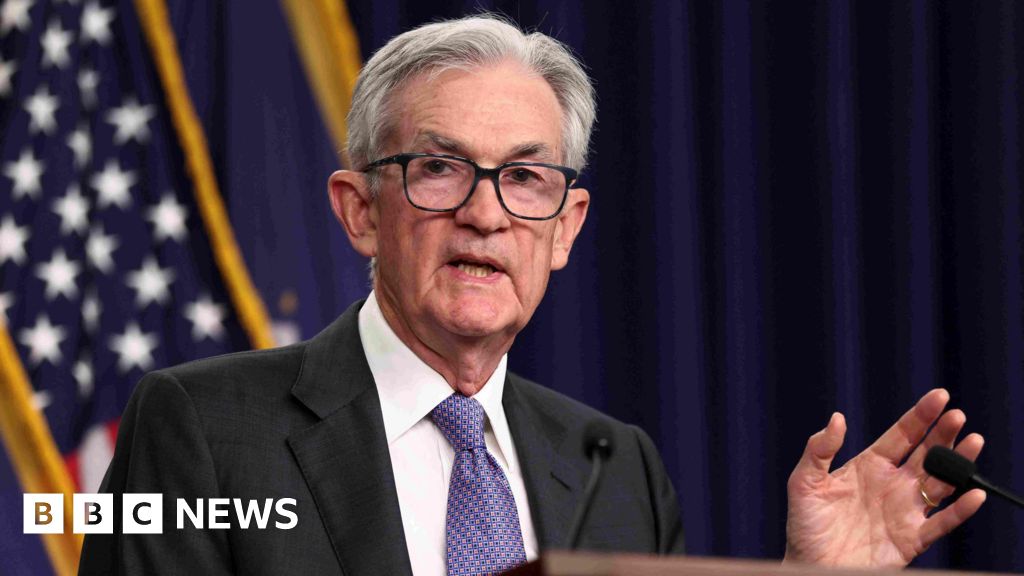
Fed chair Jerome Powell said central bankers need time to see how the Fed’s three cuts this year work their way through the US economy. Policymakers will closely examine incoming data leading up to Fed’s next meeting in January, he added.
“We are well-positioned to wait to see how the economy evolves,” Powell told reporters.
Those hoping for interest rates to keep coming down, including President Donald Trump, might have to wait.
The Fed is facing a “very challenging situation” as it confronts risks of rising inflation and unemployment, Powell said, adding: “you can’t do two things at once”.
The decision to lower rates on Wednesday was not unanimous, suggesting widening divisions among central bankers over the outlook for the US economy.
Three Fed officials broke ranks and officially dissented.
Stephen Miran, who is on leave from his post leading Trump’s Council of Economic Advisers, voted for a larger 0.5 percentage point cut.
Austan Goolsbee, president of the Federal Reserve Bank of Chicago, and Jeffrey Schmid, president of the Federal Reserve Bank of Kansas City, voted to hold rates steady.
Trump, who has repeatedly urged Powell to lower rates, said after the meeting on Wednesday that the Fed’s cut could have been “at least doubled”.
“Our rates should be much lower,” he said at a roundtable at the White House. “We should have the lowest rates in the world.”
A data blackout during the longest-ever US government shutdown, which ended in November, has left policymakers partially in the dark about the state of the economy. But concerns about a slowing job market continue to outweigh inflation fears, at least for now.
The unemployment rate ticked up from 4.3% to 4.4% in September, Labor Department figures showed in a delayed report released last month. Cutting interest rates is aimed at stimulating the job market by creating lower borrowing costs for businesses.
Fears about tariff-driven inflation had taken centre stage earlier this year when Trump pushed forward with sweeping tariffs on many of the country’s largest trading partners.
Inflation is still above the Fed’s 2% target. In September, it hit 3% for the first time since January.
But while tariffs appear to be boosting some consumer prices, recent milder-than-expected inflation readings have allowed the Fed to focus on boosting the labour market by lowering rates, analysts said.
Dissents and disagreements
Still, policymakers remain divided over the path forward for interest rates.
Asked about disagreement among policymakers, Powell acknowledged that it’s “unusual” to have “persistent tension” between the Fed’s two mandates to keep prices stable and unemployment low.
“And when you do, this is what you see,” he said, referring to growing divisions.
Still, Powell characterised the internal debate between Fed officials as thoughtful and respectful.
“We come together and we reach a place where we can make a decision,” he said.
The central bank’s so-called dot plot, a quarterly anonymous economic forecast, showed on Wednesday a median expectation for one additional 0.25 percentage point cut in 2026.
That prediction was unchanged from the previous dot plot in September.
Central bankers are poised to have a bit more clarity next week, with the expected release of official data on the labour market and inflation for November.
The incoming data could shift policymakers’ outlook, potentially bolstering calls for further easing next year if there are new signs that the job market is stalling.
Who will succeed Powell?
Trump’s search for Powell’s replacement as Fed chair, once his term ends next May, is adding to uncertainty about the path forward for Fed policy.
Trump could announce his pick as soon as within the next few weeks.
Kevin Hassett, a long-time conservative economist and key Trump economic adviser, is seen as the front-runner to succeed Powell.
A Trump loyalist, Hassett served as chair of the White House Council of Economic Advisers during Trump’s first term and now leads the National Economic Council.
He has been a stalwart defender of Trump’s economic policies, downplaying data showing signs of weakness in the US economy, doubling down on allegations of bias at the Bureau of Labor Statistics and backing Trump’s handling of the Fed.
Hassett’s allegiance to the president has drawn questions from analysts about whether he would act independently and how much sway he would have with other members of the board.
Other names that have been floated for the Fed chair include economist Kevin Warsh, current Fed Governor Christopher Waller and even Treasury Secretary Scott Bessent.
Trump is “still making up his mind, and he’s looking for someone who will be in his way of thinking,” Thomas Hoenig, a distinguished senior fellow at the Mercatus Center, told the BBC.
The candidates, he added, “have to project that they will be independent, or the markets will become quite nervous – and that will create more volatility”.
Asked on Wednesday whether Trump’s search for a new Fed chair is hindering his job or changing his thinking, Powell responded with a resounding “no”.
Heineken has announced a substantial investment exceeding £44 million into hundreds of its pubs across the UK, a move expected to create approximately 850 jobs.
The Dutch brewing giant’s Star Pubs operation, which manages 2,350 sites nationwide, is undertaking this significant financial commitment despite a challenging period for the pub sector.
The industry has faced considerable pressure over the past year, grappling with escalating labour costs and increases in national insurance contributions.
Concurrently, consumer spending has been constrained by concerns over inflation and rising unemployment, further impacting pub revenues. However, pubs did receive additional business rates support from the government last month, aimed at alleviating some of these financial burdens.
Lawson Mountstevens, managing director of Star Pubs, indicated that the investment strategy is partly designed to bolster revenues and help the group navigate the recent “sustained increases in running costs”.
This year, £44.5 million will be allocated to upgrades for 647 pubs. A notable 108 of these venues are earmarked for particularly significant cash injections, with each transformation costing at least £145,000.
Heineken clarified that while the majority of its pubs are group-owned, they are independently operated by local licensees. A key focus for this investment, particularly in the lead-up to the 2026 football World Cup, will be on sports-focused venues.
The pub firm and brewer has a history of significant investment in British pubs, having pumped £328 million into the sector since 2018. Work has already commenced at 52 locations, including eight projects dedicated to reopening boarded-up pubs that have endured lengthy closures.
Mr Mountstevens also urged the government to reduce the tax burden on pubs, arguing it would ease cost pressures and foster further job creation within the industry.
He stated: “We can only do so much; the root-and-branch reform of business rates that the industry has been calling for over many years is urgently required, as well as a lowering of the burden of taxation on pubs, including VAT and beer duty.”
He concluded with a direct appeal: “We are calling on the Government to support us in bringing out the best in the Great British pub.”

GameStop’s boss Ryan Cohen says he sees potential to make eBay a much bigger rival to Amazon.
Source link
It comes as the US said on Monday it will begin to help “guide” vessels out of the Strait of Hormuz.
Source link


Met Gala 2026 “Costume Art” red carpet pictures from New York City

Jack Brooksbank opts for intimate celebration as new baby brings fresh focus

White House briefly locked down after Secret Service shooting in Washington

-

 Tech1 week ago
A Brain Implant for Depression Is About to Be Tested in Humans
-

 Tech1 week ago
Almost 90% of women leave tech industry within 10 years | Computer Weekly
-
 Business1 week ago
Pakistan’s oil market is fuelling the crisis | The Express Tribune
-
 Business1 week ago
‘I had £20,000 stolen and had to fight a 13-month fraud reporting rule to get it back’
-

 Sports6 days ago
Pro wrestling star Steph De Lander reveals how colleague’s advice helped lead her to title triumph at ACW
-

 Entertainment1 week ago
Melania Trump says ABC should ‘take a stand’ on late-night host Kimmel
-

 Tech7 days ago
This Ambitious Laptop Doesn’t Leave Much Room for Your Hands
-

 Entertainment1 week ago
Norway joins Type 26 Frigate Programme to boost NATO naval power