

Fashion
Japan factory downturn eases as PMI inches up to 48.7 in November: S&P


Manufacturers reported softer declines in output, with some firms increasing production in anticipation of stronger future demand. Consumer goods producers saw a marginal improvement, while operating conditions remained weak in intermediate and investment goods categories.
Japan’s manufacturing PMI edged up to 48.7 in November from 48.2, marking a fifth month of contraction but the mildest decline since August.
Weak demand and falling new orders persisted, though output softened and employment rose slightly.
Input costs increased at the fastest pace since June, prompting higher selling prices.
Business confidence reached a 10-month high as firms anticipated recovery.
New business continued to fall solidly amid sluggish global conditions, tighter customer budgets, and reduced capital investment. Export orders also declined, albeit at a modest pace, S&P Global said in a press release.
Cost pressures intensified, with input prices rising at the fastest rate since June, driven by increased staffing and raw material expenses. Firms raised selling prices again at a solid pace to offset cost burdens.
Purchasing activity and inventories fell further as companies adjusted to subdued demand. Stocks of purchased items declined at the steepest rate in five years, while delivery times lengthened for a fifteenth straight month due to supplier shortages.
Employment saw a slight uptick—the fastest increase in three months—as firms filled vacancies and prepared for planned expansions and upcoming retirements. Backlogs of work continued to decline for the 38th consecutive month.
Despite persistent weakness in current conditions, business confidence improved to a ten-month high, reflecting expectations of gradual recovery ahead.
“The latest PMI data showed that Japan’s manufacturing sector continued to struggle with weak demand conditions in November, with firms signalling another solid decline in overall new business. Reduced demand was reported across key markets across Asia, with weaker-than-expected sales across the automotive and semiconductor industries noted in particular,” said Annabel Fiddes, economics associate director at S&P Global Market Intelligence.
“Encouragingly, production fell at a slower and only marginal rate, which coincided with improved optimism around the year-ahead. Overall, business confidence rose to the highest level since the start of the year. Upbeat projections also supported a further rise in employment, as a number of firms anticipated a recovery in market demand over the course of 2026,” added Fiddes. “With Japan’s new prime minister recently announcing a substantial economic stimulus package – the biggest since the pandemic – it will be important to see how this impacts demand and the sector’s performance as the administration seeks to boost investment in key strategic areas such as AI.”
The survey indicated that Japanese factories were more upbeat about the 12-month outlook for output in November. Furthermore, the degree of optimism was the highest seen since January amid reports of new product launches and forecasts of stronger customer demand, added the release.
Fibre2Fashion News Desk (SG)




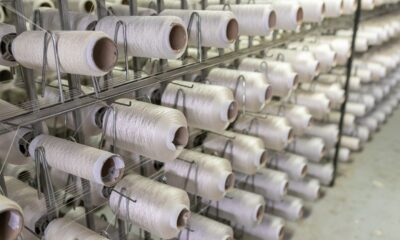








The company posted net sales of $130 million for the quarter ended March 29, 2026, down 11.3 per cent year on year (YoY) from $146.6 million. However, sales increased 7.1 per cent sequentially from the previous quarter.
US-based Unifi Inc has reported improved Q3 FY26 profitability despite an 11.3 per cent YoY decline in net sales to $130 million.
The gross profit rose to $9.1 million from a loss a year earlier, while net loss narrowed sharply to $2.3 million.
Adjusted EBIT turned positive at $4 million, supported by cost reductions, operational optimisation and stronger Repreve product sales.
Eddie Ingle, CEO at Unifi said the company’s operational and cost restructuring measures were beginning to translate into improved financial performance. “We are pleased to report that the impact of our team’s hard work is beginning to translate into improved financial performance, highlighted by improved gross profit and debt reduction,” added Ingle.
Gross margin returns to positive territory
The gross profit improved significantly to $9.1 million compared to a gross loss of $0.4 million in Q3 FY25. Gross margin rose to 7 per cent from negative 0.3 per cent a year earlier, supported by multi-year cost reduction efforts and operational optimisation, Unifi said in a press release.
Net loss narrowed sharply to $2.3 million, or $0.12 per diluted share, from $16.8 million, or $0.92 per diluted share, in the corresponding quarter last year. Adjusted net loss improved to $3.8 million from $13.9 million in Q3 FY25, while adjusted EBITDA turned positive at $4 million against a negative $4.9 million a year ago.
Revenue from Repreve fibre products reached $38.2 million during the quarter and accounted for 29 per cent of total net sales, up from $34.3 million and 28 per cent share in the second quarter of FY26.
Unifi also generated $8 million in cash from operating activities during the quarter and $24.4 million during the first nine months of FY26. Debt principal stood at $94.9 million, while net debt was reduced to $68.4 million as of March 29, 2026.
Selling, general and administrative (SG&A) expenses declined 9 per cent YoY to $11.2 million, driven by continued cost-saving initiatives.
“These results were driven by the actions we have taken over the past several quarters to realign our cost structure and optimise our operations and give us confidence that we can generate stronger profitability and cash flow from a lower revenue base moving forward,” said Ingle.
The Americas segment recorded the largest improvement in gross profit due to cost reductions, partially offset by lower sales. Meanwhile, the Brazil segment faced import pricing pressure, and the Asia segment was impacted by lower sales volumes.
Innovation and sustainability focus continue
During the quarter, Unifi published its ‘Sustainability Snapshot’ highlighting progress in textile-to-textile recycling and launched Luxel, a linen-inspired easy-care performance yarn.
Looking ahead, the company expects the fourth quarter of FY26 to benefit from responsive price increases linked to petrochemical-related inflation.
“As we enter the fourth quarter and look towards the remainder of calendar year 2026, we are encouraged by the momentum we are seeing across our businesses,” Ingle said.
“Our innovative beyond apparel business is continuing to gain traction, which should help support improved financial results,” he added.
Fibre2Fashion News Desk (SG)

“Our launch on Nordstrom Marketplace marks an important step in making H&M even more accessible to customers across the U.S.,” said Kate Rogowski, Head of Customer Activation and Marketing for H&M Americas. “The platform provides a seamless new way for shoppers to discover and experience H&M where they already love to browse, complemented by Nordstrom’s best-in-class customer experience.”
H&M’s entry into Nordstrom Marketplace signals a strategic shift towards curated digital retail, enhancing accessibility and brand visibility in the US.
The move aligns with evolving consumer shopping habits, leveraging Nordstrom’s service ecosystem while enabling H&M to reach new audiences and strengthen omnichannel engagement through a controlled, curated assortment.
At launch, the platform will carry a selected range of specially curated H&M favorites for women, men, and kids, as well as the brand’s sport collection, H&M Move. Styles will continue to evolve with fresh new arrivals that keep shoppers inspired for seasons to come.
“We’re proud to welcome H&M to Nordstrom Marketplace, expanding our ability to serve more customers on more occasions,” said Miguel Almeida, president of digital and customer experience at Nordstrom. “Customers shopping H&M on nordstrom.com will have access to all of the same Nordstrom services they know and love, including loyalty benefits, customer care support, styling, alterations, and returns that are fast and easy.”
H&M’s April launch is part of the brand’s broader strategy to continually meet customers wherever they choose to shop. Joining the trusted Nordstrom Marketplace means expanded visibility among both new and existing audiences while reinforcing the brand’s commitment to providing a seamless and inspirational shopping experience across touchpoints.
Note: The headline, insights, and image of this press release may have been refined by the Fibre2Fashion staff; the rest of the content remains unchanged.
Fibre2Fashion News Desk (MS)

US Customs and Border Protection (CBP) launched an online refund portal on April 20 to process claims linked to tariffs collected under President Donald Trump’s use of the International Emergency Economic Powers Act (IEEPA).
The Trump administration has begun refunding part of the $166 billion in global tariffs ruled unlawful by the US Supreme Court earlier this year.
US Customs launched an online claims portal, with over 1.7 million import entries already in the refund process.
The tariffs were originally introduced to address mounting US balance-of-payments deficits and rising trade imbalances.
According to court filings, claims covering around 1.74 million import entries had passed initial validation and entered the refund process by the end of April, while several million entries were rejected. The government is expected to provide its next status update to the US trade court on May 12.
The Supreme Court ruled against the tariffs in February but did not immediately settle how refunds would be handled, prompting further legal proceedings in New York. The administration has confirmed that approved refunds will include interest payments, although it has not guaranteed repayment for all tariffs collected under the programme.
The tariffs were originally introduced to address mounting US balance-of-payments deficits, rising trade imbalances, and concerns over financial stability. The White House had cited persistent goods trade deficits of about $1.2 trillion in both 2024 and 2025, alongside a deteriorating net international investment position.
Fibre2Fashion News Desk (CG)


Renée Zellweger joins cast of ‘A Woman in the Sun’

Terrell Owens declares he ‘couldn’t care less’ about the Cowboys years after tumultuous exit

25% ethanol blending in petrol likely in calibrated manner – The Times of India

-

 Politics5 days ago
Iran weighs US reply delivered via Pakistan as Trump signals opposition to deal terms
-

 Tech1 week ago
This Indigenous Language Survived Russian Occupation. Can It Survive YouTube?
-
 Fashion1 week ago
Canada’s Lululemon appoints Esi Eggleston Bracey to board of directors
-
 Business1 week ago
PSX plunges over 4,800 points | The Express Tribune
-

 Tech1 week ago
Almost half of UK businesses hit by cyber attacks | Computer Weekly
-

 Fashion7 days ago
US’ J.Jill, Inc. appoints Kimberly Wallengren as CMO
-

 Entertainment1 week ago
David Allan Coe, country singer who wrote “Take This Job and Shove It,” dies at age 86
-
 Business1 week ago
Government hikes jet fuel prices by 5% for international airlines – The Times of India