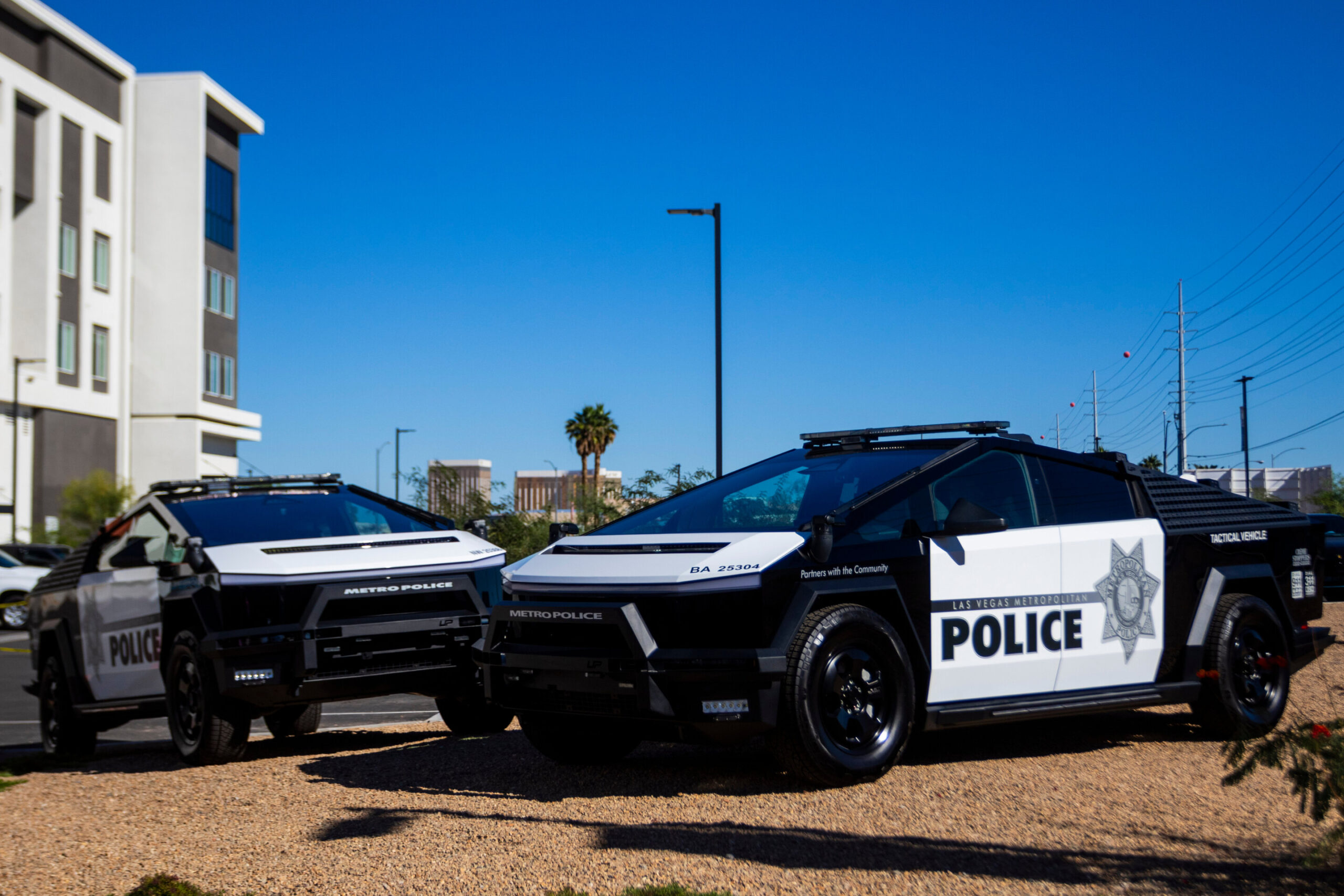
Tesla Cybertrucks owned by the Las Vegas Metro Police department is on display in Las Vegas on Tuesday Oct, 28th 2025. Credit: AP Photo/Ty ONeil
The nation’s largest police fleet of Tesla Cybertrucks is set to begin patrolling the streets of Las Vegas in November thanks to a donation from a U.S. tech billionaire, raising concerns about the blurring of lines between public and private interests.
“Welcome to the future of policing,” Clark County Sheriff Kevin McMahill said during a recent press conference, surrounded by the Cybertrucks while drones hovered overhead and a police helicopter circled above him.
The fleet of 10 black-and-white Cybertrucks of the Las Vegas Metropolitan Police Department with flashing lights and sirens are wrapped with the police department’s logo. About 400 officers have been trained to operate the trucks that will use public charging stations.
The all-electric vehicles are equipped with shotguns, shields and ladders and additional battery capacity to better handle the demands of a police department, McMahill said.
The donation has raised concerns from government oversight experts about private donors’ influence on public departments and the boost to the Tesla brand. The department is the latest U.S. city to turn to Tesla models even as Elon Musk ‘s electric vehicle company has faced blowback because of his work earlier in the year to advance the president’s political agenda and downsize the federal government.
McMahill noted the trucks will help keep officers safer because they are bulletproof, while Metro’s other squad cars are not. Each Cybertruck is valued at somewhere between $80,000 and $115,000 and will be used to respond to calls like barricades and shootings in addition to regular patrols.
The Cybertrucks also offer unique benefits such as a shorter turn radius, he said.
“They look a little bit different than the patrol cars that we have out there, but they represent something far bigger than just a police car,” the sheriff said. “They represent innovation. They represent sustainability, and they represent our continued commitment to serve this community with the best tools that we have available, safely, efficiently and responsibly.”
A Tesla Cybertruck owned by the Las Vegas Metro Police department is on display in Las Vegas on Tuesday Oct, 28th 2025. Credit: AP Photo/Ty ONeil
Cybertrucks have bee
n repeatedly recalled
The fleet comes amid a roller coaster year for Tesla that has dealt with multiple recalls.
In March, U.S. safety regulators recalled virtually all Cybertrucks on the road.
The National Highway Traffic Safety Administration’s recall, which covered more than 46,000 Cybertrucks, warned that an exterior panel that runs along the left and right side of the windshield can detach while driving, creating a dangerous road hazard for other drivers, increasing the risk of a crash. Tesla offered to replace the panels free of charge in notification letters sent out in May.
In late October, Tesla announced another recall of more than 63,000 Cybertrucks in the U.S. because the front lights are too bright, which may cause a distraction to other drivers and increase the risk of a collision.
Las Vegas officer Robert Wicks with the department’s public information office said all of Tesla’s recalls will have been dealt with before the Cybertrucks patrol the streets. The March recall regarding panel issues was handled before the department received the trucks, he said.
A member of the Las Vegas Police Department inspects a Tesla Cybertruck, part of the department’s fleet of vehicles, in Las Vegas on Tuesday Oct, 28th 2025. Credit: AP Photo/Ty ONeil
Federal regulators also have opened yet another investigation into Tesla’s self-driving feature after dozens of incidents in which the cars ran red lights or drove on the wrong side of the road, sometimes crashing into other vehicles and causing injuries.
The Cybertrucks modified for the Las Vegas police fleet do not have any kind of self-driving feature.
Laura Martin, executive director of the Progressive Leadership Alliance of Nevada Action Fund, said the imposing trucks with their sharp angles “seems like they’re designed for intimidation and not safety.”
“It just seems like Cybertrucks arriving on the streets of Clark County shows that Sheriff McMahill is prioritizing corporate giveaways and police militarization over real community needs,” she said.
Some express concerns with private donation
The donation comes after President Donald Trump earlier this year shopped for a new Tesla on the White House driveway and said he hoped his purchase would help the company as it struggled with sagging sales and declining stock prices.
Athar Haseebullah, executive director of the American Civil Liberties Union of Nevada, said now the Las Vegas fleet of another Tesla model “to patrol our communities really draws the next parallel there.”
Sheriff Keven McMahill talks about Tesla Cybertrucks owned by the Las Vegas Metro Police department in Las Vegas, Tuesday Oct. 28th 2025. Credit: AP Photo/Ty ONeil
Haseebullah also is worried about the Cybertrucks’ surveillance abilities that the public may not be unaware of, and that the fleet might give Tesla access to police data.
Following the explosion of a Cybertruck outside of Trump’s Las Vegas tower earlier this year, Tesla was able to provide detailed data of the driver inside, including the driver’s movements leading up to the explosion.
Ed Obayashi, a special prosecutor in California and an expert on national and state police practices, said private donations to law enforcement is not uncommon nor illegal unless a local or state law prohibits it.
In this case, the donation is a physical piece of equipment, and the money can’t be diverted to something else, Obayashi said. That said, he doesn’t think the trucks provide the department with a specific advantage.
“There’s not going to be really any distinct or noticeable advantage or benefits, so to speak, other than the fact that it’s a free vehicle and it saves the taxpayers money to replace equipment,” Obayashi said.
Donation comes from tech venture capitalist
The Las Vegas fleet was a donation totaling about $2.7 million from Ben Horowitz, co-founder of the Silicon Valley venture capital firm known as Andreessen Horowitz, or a16z, and his wife, Felicia Horowitz.
A Tesla Cybertruck owned by the Las Vegas Metro Police department is on display in Las Vegas, Tuesday Oct. 28th 2025. Credit: AP Photo/Ty ONeil
The couple, who live in Las Vegas, have made multiple donations to the department, including between $8 million to $9 million for Project Blue Sky, the department’s implementation of drones throughout the valley. They’ve also donated funds to buy emergency call technology and license plate readers—products from companies in which Andreessen Horowitz invests.
Ben Horowitz, who has donated to political campaigns for both Democrats and Republicans, was among the investors who backed Elon Musk’s bid to take over Twitter, now known as X.
His venture capitalist firm also hosted McMahill and Metro Chief of Staff Mike Gennaro on a podcast in November 2024.
Ben and Felicia Horowitz could not be reached for comment, however in a 2024 blog post, Ben Horowitz described their interest in donating to the department, stressing the importance of public safety and the difficulties public sectors have in budgeting for technology.
McMahill said the couple wanted to make sure that Las Vegas didn’t “become California when it comes to crime.”
Citation:
Nation’s largest fleet of police Cybertrucks to patrol Las Vegas (2025, November 2)
retrieved 2 November 2025
from https://techxplore.com/news/2025-11-nation-largest-fleet-police-cybertrucks.html
This document is subject to copyright. Apart from any fair dealing for the purpose of private study or research, no
part may be reproduced without the written permission. The content is provided for information purposes only.
Last month, the UK government announced the AI Skills Boost programme, promising “free AI training for all” and claiming that the courses will give people the skills needed to use artificial intelligence (AI) tools effectively. There are multiple reasons why we don’t agree.
US dependency over UK sovereignty
The “AI Skills Boost” is the free, badged “foundation” element of the government’s AI Skills Hub which was launched with great fanfare. There are 14 courses, exclusively from big US organisations, promoting and training on their platforms. The initiative increases dependency on US big tech – the opposite of the government’s recent conclusion, in its new AI opportunities action plan, to position the UK “to be an AI maker, not an AI taker”. It is also not clear how increasing UK workers’ reliance and usage of US big tech tools and platforms is intended to increase the UK’s homegrown AI talent.
In stark contrast to President Macron’s announcement last week that the French government will phase out dependency on US-based big tech, by using local providers to enhance digital sovereignty and privacy, technology secretary Liz Kendall’s speech was a lesson in contradictions.
Right after affirming that AI is “far too important a technology to depend entirely on other countries, especially in areas like defence, financial services and healthcare”, the secretary of state went on that the country’s strategy is to adopt existing technologies based overseas.
Microsoft, one of the founding partners for this initiative, has already admitted that “US authorities can compel access to data held by American cloud providers, regardless of where that data physically resides”, further acknowledging that the company will honour any data requests from the US state, regardless of where in the world the data is housed. Is this the sovereignty and privacy the UK government is trying to achieve?
Commercial content rather than quality skills provision
The AI Skills Hub indexes hundreds of AI-related courses. That means the hub, which cost £4.1m to build, is simply a bookmark or affiliate list of online courses and resources that are already available, with seemingly no quality control or oversight. The decision to award the contract to a “Big Four” commercial consultancy, PwC, rather than the proven national data, AI and digital skills providers who tendered, needs to be investigated.
The press releases focus on the “free” element of the training, but 60% of the courses are paid, even some of those which are marked as free, providing a deceptive funnel for paid commercial training providers.
We need to have greater national ambition than simply providing skills training. That the only substandard skills provision available is provided by those with commercial interests in controlling how people think about and use AI is a further insult
The package launched includes 595 courses, but only 14 have been benchmarked by Skills England, and there has been a critical outcry over the dangerously poor quality of many courses, some of which are 10 years’ old, don’t exist, or are poor quality AI slop.
An example of why this is so concerning is that many courses are not relevant to the UK. One of the courses promoted has already been shown to misrepresent the UK law on intellectual property, with the course creators later denying they had any contractual arrangement with the site and admitting that they were “not consulted before our materials were posted and linked from there”.
Warnings on the need for public AI literacy provision ignored
Aside from concerns over the standards, safety, sovereignty and cost of the content offered, there is a much bigger issue, which we have been warning about.
Currently, 84% of the UK public feel disenfranchised and excluded from AI decision-making, and mistrust key institutions, and 91% prioritise safe and fair usage of AI over economic gain and adoption speed.
In 2021, the UK’s AI Council provided a roadmap for developing the UK’s National AI Strategy. It advised on programmes of public and educational AI literacy beyond teaching technical or practical skills. This call has been repeated, especially in the wake of greater public exposure to generative AI since 2023, which now requires the public to understand not just how to prompt or code, but to use critical thinking to navigate a number of related implications of the technology.
In July 2025, we represented a number of specialists, education experts and public representatives, and wrote an open letter calling for investment in the UK’s AI capabilities beyond being passive users of US tools. Despite initial agreements to meet and discuss from the Department for Education and Department for Science, Innovation and Technology, the offer was rescinded.
Without comprehensive public understanding and sustained engagement, developing AI for public good and maintaining public trust will be a significant challenge. By investing in independent AI literacy initiatives that are accessible to all and not just aimed at onboarding uncritical users and consumers, the UK can help to ensure that its AI future is shaped with the UK public’s benefit at the heart.
Wasted opportunity to develop a beneficial UK approach to AI
We need to have greater national ambition than simply providing skills training. That the only substandard skills provision available is provided – at great public cost – by those with commercial interests in controlling how people think about and use AI is a further insult.
Indeed, Kendall’s claim that AI has the potential to add £400bn to the economy by 2030 is lifted from a report built by a sector consultancy that only focuses on the positive impact of Google technologies in the UK. Her announcement leaned heavily on claims such as “AI is now the engine of economic power and of hard power”, which come from a Silicon Valley playbook.
The focus on practical skills undermines the nation’s AI and tech sovereignty, harms the economy, with money leaving the nation to fund big tech. It entrenches political disenfranchisement, with decisions about AI framed as too complex for the general population to meaningfully engage with. It stands on fictitious narratives about inevitable big tech AI futures, in which public voice and public good are irrelevant.
If you wish to sign a second version of the open letter, which we are currently drafting, or to submit a critical AI literacy resource to We and AI’s resource hub, contact us here.
This article is co-authored by:
Tania Duarte, founder, We and AI
Bruna Martins, director at Tecer Digital
Dr. Elinor Carmi, senior lecturer in data politics and social justice, City St. George’s University of London
Dr. Mark Wong, head of social and urban policy, University of Glasgow
Dr Susan Oman, senior Lecturer, data, AI & society, The University of Sheffield
Ismael Kherroubi Garcia, founder & CEO, Kairoi
Cinzia Pusceddu, senior fellow of the Higher Education Academy, independent researcher
Dylan Orchard, postgraduate researcher, King’s College London
Tim Davies, director of research & practice, Connected by Data
Steph Wright, co-founder & managing director, Our AI Collective
Peter Thiel—the billionaire venture capitalist, PayPal and Palantir cofounder, and outspoken commentator on all matters relating to the “Antichrist”—appears at least 2,200 times in the latest batch of files released by the Department of Justice related to convicted sex offender and disgraced financier Jeffrey Epstein.
The tranche of records demonstrate how Epstein managed to cultivate an extensive network of wealthy and influential figures in Silicon Valley. A number of them, including Thiel, continued to interact with Epstein even after his 2008 guilty plea for solicitation of prostitution and of procurement of minors to engage in prostitution.
The new files show that Thiel arranged to meet with Epstein several times between 2014 and 2017. “What are you up to on Friday?” Thiel wrote to Epstein on April 5, 2016. “Should we try for lunch?” The bulk of the communications between the two men in the data dump concern scheduling meals, calls, and meetings with one another. Thiel did not immediately return a request for comment from WIRED.
One piece of correspondence stands out for being particularly bizarre. On February 3, 2016, Thiel’s former chief of staff and senior executive assistant, Alisa Bekins, sent an email with the subject line “Meeting – Feb 4 – 9:30 AM – Peter Thiel dietary restrictions – CONFIDENTIAL.” The initial recipient of the email is redacted, but it was later forwarded directly to Epstein.
The contents of the message are also redacted in at least one version of the email chain uploaded by the Justice Department on Friday. However, twoother files from what appears to be the same set of messages have less information redacted.
In one email, Bekins listed some two dozen approved kinds of sushi and animal protein, 14 approved vegetables, and 0 approved fruits for Thiel to eat. “Fresh herbs” and “olive oil” were permitted, however, ketchup, mayonnaise, and soy sauce should be avoided. Only one actual meal was explicitly outlined: “egg whites or greens/salad with some form of protein,” such as steak, which Bekins included “in the event they eat breakfast.” It’s unclear if the February 4 meeting ultimately occurred; other emails indicate Thiel got stuck in traffic on his way to meet Epstein that day.
According to a recording of an undated conversation between Epstein and former Israeli Prime Minister Ehud Barak that was also part of the files the DOJ released on Friday, Epstein told Barak that he was hoping to meet Thiel the following week. He added that he was familiar with Thiel’s company Palantir, but proceeded to spell it out loud for Barak as “Pallentier.” Epstein speculated that Thiel may put Barak on the board of Palantir, though there’s no evidence that ever occurred.
“I’ve never met Peter Thiel, and everybody says he sort of jumps around and acts really strange, like he’s on drugs,” Epstein said at one point in the audio recording, referring to Thiel. The former prime minister expressed agreement with Epstein’s assessment.
In 2015 and 2016, Epstein put $40 million in two funds managed by one of Thiel’s investment firms, Valar Ventures, according to The New York Times. Epstein and Thiel continued to communicate and were discussing meeting with one another as recently as January 2019, according to the files released by the DOJ. Epstein committed suicide in his prison cell in August of that year.
Below are Thiel’s dietary restrictions as outlined in the February 2016 email. (The following list has been reformatted slightly for clarity.)
APPROVED SUSHI + APPROVED PROTEIN
Kaki Oysters
Bass
Nigiri
Beef
Octopus
Catfish
Sashimi
Chicken
Scallops
Eggs
Sea Urchin
Lamb
Seabass
Perch
Spicy Tuna w Avocado
Squid
Turkey
Sweet Shrimps
Whitefish
Tobiko
Tuna
Yellowtail
Trout
APPROVED VEGETABLES
Artichoke
Avocado
Beets
Broccoli
Brussels sprouts
Cabbage
Carrots
Cucumber
Garlic
Olives
Onions
Peppers
Salad greens
Spinach
APPROVED NUTS
Anything unsalted and unroasted
Peanuts
Pecans
Pistachios
CONDIMENTS
Most fresh herbs, and olive oil
AVOID
Dairy
Fruits
Gluten
Grains
Ketchup
Mayo
Mushroom
Processed foods
Soy Sauce
Sugar
Tomato
Vinegar
MEAL SUGGESTIONS
Breakfast Egg whites or greens/salad with some form of protein (Steak etc)
Elon Musk’s rocket and satellite company SpaceX is acquiring his AI startup xAI, the centibillionaire announced on Monday. In a blog post, Musk said the acquisition was warranted because global electricity demand for AI cannot be met with “terrestrial solutions,” and Silicon Valley will soon need to build data centers in space to power its AI ambitions.
“In the long term, space-based AI is obviously the only way to scale,” Musk wrote. “The only logical solution therefore is to transport these resource-intensive efforts to a location with vast power and space. I mean, space is called ‘space’ for a reason.”
The deal, which pulls together two of Musk’s largest private ventures, values the combined entity at $1.25 trillion, making it the most valuable private company in the world, according to a report from Bloomberg.
SpaceX was in the process of preparing to go public later this year before the xAI acquisition was announced. The space firm’s plans for an initial public offering are still on, according to Bloomberg.
In December, SpaceX told employees that it would buy insider shares in a deal that would value the rocket company at $800 billion, according to The New York Times. Last month, xAI announced that it had raised $20 billion from investors, bringing the company’s valuation to roughly $230 billion.
This isn’t the first time Musk has sought to consolidate parts of his vast business empire, which is largely privately owned and includes xAI, SpaceX, the brain interface company Neuralink, and the tunnel transportation firm the Boring Company.
Last year, xAI acquired Musk’s social media platform, X, formerly known as Twitter, in a deal that valued the combined entity at more than $110 billion. Since then, xAI’s core product, Grok, has become further integrated into the social media platform. Grok is featured prominently in various X features, and Musk has claimed the app’s content-recommendation algorithm is powered by xAI’s technology.
A decade ago, Musk also used shares of his electric car company Tesla to purchase SolarCity, a renewable energy firm that was run at the time by cousin Lyndon Rive.
The xAI acquisition demonstrates how Musk can use his expansive network of companies to help power his own often grandiose visions of the future. Elon Musk said in the blog post that SpaceX will immediately focus on launching satellites into space to power AI development on Earth, but eventually, the space-based data centers he envisions building could power civilizations on other planets, such as Mars.
“This marks not just the next chapter, but the next book in SpaceX and xAI’s mission: scaling to make a sentient sun to understand the Universe and extend the light of consciousness to the stars,” Musk said in the blog post.





















 Sports7 days ago
 Sports6 days ago
 Entertainment6 days ago
 Politics6 days ago
 Sports6 days ago
 Tech7 days ago
 Entertainment6 days ago