

Tech
Sodium-based battery design maintains performance at room and subzero temperatures

All-solid-state batteries are safe, powerful ways to power EVs and electronics and store electricity from the energy grid, but the lithium used to build them is rare, expensive and can be environmentally devastating to extract.
Sodium is an inexpensive, plentiful, less-destructive alternative, but the all-solid-state batteries they create currently don’t work as well at room temperature.
“It’s not a matter of sodium versus lithium. We need both. When we think about tomorrow’s energy storage solutions, we should imagine the same gigafactory can produce products based on both lithium and sodium chemistries,” said Y. Shirley Meng, Liew Family Professor in Molecular Engineering at the UChicago Pritzker School of Molecular Engineering (UChicago PME). “This new research gets us closer to that ultimate goal while advancing basic science along the way.”
A paper from Meng’s lab, published this week in Joule, helps rectify that problem. Their research raises the benchmark for sodium-based all-solid-state batteries, demonstrating thick cathodes that retain performance at room temperature down to subzero conditions.
The research helps put sodium on a more equal playing field with lithium for electrochemical performance, said first author Sam Oh of the A*STAR Institute of Materials Research and Engineering in Singapore, a visiting scholar at Meng’s Laboratory for Energy Storage and Conversion during the research.
How they accomplished that goal represents an advance in pure science.
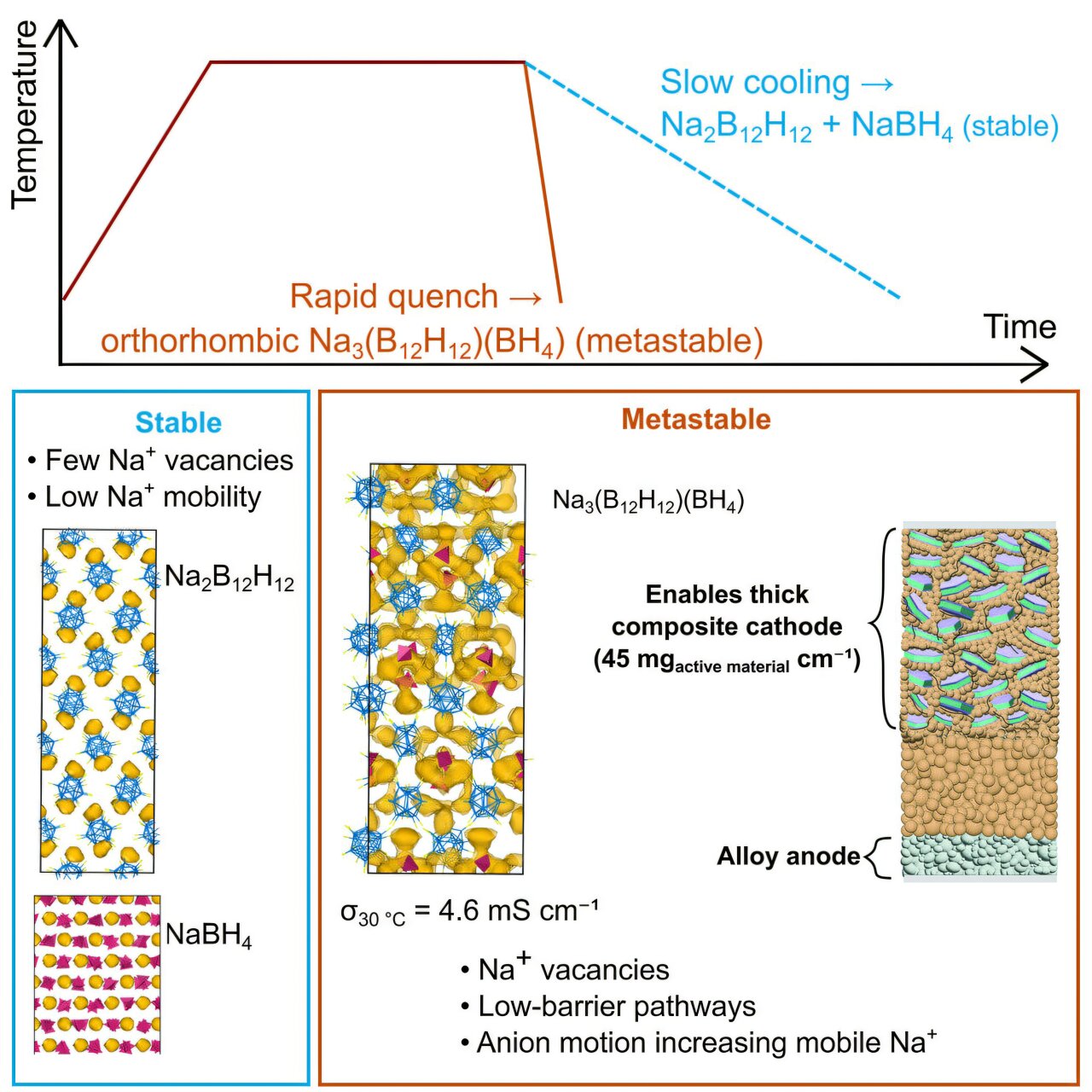
“The breakthrough that we have is that we are actually stabilizing a metastable structure that has not been reported,” Oh said. “This metastable structure of sodium hydridoborate has a very high ionic conductivity, at least one order of magnitude higher than the one reported in the literature, and three to four orders of magnitude higher than the precursor itself.”

Established technique, new field
The team heated a metastable form of sodium hydridoborate up to the point it starts to crystallize, then rapidly cooled it to kinetically stabilize the crystal structure. It’s a well-established technique, but one that has not previously been applied to solid electrolytes, Oh said.
That familiarity could, down the road, help turn this lab innovation into a real-world product.
“Since this technique is established, we are better able to scale up in the future,” Oh said. “If you are proposing something new or if there’s a need to change or establish processes, then industry will be more reluctant to accept it.”
Pairing that metastable phase with an O3-type cathode that has been coated with a chloride-based solid electrolyte can create thick, high-areal-loading cathodes that put this new design beyond previous sodium batteries. Unlike design strategies with a thin cathode, this thick cathode would pack less of the inactive materials and more cathode “meat.”
“The thicker the cathode is, the theoretical energy density of the battery—the amount of energy being held within a specific area—improves,” Oh said.
The current research advances sodium as a viable alternative for batteries, a vital step to combat the rarity and environmental damage of lithium. It’s one of many steps ahead.
“It’s still a long journey, but what we have done with this research will help open up this opportunity,” Oh said.
More information:
Jin An Sam Oh et al, Metastable sodium closo-hydridoborates for all-solid-state batteries with thick cathodes, Joule (2025). DOI: 10.1016/j.joule.2025.102130
Citation:
Sodium-based battery design maintains performance at room and subzero temperatures (2025, September 17)
retrieved 17 September 2025
from https://techxplore.com/news/2025-09-sodium-based-battery-room-subzero.html
This document is subject to copyright. Apart from any fair dealing for the purpose of private study or research, no
part may be reproduced without the written permission. The content is provided for information purposes only.












For most of the past year, it looked like prediction markets had kicked off a new golden age of fraud. On Polymarket, traders raked in fortunes from suspiciously timed bets on geopolitical events like the raid on Venezuela and the Iran War. It wasn’t clear whether the US government would bother pursuing some of the most flagrant bad actors, since Polymarket’s crypto-based platform was technically offshore and not regulated or licensed within the country.
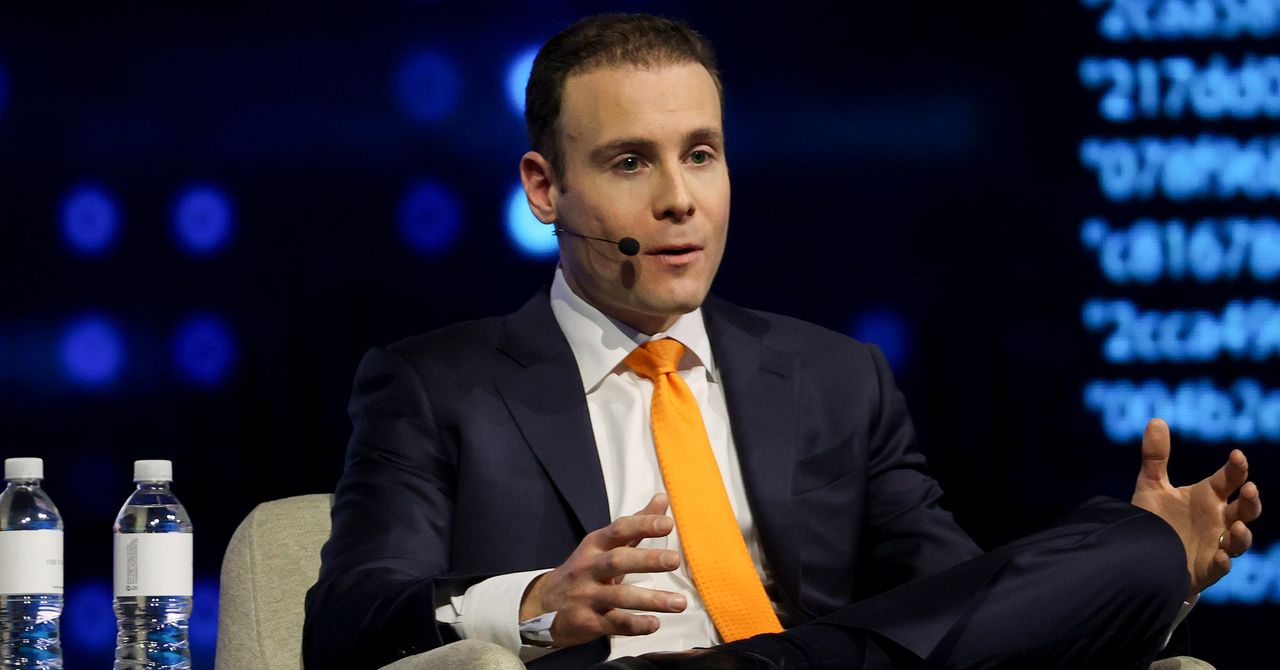
Now, however, the Commodity Futures Trading Commission, which oversees prediction markets, wants you to know that it’s watching very, very closely. The agency is searching for suspicious behavior from traders within the United States who have been sneaking onto offshore markets, including Polymarket’s crypto platform—which is blocked stateside—by using virtual private networks. “We’re going to find them, and we’re going to bring actions,” agency chairman Michael Selig told WIRED this week, speaking from the CFTC’s headquarters in a Washington, DC, office park called Patriots Plaza II.
Selig says the agency, which is especially lean right now, is staffing up. Like so many other AI-pilled workplaces, the CFTC is also leaning into automation to handle the growing workload, including tools that analyze trading patterns and flag potential manipulation. “You’ve got so much data,” Selig says. “When we feed it into AI, we get really great information. It can help us understand things, like where we might want to investigate, or when we might need to send a subpoena to a trader.”
In addition to proprietary surveillance systems developed in-house, the agency’s arsenal includes third-party blockchain tracing tools like Chainalysis for crypto platforms, and market abuse detection software including Nasdaq Smarts for centralized markets. (Beyond Nasdaq Smarts, the agency did not specify which AI tools it uses and declined to share more specific examples.)
Prominent prediction market companies have recently started touting all the work they’re doing to catch sketchy bettors. US-based exchange Kalshi, Polymarket’s primary competitor, eagerly announced that it has suspended and penalized customers flagged for insider trading and market manipulation.
In April, after significant backlash over suspected insider trading, Polymarket announced its own partnership with Chainalysis. It was part of a broader push to crack down on market manipulation. While the company’s CEO, Shayne Coplan, had talked in the past about why insider trading could be good for prediction markets, Polymarket changed its approach this spring, updating its market integrity rules and announcing a partnership with Palantir for its US-based sports markets (the Chainalysis deal focuses on the offshore platform). The company did not respond to WIRED’s request for comments for this story.
According to Chainalysis spokesperson Maddie Kenney, the company analyzes the same data for both clients. “The value Chainalysis adds for our customers, including Polymarket and the CFTC, is organizing the data and enriching it with the attributions and insights we’ve accumulated over years in the space,” she says. Certainly sounds like a good deal for Chainalysis!
The CFTC’s assurances that it is hunting insiders comes at a moment of intense scrutiny on prediction markets. In March, Connecticut senator Chris Murphy told WIRED that he suspected White House staffers were engaged in insider trading on war-related contracts. At the beginning of April, seven members of Congress asked the CFTC to investigate overseas markets offering war-themed events contracts. In a letter, the lawmakers argued that the commission had the authority and responsibility to curb insider trading, especially on “morally obscene” trades on military action. Selig recently told Congress that the company is pursuing “hundreds, if not thousands” of insider trading tips.

Whether you’re starting a small business or just want a public profile outside of LinkedIn to showcase your work, HostGator is the place to come for your web hosting needs. With affordable introductory pricing, a wide range of plans, and beginner-friendly user interface, it’s been in the game for over 20 years, powering over 700,000 websites to date. Hostgator is a good entry-level choice for folks like me that have no experience creating or running a website, but want a place to showcase their work or make their small biz more accessible.
With affordable hosting services like WordPress, VPS, shared budget-friendly, and dedicated servers, HostGator has a plan for every type of client, from beginners to growing small businesses. You’ll have peace of mind with 24/7 support and a 30-day money-back guarantee if you aren’t happy with the plan you’ve chosen. With HostGator, not only will you get help with a website builder, you’ll also receive a free SSL certificate, domain registration, and professional email addresses. It couldn’t be easier—launch your website today (for so much less) using an updated, always-changing HostGator coupon or HostGator promo code here.
Score Up to 70% Off With This HostGator Coupon
Creating your own website can be stressful and confusing, especially if you’re a novice like me. The Baby HostGator plan is best for most people who need web services and additional help with plans, but maybe don’t need all the bells-and-whistles that the expanded business plan needs. With this HostGator coupon, you’ll get 70% off the Baby web hosting plan, which has everything you’ll need as a jumping-off point, including up to 20 websites, 20GB of memory, one year domain registration, one-click WordPress installation, and more. If this tier of service seems right for you, get it at 70% off (based on a 36-month plan) with HostGator promo code SNAPPY.
Unlock HostGator Promo Code for 76% Off WordPress Hosting
The HostGator Business Plan is ideal for users who have multiple sites that need increased storage, security, and backups. And right now, it’s 76% off at $5.25 per month (based on 36-month pricing). This plan acts as a WordPress staging site with managed WordPress updates, and includes 50 websites, 50 gigs of SSD storage, a free domain for the first year, site migration tools, and advanced security measures and enhanced marketing tools. Read here to see all the details of the differing HostGator plans. Be sure to use HostGator coupon code SNAPPY for the 76% discount.
Save Up to 53% Using HostGator Discount on Top Plan
The HostGator Pro Plan is its top tier, with the most advanced processing power and speeds, and it’s now 53% off—only $14 per month (for 36 months). This expansive plan is ideal for 400,00 visits per month, and includes 100 websites, 100 gigs of SSD storage, and advanced security, marketing, and caching features. Be sure to check out the four different plans to see which is best for your business, including this deal for 53% off the top Pro plan—no HostGator hosting coupon needed.
Get Hassle-Free Domain Registration from $0.99 at HostGator
Have a great idea for a business that isn’t quite up and running yet, but you don’t want to lose out on the million-dollar domain name? Fear not, HostGator’s hassle-free domain registration starts at only $0.99. To start, you’ll search availability on your favorite domain name, or have AI create one for you if you’re stuck. Plus, you can get your HostGator domain included for free for one year if you bundle it with a HostGator hosting plan, no HostGator discount code is needed for this less-than-a-dollar deal.
Up to 36% Off VPS Hosting and Free Migration Tool
Thinking about cybersecurity is no fun, but VPS hosting on your website is a necessary step to protect the privacy and data of both you and your users. This provides next-generation AMD EPYC servers with NVMe storage, stabilized performance, increased control, and advanced security, no matter how much traffic you get. There are various VPS hosting plans, which Hostgator calls ‘Snappy,’ which are priced on a tier system. Right now, you can get up to 36% off the most popular mid-tier plan, including a free migration tool to make the transition safe and seamless.

Attorneys delivered closing arguments in the Musk v. Altman trial on Thursday in a final attempt to convince a judge and jury that their respective clients, Elon Musk and Sam Altman, are the most well-intentioned, truth-telling stewards of OpenAI’s founding nonprofit mission. A judgement could be delivered as soon as next week, ending a decade-long battle between two of the technology industry’s most influential entrepreneurs.
But regardless of the outcome, there is a wide set of losers in this case. Based on ample amounts of evidence, it appears that the people worst off are the employees, policy makers, and members of the public who believed in the mission of a nonprofit research lab—and supported OpenAI because of it. What seemed to take precedent for Musk and OpenAI’s other cofounders at almost every turn was building the world’s leading AI lab—even if that meant creating a multibillion dollar for-profit company in the process.
“It’s hard to see how the public interest is being protected by either of these parties, and that is really what is ultimately at stake in a case about a nonprofit,” says Jill Horwitz, a Northwestern University law professor with expertise in nonprofits and innovation, who listened to the closing arguments. “The public interest in the nonprofit is at risk no matter who wins.”
OpenAI’s stated mission is to ensure artificial general intelligence (AGI) benefits humanity, but humanity is not a party in this case. In practice, OpenAI has spent the last decade attempting to rival multitrillion dollar companies like Google, and build AGI first. Additionally, Musk and Altman have fought tooth and nail to be the ones who control OpenAI.
“Musk and Altman are basically locked in a race to be the first to build superintelligence, and they both rightly fear what the other will do if they win. The rest of us should fear them both,” says Daniel Kokotajlo, a former OpenAI researcher who joined in 2022 and has raised concerns over the company’s safety culture. He was part of a group of former OpenAI researchers that filed an amicus brief in this case against OpenAI’s for-profit conversion, arguing that the nonprofit structure was critical in their decision to join the company.
At trial, OpenAI’s nonprofit was discussed as if it were yet another corporate investor. OpenAI’s lawyers argued that giving the nonprofit a $200 billion stake in the for-profit company is proof that OpenAI is fulfilling its mission. Public advocacy groups disagree that funding alone is sufficient.
“I am among the many people who are glad to see how many philanthropic resources the OpenAI foundation has at its disposal to do good work,” says Nathan Calvin, VP of state affairs for the AI safety nonprofit Encode, which filed an amicus brief opposing OpenAI’s restructuring earlier in this case. “But it’s worth remembering that the nonprofit also has a governance role, and that the mission of the nonprofit is not that of a typical foundation, it is specifically to ensure that AGI benefits all of humanity. Money is important for that goal and is useful all else equal, but it is not the goal in and of itself.”
Origin Story
Evidence revealed in this case suggests Altman and Musk were in agreement about OpenAI launching as a nonprofit and operating much like a typical startup. They shared the goal of beating Google DeepMind in the race to AGI. But creating OpenAI as a nonprofit turned out to be a horribly inconvenient means to winning that race.
Musk has accused Altman, OpenAI’s CEO, and Greg Brockman, its cofounder and president, of straying from the nonprofit’s founding mission. He claims the founders used his $38 million investment to turn OpenAI into an $850 billion company and make several of its cofounders billionaires.


India’s FY26 GDP growth estimated at 7.5%: SBI

The US Is Using AI to Hunt Down Insider Trading on Polymarket

Trump leaves Beijing with few wins, many warm words for Xi

-

 Tech1 week ago
A new frontier: Identity stack evolves for agentic systems | Computer Weekly
-

 Tech7 days ago
‘Orbs,’ ‘Saucers,’ and ‘Flashes’ on the Moon: Pentagon Drops New UFO Files
-

 Fashion7 days ago
New orders in German manufacturing up 5% MoM in Mar 2026: Destatis
-

 Tech7 days ago
Nick Bostrom Has a Plan for Humanity’s ‘Big Retirement’
-

 Tech1 week ago
What Microsoft Executives Really Thought About OpenAI in 2018
-

 Sports7 days ago
Shaheen Afridi achieves landmark feat during opening Test against Bangladesh
-

 Fashion7 days ago
US’ Carter’s taps retail veteran Sharon Price John as new CEO
-

 Entertainment7 days ago
Rihanna embraces new tattoo given by children