

Business
Swedish business team to explore trade avenues | The Express Tribune


ISLAMABAD:
Scores of Swedish small and medium-sized enterprises (SMEs) are eager to explore opportunities in Pakistan, particularly in the textile garment sector, and a business delegation is expected to visit Karachi soon to interact with local manufacturers and assess the potential for export.
Swedish Ambassador Alexandra Berg von Linde stated this in a meeting with Federal Minister for Commerce Jam Kamal Khan on Monday, where they discussed bilateral trade, investment opportunities and other areas of mutual collaboration. The ambassador expressed her condolences over the recent loss of lives and property in Pakistan, caused by heavy rains and cloudburst incidents. Jam Kamal, while terming it a natural disaster, underlined the urgent need for collective efforts to address climate change challenges.
During the meeting, both sides reviewed avenues where they could strengthen economic cooperation, with a special focus on trade enhancement. The minister highlighted Pakistan’s potential in textiles, readymade garments, IT and technical education, mining, surgical goods and sports equipment, noting that Swedish companies could greatly benefit from investing in those sectors.
The ambassador acknowledged Pakistan’s reputation in textile exports, noting that Swedish buyers consider Pakistani products among the best in the world. Jam Kamal told the ambassador that, for the first time in Pakistan’s history, the government was gradually reducing import tariffs, which would be brought down to 15-20% within the next five years. The policy aims to support exports while allowing imports of quality products not available domestically, which will enable value addition before re-export.
He highlighted Pakistan’s progress on reforms, especially the establishment of the National Compliance Centre to help local businesses meet national and international standards. He proposed the organisation of seminars in association with the compliance centre to inform foreign companies and diplomatic missions about compliance processes in Pakistan.
Both sides identified mining, renewable energy, green technologies, vocational training and skill development as areas for future collaboration. The commerce minister emphasised that Pakistan had a large pool of skilled youth, especially in healthcare, where Pakistani professionals could meet shortages in Europe, including the nursing staff.
He underscored that more than 40 Swedish companies, including global brands such as H&M and IKEA, were already sourcing goods from Pakistan, reflecting the strength of bilateral economic ties. He invited Swedish investment in renewable energy, sustainable manufacturing, IT and infrastructure, while encouraging Sweden’s participation in the upcoming trade events in Pakistan such as FoodAg 2025.
The minister appreciated Sweden’s consistent support for Pakistan’s GSP Plus status in the European Union and urged continued advocacy during the next review process. He also called for enhanced engagement between Pakistan’s central bank and Swedish financial regulators to address the compliance-related issues faced by exporters.
Reaffirming Pakistan’s commitment to deepening political, economic and people-to-people ties, he said both countries had an immense untapped potential for cooperation.








Pakistan’s inflation rose to 7% in February 2026, marking the highest level since October 2024, as electricity price hikes and rising global uncertainty pushed consumer costs upward.
According to the Pakistan Bureau of Statistics, the Consumer Price Index (CPI) increased 6.98% year-on-year, compared to 5.8% in January and 1.5% in February last year.
Electricity Tariffs Drive Surge
The biggest impact came from higher electricity prices after subsidy cuts and revised tariff structures.
Housing, water, electricity, gas & fuels index rose 9.65% annually
Electricity prices alone increased 10.03% month-on-month
These adjustments significantly burdened households already coping with high living costs.
Core Inflation & Interest Rates
Core inflation showed slight easing:
Urban core inflation: 7.1% (down from 7.2%)
Rural core inflation: Stable at 8.3%
The rise in CPI reduced real interest rates by around 120 basis points. The State Bank of Pakistan kept its policy rate unchanged at 10.5% last month.
Food Prices Mixed
Food inflation rose to 5.8%, up from 3.9% in January.
Major increases:
Tomatoes: +82%
Wheat: +42.6%
Wheat flour: +25.9%
Meat: +11.3%
Milk powder: +9.4%
Price declines:
Potatoes: -40%
Chicken: -21.8%
Gram pulse: -21.7%
Onions: -17%
Wholesale Pressure Rising
The Wholesale Price Index (WPI) increased to 1.0%, signaling growing producer-level cost pressures that could pass on to consumers in coming months.
External Risks Loom
Analysts warn that escalating Middle East tensions could:
Raise global oil prices
Increase Pakistan’s import bill
Pressure the rupee
Worsen inflation further
With millions of Pakistanis working in Gulf countries, any prolonged instability could also affect remittances — a key pillar of the economy.

Last Updated:
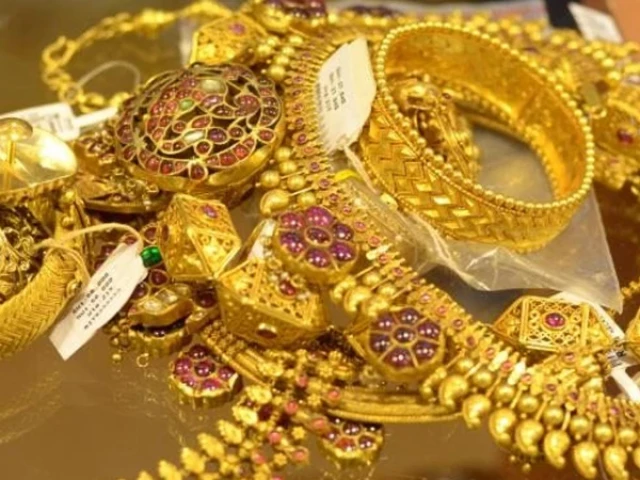
Gold and silver prices in India eased after a rally driven by Middle East conflict. 24-carat gold is Rs 1,70,020 per 10gm, silver below Rs 3,00,000.




Amid escalating tensions in the Middle East, gold and silver prices have witnessed a sharp surge, with market experts warning of further increases if the conflict intensifies.
Gold and silver prices: Gold and silver prices across India eased slightly after rallying as investors rushed towards safe havens due to the conflict in the Middle East. The price of 24-carat gold stood at Rs 1,70,020 per 10 grams, while 22k gold was available at Rs 1,55,850 per 10 grams. These rates do not include GST and making charges.
Silver also fell by Rs 20,000 to come down below Rs 3,00,000.
On MCX, gold futures, whose expiry is on April 02, 2026, was traded at Rs 1,66,199 per 10 gram, with a rise of 2.53 per cent. While silver futures expiring on March 05, 2026, were trading at Rs 2,80,090 per kg, with a fall of 0.90 per cent.
What Is The Price Of 22kt, 24kt Gold Rates Today In India Across Key Cities On March 03?
| City | 22K Gold (per 10gm) | 24K Gold (per 10gm) |
|---|---|---|
| Delhi | Rs 1,56,000 | Rs 1,70,170 |
| Jaipur | Rs 1,56,000 | Rs 1,70,170 |
| Ahmedabad | Rs 1,55,900 | Rs 1,70,070 |
| Pune | Rs 1,55,900 | Rs 1,70,070 |
| Mumbai | Rs 1,55,850 | Rs 1,70,020 |
| Hyderabad | Rs 1,55,850 | Rs 1,70,020 |
| Chennai | Rs 1,55,850 | Rs 1,70,020 |
| Bengaluru | Rs 1,55,850 | Rs 1,70,020 |
| Kolkata | Rs 1,55,850 | Rs 1,70,020 |
What Factors Affect Gold Prices In India?
International market rates, import duties, taxes, and fluctuations in exchange rates primarily influence gold prices in India. Together, these factors determine the daily gold rates across the country.
In India, gold is deeply cultural and financial. It is a preferred investment option and is key to celebrations, particularly weddings and festivals.
With constantly changing market conditions, investors and traders monitor fluctuations closely. Staying updated is crucial for effectively navigating dynamic trends.
 Click here to add News18 as your preferred news source on Google.
Follow News18 on Google. Join the fun, play games on News18. Stay updated with all the latest business news, including market trends, stock updates, tax, IPO, banking finance, real estate, savings and investments. To Get in-depth analysis, expert opinions, and real-time updates. Also Download the News18 App to stay updated.
March 03, 2026, 09:52 IST
Read More

Shop price inflation eased in February but consumers are still paying 3.5% more for food than a year ago, figures show.
Overall shop inflation fell slightly to 1.1% from January’s 1.5%, in line with the three-month average of 1.1%, as fierce competition between retailers kept price rises in check and customers benefited from promotions across health, beauty and fashion, according to the British Retail Consortium (BRC) and NIQ.
Prices of products other than food were down 0.1% year on year, a significant drop from January’s growth of 0.3%.
Overall food inflation fell slightly to 3.5% from 3.9% in January, while fresh food prices remained 4.3% higher than last February, a slight drop from January’s 4.4% and above the three-month average of 4.2%.
However falling global costs pushed ambient food inflation down to 2.3% – its lowest level in four years and a significant fall from January’s 3.1%.
BRC chief executive Helen Dickinson said: “Households got some welcome relief in February as shop price inflation eased.
“While the direction of travel is promising, prices are still rising, and many consumers remain under pressure.”
Mike Watkins, head of retailer and business insight at NIQ, said: “Since the start of the year, we have seen some competitive pricing across both the food and non-food channels which is helping to bring down inflation.
“Whilst the inclement weather and weak sentiment is making consumer demand rather unpredictable for retailers, at least shoppers are now seeing some of their cost-of-living pressures start to ease.”


Retech to showcase precision godet technology at Techtextil 2026

Football is life! ‘Dani Rojas’ from Ted Lasso is on trial at a USL club
Inflation Climbs to 16-Month High at 7% in February – SUCH TV

-

 Politics5 days ago
What are Iran’s ballistic missile capabilities?
-
 Business6 days ago
Households set for lower energy bills amid price cap shake-up
-

 Sports5 days ago
Sri Lanka’s Shanaka says constant criticism has affected players’ mental health
-
 Business6 days ago
Lucid widely misses earnings expectations, forecasts continued EV growth in 2026
-

 Sports1 week ago
Top 50 USMNT players of 2026, ranked by club form: USMNT Player Performance Index returns
-
 Business1 week ago
Haryana Govt bars IDFC First Bank, AU Small Finance Bank over alleged Rs 590 crore fraud
-
 Business4 days ago
Attock Cement’s acquisition approved | The Express Tribune
-

 Tech6 days ago
Here’s What a Google Subpoena Response Looks Like, Courtesy of the Epstein Files