

Business
UK borrowing costs hit 27-year high adding to pressure on Reeves

Tom Espiner & Nick EdserBusiness reporters, BBC News
 Reuters
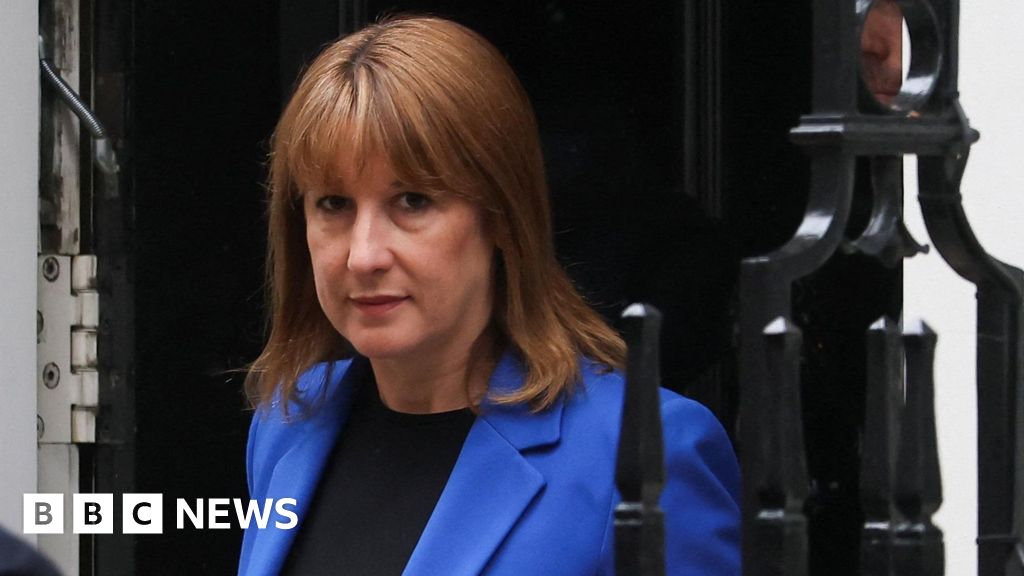
UK government borrowing costs have reached their highest level since 1998, adding to the pressure on the chancellor ahead of the Budget.
The interest rate on 30-year government bonds, known as the yield, jumped to 5.698%, making it more expensive for the government to borrow money.
There are rising expectations that Chancellor Rachel Reeves will increase taxes in the Budget later this year in order to meet her borrowing and spending rules, as worries grow about the state of the government’s finances.
On the currency markets, the pound also fell more than 1% against the dollar on Tuesday.
Sterling dropped to $1.3379, which is the lowest level against the US currency since 7 August.
The UK was not alone in seeing borrowing costs rise, with yields on 30-year German, French and Dutch bonds climbing to their highest 2011.
A number of factors have led to borrowing costs for governments around the globe to go up, such as geopolitical tensions, US President Donald Trump’s trade policies and the upcoming confidence vote in the French government.
‘Difficult choices’
But Susannah Streeter, head of money and markets at Hargreaves Lansdown, said the chancellor faced “highly difficult choices” in the Budget and that she had been “dealt a warning” by investors.
“They are selling off UK government debt, clearly concerned that the government may be losing its grip on the public finances,” she said.
In its manifesto, Labour promised not to raise taxes such as income tax, VAT or national insurance on “working people”. This has led to much speculation over what taxes Reeves could raise in the autumn Budget.
One option suggested is that the freeze on income tax thresholds, which is due to end in 2028, could be extended.
Often referred to as a “stealth tax”, freezing income tax thresholds means that, over time as salaries rise, more people are dragged into paying higher rates.
There have also been reports that Reeves is considering reforming property taxes.
“With so many options for raising taxes being bandied about during the summer, there appears to be concern that the decisions made might not be sufficiently thought through,” said Ms Streeter.
“The worry isn’t just that government coffers won’t be replenished, but that they will be filled at the expense of growth, leading to a vicious circle emerging.”
On Monday, the government announced a partial reshuffle, with Darren Jones, formerly Reeves’s deputy, being given a key No 10 role by the prime minister.
The changes are focused on beefing up the economic know-how in Downing Street. Baroness Shafik, a former deputy governor of the Bank of England, has been named at Keir Starmer’s new chief economic adviser.
The moves are a recognition that the upcoming autumn’s Budget will be a defining moment in this Labour government.
Governments borrow money from investors by selling bonds – which is a loan the government promises to pay back at the end of an agreed time.
The yield on 30-year UK government bonds – known as gilts – has been rising for some months, and this makes it more expensive for the government to borrow money due to higher interest payments.
The government’s official forecaster, the Office for Budget Responsibility (OBR), takes borrowing costs into account when looking at whether the chancellor is meeting her self-imposed fiscal rules.
When she became chancellor, Reeves set out two rules on government borrowing, which she has repeatedly said are “non-negotiable”. These were:
- day-to-day government costs will be paid for by tax income, rather than borrowing by 2029-30
- to get debt falling as a share of national income by the end of this parliament in 2029-30
Part of the reason Reeves is under pressure is that her financial buffer to stick to these rules is a relatively slim £10bn. The chancellor recently refused to rule out tax rises after disappointing data on economic growth.
On Tuesday, a spokesperson for Starmer said the government’s “iron-clad commitment to our robust fiscal rules remains”, adding it had made the necessary decisions to “stabilise the public finances”.
But shadow chancellor Mel Stride said the latest market movements were “another economic disaster from Rachel Reeves – and a clear vote of no confidence in Labour from the markets”.
“With more tax rises on the horizon, the economy is now in a precarious position,” he added.
There has been a wide range of forecasts for how much money Reeves might need to raise in the Budget to meet her rules.
One factor that will influence this is the borrowing costs facing the government.
When the OBR makes makes its forecasts for government debt it looks at yields on all bonds.
Paul Dales, chief UK economist at Capital Economics, said concerns about the path of UK inflation and interest rates, combined with global issues, were pushing UK government borrowing costs up.
In addition, he added that pension funds were also not buying as much long-term government debt due to the change in recent years from defined-benefit to defined-contribution schemes.
Mr Dales said Reeves would have to raise between £18bn and £28bn in the Budget to avoid breaking her fiscal rules, and to maintain her £10bn buffer.
Households and banks “will probably feel the brunt of the higher taxes”, he said.

Analysts fear the disruption to supply could continue for longer than initially thought.
Source link
Policymakers vote unanimously to hold rates at 3.75% after the Iran war prompts a sea-change in the debate over borrowing costs.
Source link
Business
Eli Lilly’s next-generation obesity drug retatrutide clears first late-stage diabetes trial

Eli Lilly on Thursday said its next-generation obesity drug retatrutide cleared its first late-stage trial on Type 2 diabetes patients, helping them manage their blood sugar levels and lose weight.
The drug lowered hemoglobin A1c — a key measure of blood sugar levels — by an average of 1.7% to 2% across different doses at 40 weeks compared to placebo, meeting the study’s main goal. Patients started the trial with an A1c in the range of 7% to 9.5%, and were not taking other diabetes medications.
Retatrutide also met the study’s second goal, helping patients at the highest dose lose an average of 16.8% of their weight, or 36.6 pounds, at 40 weeks, when evaluating only patients who stayed on the drug. When analyzing all participants, including those who discontinued treatment, the highest dose of the drug helped patients lose 15.3% of their weight.
Patients with Type 2 diabetes historically struggle to lose weight, so Lilly is “very excited” to see that the drug led to both a competitive drop in blood sugar levels and significant weight loss, Ken Custer, president of Lilly Cardiometabolic Health, said in an interview.
The company was also “very pleased” with the relatively low discontinuation rates due to side effects, which were up to 5%, he added.
They are the second late-stage results to date on retatrutide, which works differently from existing injections and appears to be more effective, at least for weight loss. Lilly is betting big on retatrutide as the next pillar of its obesity portfolio after its blockbuster weight loss injection Zepbound and its upcoming pill, orforglipron.
But Lilly has yet to file for approval for the drug for obesity or diabetes. The company expects to report findings from seven additional phase three trials on the drug by the end of the year.
There are no head-to-head trials of retatrutide against other drugs, making it difficult to directly compare efficacy.
Still, retatrutide’s A1C reduction doesn’t appear to be the greatest Lilly has seen within its portfolio: The highest dose of Zepbound lowered the measure by more than 2% at 40 weeks in two separate trials on diabetes patients.
But Custer said retatrutide’s A1C reduction is still “very, very strong” compared to other diabetes medications that don’t target gut hormones.
He also said that having options in the obesity and diabetes space will be important because “not everybody is going to be helped with or satisfied with the same treatment.” Choosing which drug to take will depend on “individualized tailoring of solutions and patients,” particularly earlier in their diabetes treatment, he added.
For example, Custer said patients who want to regulate their blood sugar could benefit from either Zepbound or retatrutide. But if they are looking to lose more weight, the latter might be a better option, he said.
In the two separate diabetes trials, Zepbound helped patients lose slightly less weight than retatrutide did. In one study called SURPASS-2, the highest dose of Zepbound helped patients lose an average of 13.1% of their weight at 40 weeks. In the other study, SURPASS-1, the highest dose helped patients lose an average of 11% of their weight at the 40-week mark.
Retatrutide’s safety profile was similar to other injectable diabetes and obesity drugs, primarily causing gastrointestinal side effects. Around 26.5% of patients on the highest dose experienced nausea, while roughly 22.8% and 17.6% had diarrhea and vomiting, respectively.
Low rates of patients experienced dysesthesia, which is an unpleasant nerve sensation.
Dubbed the “triple G” drug, retatrutide works by mimicking three hunger-regulating hormones – GLP-1, GIP and glucagon – rather than just one or two like existing treatments. That appears to have more potent effects on a person’s appetite and satisfaction with food than other treatments.
Tirzepatide, the active ingredient in Zepbound, mimics GLP-1 and GIP. Novo Nordisk’s semaglutide, the active ingredient in Wegovy, mimics only GLP-1.
As retatrutide inches closer to the market, Novo is racing to catch up to Lilly. In March 2025, Novo said it agreed to pay up to $2 billion for the rights to an early experimental drug from the Chinese pharmaceutical company United Laboratories International.
Novo’s newly acquired drug is a clear potential competitor to retatrutide because it similarly uses a three-pronged approach to promoting weight loss and regulating blood sugar. But Novo’s treatment is much earlier in development, meaning it will take several years before it reaches patients.


Signal’s Creator Is Helping Encrypt Meta AI

At last, league and union agree to new WNBA CBA

Australian wool prices decline this week as buyer caution ends rally

Stock market crash today (March 12, 2026): Nifty50 opens below 23,600; BSE Sensex down over 900 points on continuing US-Iran war – The Times of India

UK’s Topshop unveils Tolu Coker capsule collection

India’s textile recycling market may reach $3.5 bn by 2030: Report

-
Business1 week ago
Stock market crash today (March 12, 2026): Nifty50 opens below 23,600; BSE Sensex down over 900 points on continuing US-Iran war – The Times of India
-
 Fashion1 week ago
UK’s Topshop unveils Tolu Coker capsule collection
-
 Fashion1 week ago
India’s textile recycling market may reach $3.5 bn by 2030: Report
-
 Business1 week ago
US ignites Iran war, but Gulf Arab states pay the price | The Express Tribune
-

 Tech1 week ago
Meta Developed 4 New Chips to Power Its AI and Recommendation Systems
-

 Sports1 week ago
Bangladesh crush Pakistan in ODI series opener | The Express Tribune
-
 Business1 week ago
8th Pay Commission: How Much Will Central Govt Employees’ Salaries Rise? What We Know So Far
-

 Entertainment1 week ago
Gas, food, household prices explained