

Business
US and Bangladesh strike new trade deal — key terms of the agreement – The Times of India

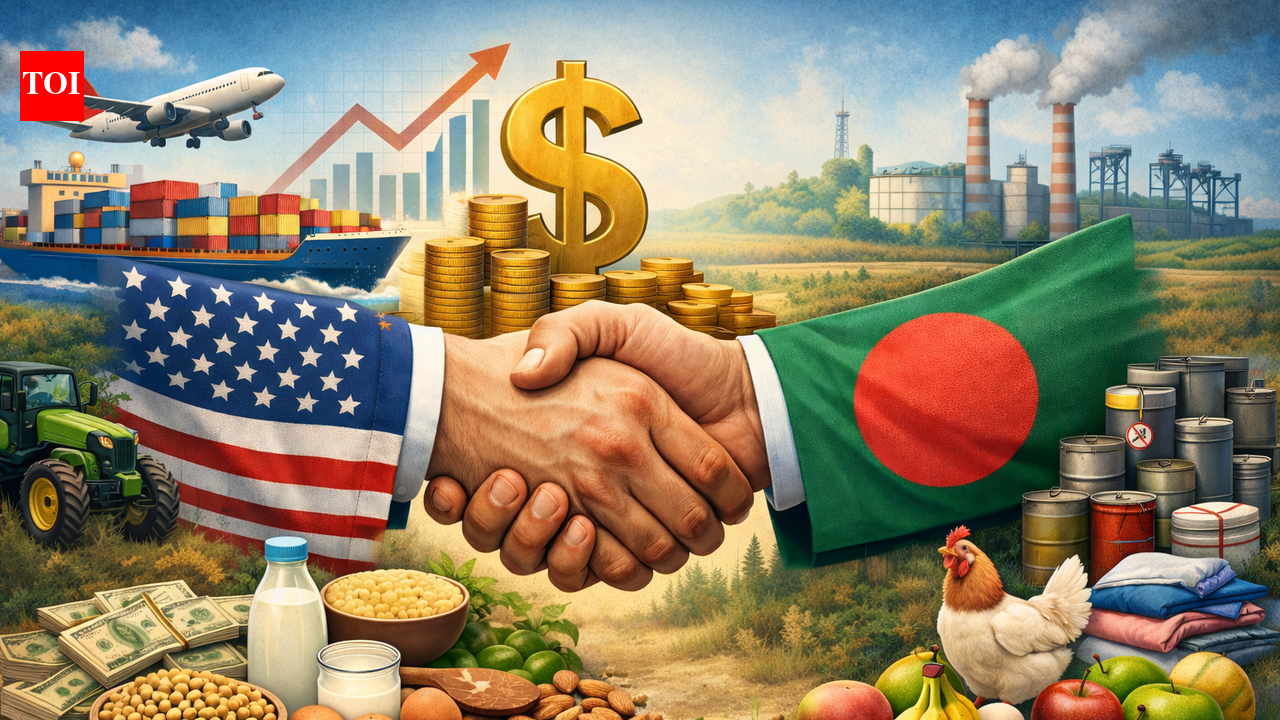
The United States and Bangladesh on Monday finalised the United States–Bangladesh Agreement on Reciprocal Trade, wrapping up negotiations as both countries stepped in to strengthen bilateral economic ties. Under the revised framework, Bangladeshi exports to the American market will attract a 19% tariff, marginally lower than the 20% imposed in August and significantly below the original reciprocal rate of 37%. The agreement was signed by US Trade Representative Jamieson Greer and Bangladesh’s Adviser for Commerce, Textiles and Jute, and Civil Aviation and Tourism, Sheikh Bashir Uddin, in the presence of Bangladesh Commerce Secretary Mahbubur Rahman and Assistant US Trade Representative Brendan Lynch.
Key terms of the agreement
- Perks for Bangladesh: Washington will reduce the reciprocal tariff imposed under Executive Order 14257 to 19% on Bangladeshi goods. In addition, selected products listed in Annex III of Executive Order 14346 will qualify for a zero-tariff rate. The United States has committed to creating a mechanism under which certain textile and apparel products from Bangladesh can qualify for a zero reciprocal tariff rate. Under this arrangement, a yet-to-be-finalised volume of garments and textile imports from Bangladesh will be allowed to enter the US at the reduced rate. The permitted volume will depend on Bangladesh’s imports of American textile inputs, such as US-produced cotton and man-made fibres, effectively tying the benefit to the level of US exports.
- Perks for US: Bangladesh will grant wide preferential entry to US industrial and agricultural products, covering chemicals, medical devices, machinery, automobiles and components, ICT equipment, energy supplies, soy items, dairy, beef, poultry, nuts and fruit.
- Both governments will seek to remove Bangladeshi non-tariff barriers affecting trade and investment. Measures include recognising vehicles meeting US federal safety and emission rules, accepting US Food and Drug Administration certificates and prior approvals for pharmaceuticals and medical devices, and ending import restrictions or licensing on US remanufactured products and parts.
- Bangladesh will enable trusted cross-border data flows, support a lasting WTO ban on customs duties for electronic transmissions, rely on science- and risk-based systems for safe American food and farm imports, open up the insurance sector, digitise customs and adopt sound regulatory practices.
- Commitments have also been made on labour. Bangladesh will act to uphold internationally recognised rights, prohibit imports made through forced or compulsory labour, amend legislation to secure freedom of association and collective bargaining, and tighten enforcement.
- Dhaka has pledged to maintain strong environmental safeguards, implement its environmental laws, improve trade facilitation at the border and tackle market distortions linked to subsidies and state-owned firms. Furthermore, the South Asian giant has committed to reinforce and apply comprehensive anti-corruption legislation.
- On intellectual property, Bangladesh will pursue tougher protection and enforcement, including ratifying or joining certain global treaties. It will also introduce provisions on geographical indications aimed at ensuring continued US market access, particularly for producers of cheese and meat that use common names.
- The two countries intend to align more closely on economic and national security matters, strengthening supply chains and innovation while working together against unfair trade practices, duty evasion, export control risks and by exchanging information on inbound investment.
- American agencies such as the Export-Import Bank and the US International Development Finance Corporation may, where eligible and in accordance with law, look at backing investment in priority Bangladeshi sectors alongside US private firms.
- The two countries also acknowledged recent and upcoming commercial agreements spanning agriculture, energy and technology. These include the procurement of aircraft, the purchase of around $3.5 billion worth of American agricultural commodities such as wheat, soy, cotton and corn, and energy imports estimated to be valued at $15 billion over the next 15 years.
Both sides said they would proceed promptly, following their respective internal processes, to complete formalities required for the Agreement on Reciprocal Trade to take effect.
Business
Middle East crisis: Jubilant FoodWorks reports some Domino’s outlets affected by LPG shortage – The Times of India

Jubilant FoodWorks Ltd (JFL), which operates Domino’s Pizza and Dunkin Donuts in India, has reported constraints in LPG cylinder supplies across parts of its store network due to the ongoing West Asia war, according to ET.In a filing to the BSE, the company said, “Operational impact at this stage is limited and being actively managed. The company is taking several steps to conserve LPG and working overtime to move to alternate energy sources like electricity and piped natural gas (PNG).”It added that it is in continuous touch with oil marketing companies to track developments and respond to the evolving situation. “The company is in constant engagement with oil marketing companies (OMCs) to remain apprised of the latest developments and plan operational responses accordingly, given the rapidly evolving nature of the situation,” the filing said.The company noted that it is closely monitoring the situation as supply disruptions persist.The impact is being felt across the restaurant industry, with several chains facing similar challenges due to LPG shortages.On March 10, the National Restaurant Association of India (NRAI) had advised its five lakh members to consider shorter operating hours, reduce items requiring long cooking times or deep frying, and adopt fuel-saving measures such as using lids while cooking, in view of supply constraints linked to the Gulf war.
Business
Russia sells reserve gold for first time in 25 years to fund Ukraine war deficit: Report – The Times of India

Russia has begun selling physical gold from its central bank reserves for the first time in 25 years, as the government seeks to plug a widening budget deficit driven by sustained military expenditure, according to a report by Berlin-based news outlet bne IntelliNews.Regulatory data show that between 2022 and 2025, Russia sold gold and foreign currency worth over RUB 15 trillion ($150 billion), followed by an additional RUB 3.5 trillion ($35 billion) in just the first two months of 2026, the report noted. In January alone, the Central Bank of Russia sold 300,000 ounces of gold, followed by another 200,000 ounces in February.The move marks a significant shift in reserve management. Earlier, gold transactions were largely notional, involving transfers between the Ministry of Finance and the central bank without physical movement of bullion. In recent months, however, the central bank has started selling actual gold bars into the market.As a result, Russia’s gold holdings have declined to 74.3 million ounces, the lowest level in four years. The disposal of 14 tonnes in January and February is the largest two-month sale since the second quarter of 2002, when 58 tonnes were offloaded in a single tranche.The sales come as Russia’s fiscal position comes under increasing strain. The government ended 2025 with a budget deficit of 2.6 per cent of GDP, compared to an initial projection of 0.5 per cent, Berlin-based bne IntelliNews report noted. Economists estimate the actual deficit could be closer to 3.4 per cent, with some payments deferred to 2026 to limit the reported gap.Pressure on the budget has intensified as oil prices weakened in the second half of the year and US sanctions tightened, reducing the contribution of oil and gas tax revenues to about 20 per cent of total revenues — roughly half of pre-war levels.The decision to sell gold has also been influenced by the sharp rise in bullion prices to above $5,000 per ounce. This surge has pushed Russia’s international reserves to over $809 billion as of February 28, including around $300 billion of assets frozen in the West, according to the Central Bank of Russia. Of this, gold reserves alone are valued at about $384 billion.Russia currently holds more than 2,000 tonnes of gold, making it the world’s fifth-largest sovereign holder, according to World Gold Council data. The country had built up these reserves over the years to reduce dependence on dollar-denominated assets, especially after sanctions imposed following the annexation of Crimea in 2014 and further tightened after the invasion of Ukraine in 2022.Since 2022, the Ministry of Finance has relied on multiple funding channels to manage budget pressures. These include drawing from the National Welfare Fund, which still holds around RUB 4 trillion, increasing issuance of domestic OFZ treasury bonds, and raising value-added tax rates, which account for about 40 per cent of government revenues.The shift to selling physical gold suggests that Russia is now tapping its liquid reserve buffers more directly, underlining the growing fiscal strain as the conflict in Ukraine continues into its fourth year.

Travelers wait in line at a Transportation Security Administration (TSA) checkpoint at George Bush Intercontinental Airport (IAH) in Houston, Texas, US, on Thursday, March 26, 2026.
Mark Felix | Bloomberg | Getty Images
TOKYO/NEW YORK — Genevieve Price considers herself a great flight hacker.
The 35-year-old naturopathic doctor based in San Diego usually buys basic economy tickets when she visits her family in New Jersey and then uses her Alaska Airlines frequent flier status to pick a seat, something that’s usually not allowed for those no-frills fares.
“I like to travel a lot,” Price told CNBC at New York’s John F. Kennedy International Airport, where she was returning from Rome.
But Price said she has her limits, and is planning to cap the spending she does on future flights, such as no more than $900 to Rome, where her partner is from.
Consumers’ willingness to fly is being put to the test this spring as soaring fuel prices are leading to higher airfares. Cathay Pacific, SAS, Finnair and others are among the carriers that have already raised fares.
Travelers also have to contend with hourslong airport security lines in the U.S. because of the second government shutdown in half a year that’s hitting the Transportation Security Administration, leaving many frustrated.
Fuel and fares
Fuel at major U.S. airports was going for $3.98 on Wednesday, up nearly 60% since before the U.S. and Israel attacked Iran on Feb. 28.
The conflict has meant crisis for the aviation industry, particularly in the Middle East, where airspace closures have forced carriers to cancel flights and take longer and costlier routes.
Airlines will brief investors starting early next month on the longer-term impacts, but they immediately started raising airfare or increasing fuel surcharges on tickets to help cover the rising costs.
United Airlines CEO Scott Kirby told reporters at a company event in Los Angeles this week that airfare could go up 20% this year. Customers appear willing to keep booking even though carriers are passing those high fuel costs along to travelers, he added.
Other airlines have also said demand has held up.
Delta Air Lines CEO Ed Bastian told a JPMorgan industry conference earlier this month that demand has remained strong in recent weeks and that the airline is “well-positioned” to recapture the spike in fuel from its own sales.
U.S. airlines have seen solid demand for years. International travel has been a strong point, particularly for high-end leisure travel, which has brought so many visitors that governments from Japan to Spain have taken steps to reduce overtourism, while locals have protested.
But airline executives said they will prune flights if demand falls.
“We’re certainly going to be nimble in terms of capacity to make sure that supply and demand stay in balance,” American Airlines CEO Robert Isom said at the JPMorgan conference.
United, for its part, is preparing for fuel prices to remain elevated through next year and is cutting about 3 percentage points off of its capacity in off-peak travel times, like midweek and redeye flights, Kirby told employees this month.
Fares up
Some of the higher fares are already here.
Fares for flights across the Atlantic from the U.S. were going for $1,059, with three weeks advanced purchase, up 26.5% from the prior week, according to a Deutche Bank note on Monday.
Domestic routes, including transcontinental flights and flights to and from Hawaii, were also up, the report said.
Mary Jean Erschen-Cooke, a nurse from Cuba City, Wisconsin, who was setting out earlier this month from Tokyo on a 10-day trip through Japan with her husband, Paul, said she has a host of domestic U.S. family trips this year.
“We haven’t booked our flights, but we should,” she said, adding that she and her husband would consider driving for one of them. She noted that gasoline prices are also up, which will affect driving.
Security snarls
The TSA PreCheck line at terminal B in LaGuardia Airport in East Elmhurst, Queens, New York City, on March 27, 2026.
Leslie Josephs | CNBC
Along with higher airfare, travelers are facing challenges at airports this spring.
TSA officers have been working without regular pay since Feb. 14 because of an impasse in Congress over funding for the Department of Homeland Security. Nearly 500 TSA officers have quit, according to DHS and elevated call-outs have left airports short-staffed.
That’s led to long security lines at major airports around the U.S., including in Houston, New York, and Atlanta. Wait times have exceeded three hours in some locations — longer than some of the flights those airports offered — as lines have snaked through terminals and outside of airports.
Elizabeth Leddy, a 38-year-old classical pianist based in New York, said she flies several times a year. The long security lines, which were running nearly 90 minutes at LaGuardia Airport for TSA PreCheck flyers on Friday, could be a deterrent for her doing that in the future.
Leddy said that if the security line was three to four hours long, “I feel like I could just drive.”
DHS has blamed Democrats for the closure, which has become the longest partial shutdown in U.S. history. As of Friday afternoon, the Senate had passed a potential deal to end the shutdown, thought its fate was unclear.
President Donald Trump separately said he would sign an order to get the more than 50,000 TSA officers paid. TSA officers will start getting paychecks as early as Monday, DHS said Friday.
The Trump administration this week sent Immigration and Customs Enforcement officers to several U.S. airports, though DHS hasn’t specified what their duties are. ICE officers, who also sit under the DHS umbrella, are still getting paid during the partial shutdown.
ICE officers were seen at New York’s LaGuardia Airport on Friday morning watching security lines.
“Even if this manages to slightly reduce wait times (we’re still reading about terrible wait times, so we’re far from big improvement), ICE presence could cause some individuals to fear traveling and upset TSA workers not getting paid,” Bernstein said in a note on Thursday. “Seems possible passenger throughput softens over the coming days and TSA screening YoY growth for this week turns slightly negative.”


Patriots’ Super Bowl appearance was no fluke, team legends say: ‘They’re for real’
Middle East crisis: Jubilant FoodWorks reports some Domino’s outlets affected by LPG shortage – The Times of India

Alex Vesia, Dodgers pitcher who lost infant daughter, gets standing ovation after scoreless return to mound

-
 Business1 week ago
Flipkart group CFO to leave co amid IPO plans – The Times of India
-

 Fashion1 week ago
China’s textile & apparel exports surge 17% to $50 bn in Jan-Feb 2026
-

 Sports1 week ago
Rating Adidas’ 2026 World Cup away shirts: Argentina, Spain, Mexico and more
-

 Sports1 week ago
American Conference Commissioner Tim Pernetti thanks Trump for Army-Navy game executive order
-
Tech1 week ago
The Corsair 4000D RS PC Case Keeps Your System Cool
-

 Tech1 week ago
Gamers Hate Nvidia’s DLSS 5. Developers Aren’t Crazy About It, Either
-

 Tech1 week ago
‘Uncanny Valley’: Nvidia’s ‘Super Bowl of AI,’ Tesla Disappoints, and Meta’s VR Metaverse ‘Shutdown’
-
 Business4 days ago
Property Play: Home flippers see smallest profits since the Great Recession, real estate data firm says