

Business
David Ellison has a rocky history at the box office. Buying Warner Bros. could fix that


Chairman & CEO Paramount David Ellison attends the UFC 324 event at T-Mobile Arena on January 24, 2026 in Las Vegas, Nevada.
Jeff Bottari | Ufc | Getty Images
If there’s one thing that Paramount Skydance CEO David Ellison knows well, it’s an impossible mission.
Ellison, producer of five of the “Mission: Impossible” films, has been trying to buy Warner Bros. Discovery for nearly six months. In September, he sent an initial, unsolicited offer to WBD, prompting the rival media company to explore a sale process that resulted in an agreement with Netflix to sell the famed Warner Bros. film studio and WBD’s prestige streaming assets.
Ellison launched a hostile tender offer and, separately, was welcomed back to the negotiating table with WBD under a seven-day waiver from Netflix. This week, Paramount upped its offer for the entirety of WBD.
The Warner Bros. movie studio is a big part of why Ellison has been so committed to winning over WBD’s board and its shareholders.
Last year, Warner Bros. was the second-highest grossing studio at the domestic box office. Paramount was fourth.
A longtime Hollywood executive, Ellison has produced some massive hits at the box office, but his track record has been far from consistent.
Where Netflix has a fraught relationship with theatrical releases — disrupting the traditional business and opting for years to prioritize streaming films for its subscribers — Ellison’s production company, Skydance, has followed the tried-and-true theatrical playbook.
Taking ownership of Warner Bros. would be a game changer for either company.
“If a merger were to be approved, the entity that then grabs up Warner Bros. would add tremendous horsepower both in terms of brand identity and revenue generating potential to their portfolio,” said Paul Dergarabedian, head of marketplace trends at Comscore. “So, it is understandable why the competition is fierce among the potential suitors vying for their chance to acquire the studio.”
A history of Skydance at the box office
Skydance released its first theatrical feature in 2006, a World War I drama featuring James Franco as a U.S. fighter pilot. Over the last two decades, the studio has launched nearly 30 films, the majority of which were in partnership with Paramount, according to data from Comscore.
Paramount and Skydance completed their merger, engineered by Ellison, in August.
Skydance’s biggest successes have come from one source in particular — Tom Cruise. The studio’s six highest-grossing films globally all star Cruise, including five “Mission: Impossible” films and the breakout 2022 hit “Top Gun: Maverick.”
Highest-grossing Skydance films globally
- “Top Gun: Maverick” (2022) — $1.4 billion
- “Mission: Impossible — Fallout” (2018) — $791 million
- “Mission: Impossible — Ghost Protocol” (2011) — $694 million
- “Mission: Impossible — Rogue Nation” (2015) — $682 million
- “Mission: Impossible — The Final Reckoning” (2025) — $599 million
- “Mission: Impossible — Dead Reckoning: Part One” (2023) — $571 million
- “World War Z” (2013) — $540 million
- “Star Trek Into Darkness” (2013) — $467 million
- “Transformers: Rise of the Beasts” (2023) — $441 million
- “Terminator Genisys” (2015) — $440 million
Source: Comscore
Having a billion-dollar film under your belt is no small feat, especially in the wake of the pandemic.
The theatrical business has been in flux in recent years as consumer habits have shifted, studios grapple with how long movies should play in cinemas before hitting the home market, and streaming siphons away potential releases.
For comparison, Disney has released six billion-dollar films since 2021: “Avatar: The Way of Water,” “Inside Out 2,” “Deadpool & Wolverine,” “Moana 2,” “Zootopia 2” and “Avatar: Fire and Ash.”
Warner Bros. had 2023’s “Barbie,” Universal had “The Super Mario Bros. Movie” that same year, and Sony had “Spider-Man: No Way Home” in 2021, according to Comscore data.
Tom Cruise in “Top Gun: Maverick”
Source: Paramount
However, “Top Gun: Maverick” is a bit of an outlier for Skydance. In addition to being the studio’s only billion-dollar film, it’s also the only film in its library to exceed $230 million domestically.
In fact, only five of Skydance’s features to date have generated more than $200 million in the U.S. and Canada.
Skydance’s highest-grossing domestic films
- “Top Gun: Maverick” (2022) — $718 million
- “Star Trek Into Darkness” (2013) — $228 million
- “Mission: Impossible — Fallout” (2018) — $220 million
- “Mission: Impossible — Ghost Protocol” (2011) — $209 million
- “World War Z” (2013) — $209 million
Source: Comscore
Globally, the production company has seen seven of its films generate more than $500 million in ticket sales, which would be a bigger feat — if budgets for many of these films weren’t so high.
“The challenge for Ellison and Skydance, as it is for every studio, production company, and distributor, is to keep budgets in line particularly for latter installments of major franchises as these tend to have diminishing returns as compared the earlier releases to justify the continued investment in these movie franchises,” said Dergarabedian.
Of course, Skydance split production costs with its studio partners, so it’s unclear exactly how much the company put toward each film it produced. Still, many of its franchise films saw budgets balloon with each new installment.
Look at the most recent Mission: Impossible film. “Mission Impossible: The Final Reckoning” generated $599 million at the global box office, the fourth-best showing for a film in the franchise. However, the film had a reported budget of $400 million. That’s before marketing costs, which usually run at about half of the production budget.
General views of the TCL Chinese Theatre promoting the new Tom Cruise film ‘Mission: Impossible The Final Reckoning’ in IMAX on May 23, 2025 in Hollywood, California.
Aaronp/bauer-griffin | Gc Images | Getty Images
So, Skydance in conjunction with Paramount would have spent an estimated $600 million ahead of the “The Final Reckoning’s” release in theaters. And that $599 million brought in from ticket sales gets split.
Studios share box-office proceeds with theater operators, typically in a 50-50 split by the end of a film’s run in theaters.
The result is often a movie that performed well at the box office, but ultimately was not profitable for the studios that produced it. And unlike some franchises — think Marvel, Star Wars or Harry Potter — Mission: Impossible doesn’t have a robust merchandising arm or as much demand from fans for things like toys, apparel or collectibles.
A mountain of content
In merging with Paramount, Ellison’s Skydance now has more properties that fall under the production company’s designation. That includes the lucrative Sonic the Hedgehog franchise and upcoming films like “Scream 7,” “Paw Patrol 3,” “Street Fighter,” “Scary Movie 6” and “Focker-in-Law,” the latest installment in the Robert De Niro-led Meet the Parents franchise.
However, Paramount’s slate of franchises still aren’t quite the heavy hitters that WBD carries on its roster.
Still from Paramount’s “Sonic the Hedgehog 2.”
Paramount
“Warner Bros. is one of the crown jewels of the theatrical distribution,” said Dergarabedian. “Their slate of films, filmmaker relationships, brand recognition, and reputation as one of the premier and iconic movie studios makes them a coveted asset by any player in the entertainment space.”
WBD has in its library DC’s superheroes, Harry Potter, Lord of the Rings, Game of Thrones, Looney Tunes and Scooby-Doo. It is also the distributor of Legendary’s Dune and Godzilla and King Kong franchises.
“In Paramount’s specific case, the studio’s box office market share has often been challenged to keep pace with competitors and its own peak performance in the years leading up to 2015,” said Shawn Robbins, director of analytics at Fandango and founder of Box Office Theory. “While occasional hits such as the Sonic, A Quiet Place, and Scream franchises have provided bright spots, plus ‘Top Gun: Maverick’ catching lightning in a bottle four years ago, some of the studio’s most bankable IP has seen diminishing returns among modern moviegoers.”
Paramount Skydance needs consistency at the box office and well-known and beloved franchises are one way to do that. Of course, just having a big name doesn’t guarantee box-office success, but it lowers the barrier to entry.
“Paramount is looking to mine every opportunity it can following the recent conclusion of Tom Cruise’s Mission: Impossible series, the regression of Transformers from its biggest blockbuster dollar days, and the cinematic dormancy of Star Trek as that brand has been re-focused toward multiple streaming series targeted at its predominately older audience,” Robbins said.
Disclosure: Versant is the parent company of CNBC and Fandango.






Crude prices fall back below $100 a barrel as markets hope an agreement can be reached between the two sides.
Source link

Broad-based rally fuelled by de-escalation hopes as investors turn optimistic about global peace
KARACHI:
The Pakistan Stock Exchange (PSX) opened on a distinctly bullish note as a renewed whisper of global calm set the tone for trading on Tuesday. The benchmark KSE-100 Index surged sharply in early hours, reflecting a wave of optimism among investors. At 9:39am, the index was hovering around 164,322.07, with gains of 3,730.74 points or 2.32%. It was then trading at 164,782.58, advancing with 4,191.25 points, or 2.61% at 12:34pm.
The rally follows growing expectations of a possible resumption of diplomatic talks between the United States and Iran, reviving hopes of de-escalation in a conflict that has shaken global financial markets.
The shift in sentiment comes in stark contrast to the previous session, where the market endured heavy losses amid failed negotiations and a spike in oil prices, triggering widespread panic selling across sectors.
Today, however, investors appear to be pricing in a different narrative – one where diplomacy may yet prevail. The prospect of renewed dialogue has eased concerns over supply disruptions and runaway energy prices, both critical variables for Pakistan’s import-heavy economy.
Read: PSX plunges over 6,600 points as US-Iran talks end without deal
Early gains were broad-based, led by index-heavy sectors such as automobile assemblers, cement, commercial banks, fertiliser, oil and gas exploration companies, OMCs, power generation and refinery, as participants moved to rebuild positions after the recent sell-off.
The sharp rebound underscores the market’s sensitivity to geopolitical signals, where even tentative progress towards peace can ignite strong bullish momentum.
Despite the upbeat start, analysts caution that volatility may persist, with much depending on whether diplomatic efforts translate into concrete outcomes. “Investors are optimistic about the likely resumption of talks between the US and Iran,” AKD Securities Director Research Mohammed Awais Ashraf told The Express Tribune.
Timely affirmation from Saudi Arabia and Qatar to bridge the gap in external financing to be created by the payment of UAE $3.5 billion this month and higher imports due to elevated oil prices have also helped to uplift the sentiment, he added. This is also likely to help in the timely approval of a $1.2 billion disbursement from the International Monetary Fund (IMF) after the approval of its executive board, Ashraf predicted.
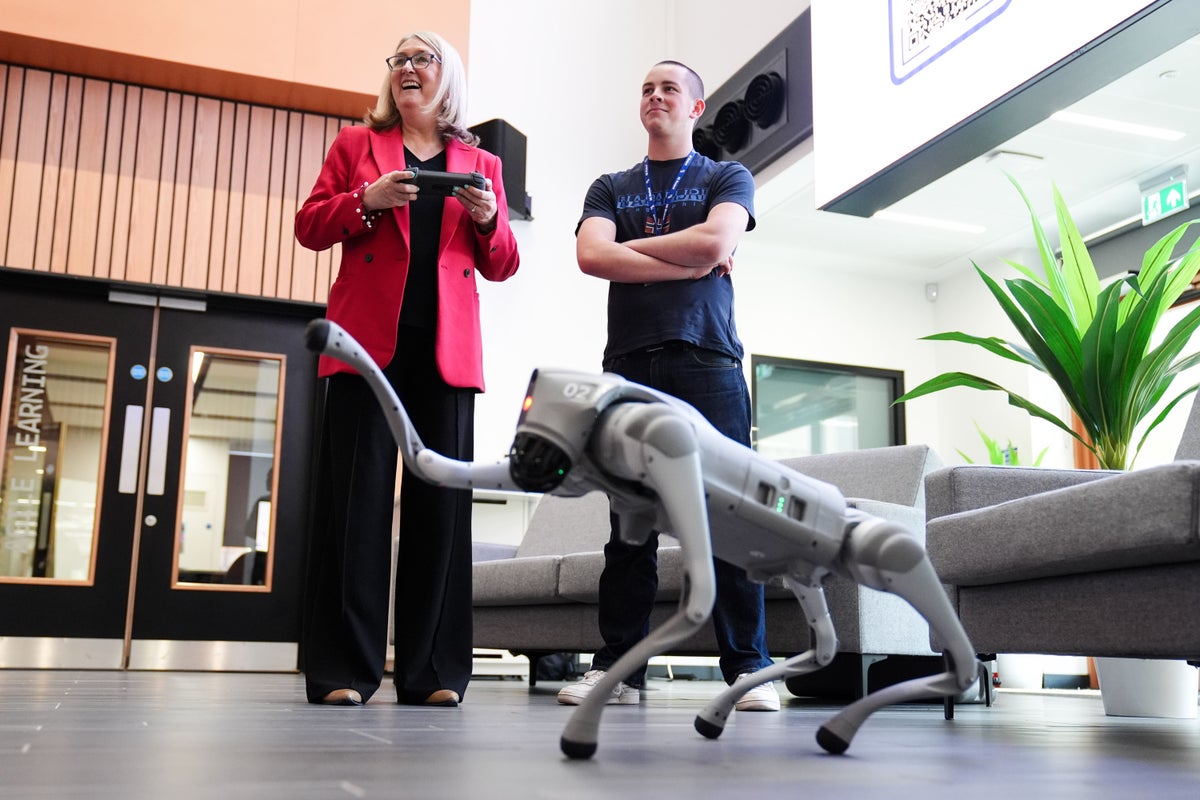
Around 65,000 young people will be able to train to enter the defence, clean energy, digital and manufacturing industries under the latest round of Government investment into colleges.
The Government will provide £175 million for 19 new Technical Excellence Colleges across the country to deliver training in sectors deemed important for the future of the UK.
Minister for skills Baroness Jacqui Smith said the investment would help build a pipeline of skilled workers for industries key to Britain’s future.
The Government has identified the areas most likely to help grow the economy, Baroness Smith told the Press Association, and said given the war happening in the Middle East, the UK needed to be able to support different ways of getting its energy.
“The Clean Energy (technical excellence colleges) that we’re announcing today will help us to develop that to speed up our shift to clean energy, to protect our energy supply and to help people with their bills,” she said.
“In the area of defence, where, given the instability and some of the new challenges to our defence in the world, and our contribution to that, this Government has pledged a big increase in defence spending that needs to support our armed forces and our capacity, but that spending also needs to deliver quality jobs to the UK defence industry, who will need skilled people in order to be able to deliver it.”
It is estimated nearly 600,000 additional workers will be needed in these key sectors by 2030, the Department for Education said.
If follows the first wave of 10 technical excellence colleges announced last year specialising in construction.
Prime Minister Sir Keir Starmer said: “I want every young person to know there is a clear route into well‑paid work, whatever their background. These colleges put technical skills front and centre, opening up high‑quality jobs in the industries driving Britain’s future.
“We are backing talent across the country, strengthening our workforce and making sure opportunity is built into the system – not left to chance.”
The colleges may spend the funding they receive on specialist equipment, developing new courses, training more specialist staff, and more.
On Monday, Baroness Smith met students and staff at Milton Keynes College, selected as a technical excellence college for digital, where students are already learning about robotics and artificial intelligence (AI).
It comes after the latest figures showed nearly a million (957,000) 16 to 24-year-olds were “Neet” (not in education, employment or training) in October to December 2025.
The high number of young people who were Neet was a “loss of opportunity” and a “loss for the country”, Baroness Smith told PA.
“That’s why we need really high-quality provision for young people between 16 to 19 to be able to access,” she said.
“We need our schools to better identify the young people who are potentially going to become Neet, we need them to take responsibility for making sure that young people have got the places, the college places, the apprenticeships, the jobs to go into.
“And we need brilliant colleges like Milton Keynes, where I am today, to be supported, to be able to provide the opportunities for young people who would otherwise be lost at such a crucial time in their lives and for the future of the skills that we need as a country as well.”
The Government has set a target for two-thirds of young people to be in higher education, higher-level training or doing a gold standard apprenticeship by age 25.
Jawad Al Midani, 21, started studying at Milton Keynes College for a Level 1 course, and has since worked his way up to studying for a Higher National Diploma (HND) in cyber security.
“I feel as soon as I finish my qualifications I’ll be ready to start my career,” he told PA.
Christian Proctor, 18, who is studying for a Higher National Certificate (HNC) in games design and will go on to an HND next year, said he was confident the skills he was learning would equip him for the next step once he finished college.
The 19 new Technical Excellence Colleges are as follows:
Defence
– Blackpool and The Fylde College– City College Plymouth– Lincoln College– RNN Group– Yeovil College
Clean Energy
– Colchester Institute– South Bank Colleges– The City of Liverpool College– The Education Training Collective– University Centre Somerset College Group
Digital and Technologies
– Birmingham Metropolitan College– Capital City College Group– Gloucestershire College– LTE Group– Milton Keynes College
Advanced Manufacturing
– City of Wolverhampton College– New College Durham– Newcastle and Stafford College Group– Weston College of Further and Higher Education


North India cotton yarn prices steady amid slow demand

Ryan Reynolds ‘unwantedly’ caught in Blake Lively legal mess

Transfer rumors, news: Bayern, Barça eye move for Milan’s Leão

-

 Fashion7 days ago
India’s exports face reset as EU links trade to carbon metrics: EY
-

 Entertainment6 days ago
Queen Elizabeth II emotional message for Archie, Lilibet sparks speculation
-

 Tech6 days ago
As the Strait of Hormuz Reopens, Global Shipping Will Take Months to Recover
-

 Tech6 days ago
Azure customers up in arms over ‘full’ UK South region | Computer Weekly
-

 Entertainment1 week ago
Lamar Odom shocking response to Khloé Kardashian account of his overdose
-

 Sports1 week ago
With Messi goal, Inter Miami open new stadium with dream moment
-

 Tech5 days ago
This AI Button Wearable From Ex-Apple Engineers Looks Like an iPod Shuffle
-

 Fashion6 days ago
CII submits 20-pt agenda to Indian govt to back firms hit by Iran war