

Business
Trade deal talks with Qatar from next week – The Times of India

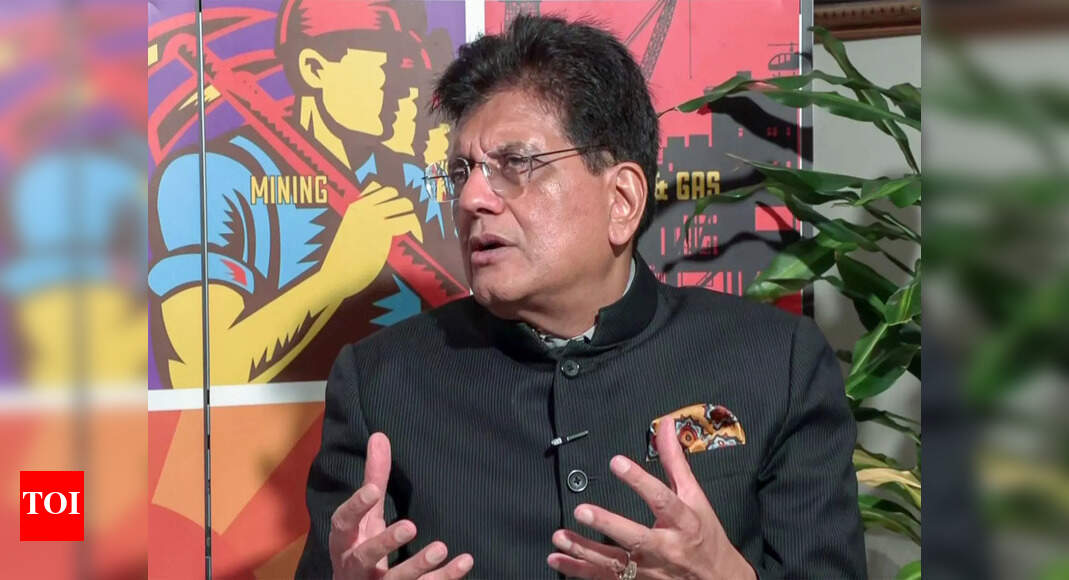
NEW DELHI: Commerce and industry minister Piyush Goyal will visit Doha next week to kick off talks for a bilateral trade agreement, adding another Gulf nation to the bouquet of countries negotiating trade treaties with India. UAE already has a pact with India.Sources said the minister will travel to Singapore as well, an ASEAN member with which India has a Comprehensive Economic Cooperation Agreement (CECA) but is not satisfied with the outcomes. He will also meet European trade commissioner Maros Sefcovic on the sidelines of the G20 meet in South Africa in Nov. India and EU are trying to conclude an FTA by the year-end. The talks come amid turbulence in the US-India trade relations with 50% tariff on Indian goods entering American markets from Aug 27.At a CII event, Goyal described India as the fastest-growing large economy in a world “full of uncertainty, turbulence and volatility.” He said that India is focusing on self-reliance by strengthening capabilities and making supply chains more resilient to counter the “weaponisation of trade.”






Crude prices fall back below $100 a barrel as markets hope an agreement can be reached between the two sides.
Source link
Around 65,000 young people will be able to train to enter the defence, clean energy, digital and manufacturing industries under the latest round of Government investment into colleges.
The Government will provide £175 million for 19 new Technical Excellence Colleges across the country to deliver training in sectors deemed important for the future of the UK.
Minister for skills Baroness Jacqui Smith said the investment would help build a pipeline of skilled workers for industries key to Britain’s future.
The Government has identified the areas most likely to help grow the economy, Baroness Smith told the Press Association, and said given the war happening in the Middle East, the UK needed to be able to support different ways of getting its energy.
“The Clean Energy (technical excellence colleges) that we’re announcing today will help us to develop that to speed up our shift to clean energy, to protect our energy supply and to help people with their bills,” she said.
“In the area of defence, where, given the instability and some of the new challenges to our defence in the world, and our contribution to that, this Government has pledged a big increase in defence spending that needs to support our armed forces and our capacity, but that spending also needs to deliver quality jobs to the UK defence industry, who will need skilled people in order to be able to deliver it.”
It is estimated nearly 600,000 additional workers will be needed in these key sectors by 2030, the Department for Education said.
If follows the first wave of 10 technical excellence colleges announced last year specialising in construction.
Prime Minister Sir Keir Starmer said: “I want every young person to know there is a clear route into well‑paid work, whatever their background. These colleges put technical skills front and centre, opening up high‑quality jobs in the industries driving Britain’s future.
“We are backing talent across the country, strengthening our workforce and making sure opportunity is built into the system – not left to chance.”
The colleges may spend the funding they receive on specialist equipment, developing new courses, training more specialist staff, and more.
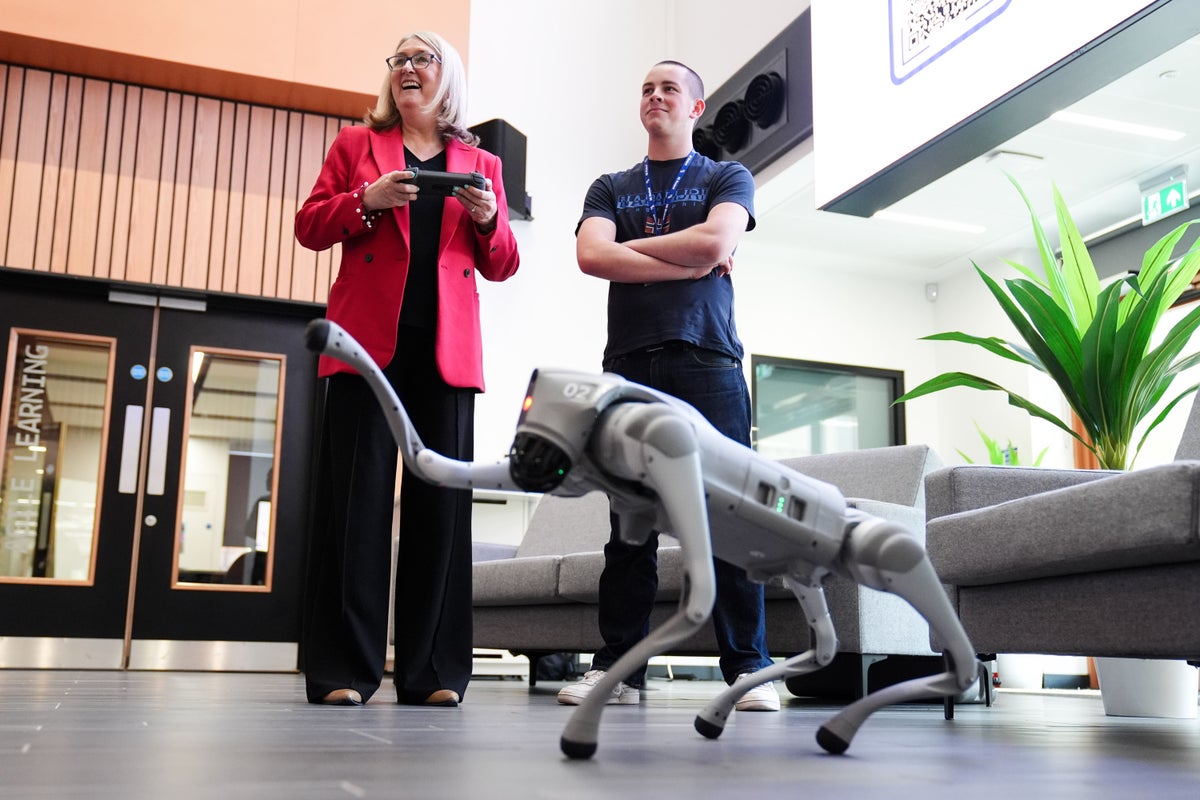
On Monday, Baroness Smith met students and staff at Milton Keynes College, selected as a technical excellence college for digital, where students are already learning about robotics and artificial intelligence (AI).
It comes after the latest figures showed nearly a million (957,000) 16 to 24-year-olds were “Neet” (not in education, employment or training) in October to December 2025.
The high number of young people who were Neet was a “loss of opportunity” and a “loss for the country”, Baroness Smith told PA.
“That’s why we need really high-quality provision for young people between 16 to 19 to be able to access,” she said.
“We need our schools to better identify the young people who are potentially going to become Neet, we need them to take responsibility for making sure that young people have got the places, the college places, the apprenticeships, the jobs to go into.
“And we need brilliant colleges like Milton Keynes, where I am today, to be supported, to be able to provide the opportunities for young people who would otherwise be lost at such a crucial time in their lives and for the future of the skills that we need as a country as well.”
The Government has set a target for two-thirds of young people to be in higher education, higher-level training or doing a gold standard apprenticeship by age 25.
Jawad Al Midani, 21, started studying at Milton Keynes College for a Level 1 course, and has since worked his way up to studying for a Higher National Diploma (HND) in cyber security.
“I feel as soon as I finish my qualifications I’ll be ready to start my career,” he told PA.
Christian Proctor, 18, who is studying for a Higher National Certificate (HNC) in games design and will go on to an HND next year, said he was confident the skills he was learning would equip him for the next step once he finished college.
The 19 new Technical Excellence Colleges are as follows:
Defence
– Blackpool and The Fylde College– City College Plymouth– Lincoln College– RNN Group– Yeovil College
Clean Energy
– Colchester Institute– South Bank Colleges– The City of Liverpool College– The Education Training Collective– University Centre Somerset College Group
Digital and Technologies
– Birmingham Metropolitan College– Capital City College Group– Gloucestershire College– LTE Group– Milton Keynes College
Advanced Manufacturing
– City of Wolverhampton College– New College Durham– Newcastle and Stafford College Group– Weston College of Further and Higher Education

Consumer spending on non-food items remained “tepid” in March as shoppers exercised heightened caution amid ongoing conflict in the Middle East, new figures reveal.
Data from the British Retail Consortium (BRC) and KPMG shows that non-food sales saw a modest 0.9% year-on-year increase last month, falling short of the 12-month average of 1.1%.
This subdued performance was further underscored by online non-food sales, which rose by a mere 0.1%, significantly below the annual average of 1%, indicating a dip in consumer confidence.
While overall UK retail sales climbed by 3.6% compared to a year ago, surpassing the 12-month average of 2.6%, this was largely attributed to an early Easter and inflationary pressures. Food sales experienced an artificial boost, increasing by 6.8%, which skewed the total retail figures.
Demand proved robust for categories such as computers, toys, and homeware. However, the clothing and footwear sectors continued to face challenges. Furthermore, the uncertainty surrounding international travel due to the Middle East situation negatively impacted sales of travel-related goods.
BRC chief executive Helen Dickinson said: “An early Easter provided a much-needed boost to food sales as families came together over the long weekend.
“Retailers hope that the Middle East ceasefire will bring lasting stability, but the outlook remains uncertain.
“Damage to supply chains has already been done, and rising costs – from shipping and fertiliser to insurance and commodities – are piling yet more pressure on to already stretched retailers.
“Government must act decisively and boldly now to curb inflation by delaying domestic policies that would push prices even higher for shoppers.”
Linda Ellett, UK head of consumer, retail and leisure at KPMG, said: “Food and drink continue to drive monthly retail sales growth, with inflation a key factor.
“Non-food sales growth remains tepid, growing at under 1% so far this year, as consumer spending caution is heightened by the current and potential impact of the Middle East conflict.”
Separate figures from Barclays show travel spending declined by 3.3% in March after five years of growth as trips abroad were delayed or swapped for staycations.
Consumer card spending increased 0.9% year on year, down from February’s 1%, the bank’s data shows.
Essential spending returned to growth – up 0.5% – for the first time since July last year as fuel prices surged, while discretionary spending growth slowed to 1.1%, driven by the decline in travel, for the first time since 2021.
However, a survey for Barclays found overall consumer resilience remained strong, with 71% of UK adults feeling confident in their ability to live within their means each month.
In response to uncertainty around the Middle East conflict, 14% said they were delaying major purchases or financial decisions, while the same proportion were building up a savings buffer in case costs rise.
Some 74% anticipate ongoing tensions will continue to affect the cost of living throughout the rest of the year.
Jack Meaning, chief UK economist at Barclays, said: “Shoppers delaying major purchases and building up a savings buffer in response to the shock from the Middle East reinforces our view that activity will be muted in the coming months.
“With an interest rate decision due in less than three weeks’ time, the Bank of England will need to consider how to balance this softening economy with the inflation already taking effect.
“Our modelling suggests this balance is best struck by holding rates, containing the worst of inflation without unduly squeezing consumers.”
Opinium surveyed 2,000 UK adults between March 27-31.


Transfer rumors, news: Bayern, Barça eye move for Milan’s Leão

British Fashion Council 2030 to strengthen UK fashion industry

‘Bridgerton’ star Phoebe Dynevor breaks silence on comeback

-

 Fashion7 days ago
India’s exports face reset as EU links trade to carbon metrics: EY
-

 Politics1 week ago
Trump confirms rescue of airman whose F-15 was downed in Iran
-

 Entertainment6 days ago
Queen Elizabeth II emotional message for Archie, Lilibet sparks speculation
-

 Tech6 days ago
As the Strait of Hormuz Reopens, Global Shipping Will Take Months to Recover
-

 Tech6 days ago
Azure customers up in arms over ‘full’ UK South region | Computer Weekly
-

 Entertainment7 days ago
Lamar Odom shocking response to Khloé Kardashian account of his overdose
-

 Sports1 week ago
With Messi goal, Inter Miami open new stadium with dream moment
-

 Tech5 days ago
This AI Button Wearable From Ex-Apple Engineers Looks Like an iPod Shuffle