

Business
How the Iran war could start to impact U.S. retail prices


The Iran war could soon mean higher prices on store shelves for consumers.
Iran’s effective closure of the Strait of Hormuz passage has significantly disrupted the global supply chain, affecting goods from fertilizers to metals to gas and fuel. The passage is a critical point, funneling tens of millions of barrels of oil daily along with other exports as one of the world’s most important shipping routes.
And the tensions with the strait are showing no signs of changing. On Thursday, Iran’s new supreme leader, Mojtaba Khamenei, said the closure should be continued as a “tool to pressure the enemy” in his first public statement since being appointed. Defense Secretary Pete Hegseth on Friday downplayed concerns about the strait, saying at a Pentagon press briefing, “We have been dealing with it, and don’t need to worry about it.”
In a Friday statement, logistics provider C.H. Robinson said it’s continuing to monitor updates and urged shippers to plan for continued variability.
“While cargo is moving, carriers are managing constrained capacity, selective acceptance, and fuel‑related cost impacts, resulting in pricing volatility and variable service conditions,” the statement read.
Though it’s still early to determine what the exact impact on retail may be, Coresight Research President Max Kahn said the disruption to the global supply chain may already be pushing the industry near its limits.
“Retailers have become much better at building flexibility in their supply chains, and that got accelerated a lot last year with tariffs,” Kahn told CNBC. “The bigger worry is if this continues to last.”
Prices at the grocery store may be hit first, Kahn said, since food items tend to have less flexible supply chains, while apparel retailers can likely afford to slow production and bulk it up again later without disrupting inventory.
As retailers navigate the geopolitical landscape, Kahn said they’ll likely be facing two factors: input cost pressure and demand pressure.
“Retailers are going to have to play that,” he said. “One of the reasons how retail stayed resilient in 2022 and 2023 was they were able to raise prices, and that raising of prices sort of offset some weakening in units, so our sense would be that that could be very similar this time around.”
Retail hasn’t just been affected by shipping changes, either. Shipments of garments for Zara owner Inditex, along with other clothing retailers, were stranded last week as flights in the Middle East were canceled, according to Reuters.
Kahn said retailers’ potential struggles could have broader economic implications, too. Though companies have learned to be somewhat adaptable to the changing macroeconomic environment over the past few years, he noted that the overall growth for retail has been “so-so,” and while the industry continues to navigate the war, that uncertainty will also begin to affect GDP growth.
Still, as the chaos persists, Kahn said he expects value retailers like Walmart and Kroger and dollar stores like Dollar General and Dollar Tree to have an easier time because shoppers will be looking for more value-priced items.
In addition to impacting the global supply chain, consumer confidence is already taking a hit from the war. Though Wednesday’s consumer price index came in as expected, industry experts have said higher gas prices will likely affect discretionary spending as consumers pull back to cover costs at the pump, affecting the retailers that may already be reeling from supply chain impacts.
In a Sunday note, Wolfe Research analysts wrote that discretionary-heavy retailers are likely to be among the largest losers from the war.
“Retailers with a bigger discretionary mix, like Five Below and Target, also face headwinds as consumer confidence comes under pressure and they mix down,” they wrote.
Still, some retailers may have other factors helping them out of the war fallout. Retailers that appeal to higher-income consumers or who have specialty offerings, like Costco, may be able to escape the squeeze.
“Costco should benefit as their price leadership on gas becomes more important, and consumers are more willing to wait 20+ minutes for gas,” the analysts added.
UBS analysts wrote in a Monday note that the war is adding uncertainty to an already weakened consumer dealing with the changing macroenvironment and the K-shaped economy, where those at the high end continue to do well while lower-income consumers struggle.
“The rise in oil prices should add a meaningful burden to household budgets and intensify strains already visible across the consumer landscape,” they wrote.
While some retailers like Ulta and Costco have historically seen same store sales increase alongside oil inflation, companies that serve lower-income shoppers like Ollie’s Bargain Outlet and Dollar General are likely to see sales decrease as consumers face budget restraints, the UBS analysts said.
“All in, the rise in oil prices could create a layered and persistent drag on consumer health,” they wrote. “It increases fixed household expenditures, puts upward pressure on grocery prices, reshapes retail traffic patterns and introduces operational challenges for retailers across multiple segments.”




Business
Stock market today (April 29, 2026): Sensex jumps 609 points, Nifty nears 24,200-Check top gainers and losers today – The Times of India

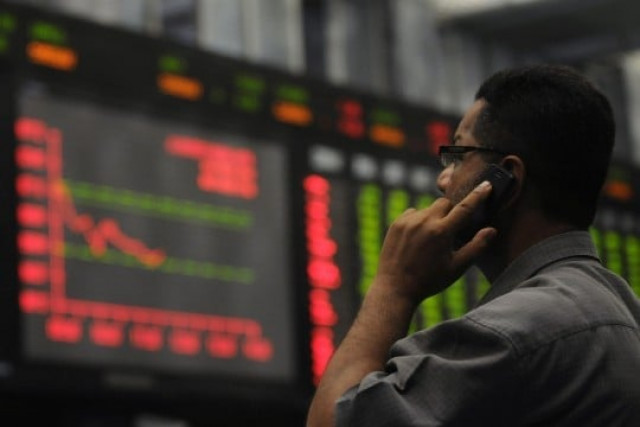
Benchmark equity indices Sensex and Nifty rebounded nearly 1 per cent on Wednesday, helped by bargain buying in FMCG, auto and telecom shares, upbeat earnings sentiment and gains across Asian markets.Traders said signs of possible de-escalation in geopolitical tensions also supported sentiment.In a volatile session, the 30-share BSE Sensex climbed 609.45 points, or 0.79 per cent, to close at 77,496.36. During the day, it surged 1,095.60 points, or 1.42 per cent, to touch 77,982.51.The NSE Nifty rose 181.95 points, or 0.76 per cent, to settle at 24,177.65, according to PTI.
Nifty 50 top gainers
- ITC (+3.88%)
- Tech Mahindra (+3.68%)
- Maruti Suzuki (+2.84%)
- Coal India (+2.77%)
- Reliance Industries (+2.63%)
- Bharti Airtel (+2.41%)
- M&M (+2.08%)
- Sun Pharma (+1.80%)
- Nestle India (+1.78%)
- Tata Consumer (+1.77%)
Nifty 50 top losers
- InterGlobe Aviation (-2.19%)
- Dr Reddy’s (-1.84%)
- NTPC (-1.37%)
- ICICI Bank (-0.86%)
- Bajaj Finserv (-0.84%)
- Hindalco (-0.67%)
- Asian Paints (-0.63%)
- Trent (-0.61%)
- Apollo Hospital (-0.57%)
- HDFC Bank (-0.46%)
BSE Sensex top gainers
- ITC (+3.88%)
- Tech Mahindra (+3.68%)
- Maruti Suzuki (+2.84%)
- Reliance Industries (+2.63%)
- Bharti Airtel (+2.41%)
- M&M (+2.08%)
- Sun Pharma (+1.80%)
- L&T (+1.45%)
- Adani Ports (+1.44%)
- Infosys (+1.34%)
BSE Sensex top losers
- InterGlobe Aviation (-2.19%)
- NTPC (-1.37%)
- ICICI Bank (-0.86%)
- Bajaj Finserv (-0.84%)
- Asian Paints (-0.63%)
- Trent (-0.61%)
- HDFC Bank (-0.46%)
- SBI (-0.41%)
Maruti advanced 2.82 per cent after the country’s largest carmaker reported a record annual consolidated net profit of Rs 14,679.5 crore for FY26, up 1.24 per cent year-on-year, driven by its highest-ever annual sales of more than 24.22 lakh units, helped by GST rate reduction.In Asian markets, South Korea’s Kospi, Shanghai’s SSE Composite and Hong Kong’s Hang Seng ended higher. Japanese markets were shut for a holiday.“The core driver of today’s strength remained earnings. Strong results from key companies reinforced confidence in underlying domestic demand and balance sheet resilience. This fundamental support, combined with easing geopolitical concerns, helped markets shift focus away from macro stress toward corporate performance,” Hariprasad K, Research Analyst and Founder, Livelong Wealth, said, PTI quoted.“Hopes of potential de-escalation in geopolitical tensions helped stabilise crude oil expectations, which is critical for India’s macro outlook,” he added.European markets were trading lower, while US markets had ended lower on Tuesday.Brent crude, the global oil benchmark, jumped 2.85 per cent to USD 114.4 per barrel.“Despite weak global cues, elevated crude prices, and a depreciating INR, India’s equity markets rebounded from recent lows as investors used the correction to add exposure, supported by better-than-expected earnings despite geopolitical uncertainty.“Gains were led by FMCG, auto, and realty stocks on strong results and positive commentary, while financials lagged due to regulatory tightening and provisioning concerns,” Vinod Nair, Head of Research, Geojit Investments Limited, said.Foreign Institutional Investors (FIIs) sold equities worth Rs 2,103.74 crore on Tuesday, while Domestic Institutional Investors (DIIs) bought shares worth Rs 1,712.01 crore, as per exchange data.
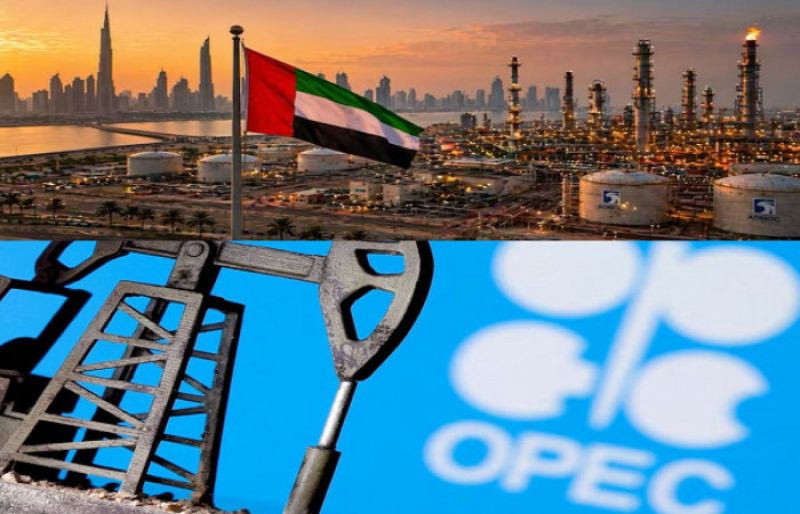
The UAE is the fourth-largest producer in the Organisation of the Petroleum Exporting Countries and said it would quit the group on Tuesday after nearly 60 years as a member.
That will free Abu Dhabi from the oil production targets imposed by OPEC and its allies to balance supply and demand.
The UAE’s exit came as a shock, said five OPEC+ sources, who asked not to be named as they are not allowed to speak to the press.
The exit would complicate OPEC+’s efforts to balance the market through adjustments to supply because the group would have control over less of global production, four of the five sources said.
The UAE will become the largest oil producer to depart OPEC, a heavy blow to the organisation and its main member, Saudi Arabia.
Abu Dhabi pumped around 3.4 million barrels per day (bpd) or about 3% of the world’s crude supply before the US-Israeli war on Iran forced it and other Middle East Gulf producers to curb shipments and shut down some production.
OPEC and the Saudi government’s communication office did not immediately reply to a request for comment.
Once outside OPEC, the UAE will join the ranks of independent oil producers that pump at will, such as the United States and Brazil.
For now, there is not much the UAE can do to increase production or exports due to the effective closure of shipping through the Strait of Hormuz.
If and when shipping recovers to pre-war levels, the UAE could increase output to the country’s capacity of 5 million bpd of crude oil and liquids.
There has been tension between the UAE and Saudi Arabia over the Emiratis’ production quota, which stands at 3.5 million bpd.
The UAE has asked for a bigger quota to reflect the fact that it has expanded capacity as part of a $150 billion investment programme.
“For years, Abu Dhabi has been looking to monetise its investment in expanding capacity,” said Helima Croft from RBC Capital Markets.
The US-Israeli war on Iran would, however, slow those plans down after drones and rockets damaged the UAE’s production facilities, she said.
The war has resulted in the biggest-ever global energy supply disruption in terms of outright daily oil production, according to the International Energy Agency.
The conflict has also exposed discord among Gulf nations, including between the UAE and Saudi Arabia.
Rumours of the UAE’s exit from OPEC+ have circulated for years amid worsening relations with Riyadh over conflicts in Sudan, Somalia and Yemen.
The UAE has also grown increasingly close to the United States and Israel.
Iraq stays in
The UAE is the fourth producer to quit OPEC+ in recent years, and by far the biggest.
Angola quit the bloc in 2024, citing disagreements over production levels. Ecuador quit OPEC in 2020 and Qatar in 2019.
Iraq, the third-largest producer in OPEC+ after Saudi Arabia and Russia, has no plan to leave OPEC+ as it wants stable and acceptable oil prices, two Iraqi oil officials said on Tuesday.
OPEC+ will not collapse as Saudi Arabia will still want to manage the market with the help of the group, said Gary Ross, a veteran OPEC watcher and CEO of Black Gold Investors.
“At the end of the day, Saudi Arabia was essentially OPEC — the only country with spare capacity,” said Ross.
Saudi Arabia can produce 12.5 million bpd, but has in recent years kept production under 10 million.
OPEC+ membership gives countries more diplomatic and international weight — one of the reasons cited by analysts behind Iran’s decision to stay in OPEC even at the peak of its fight with Gulf countries.
US President Donald Trump has accused OPEC of “ripping off the rest of the world” by inflating oil prices.
Trump has said the US may reconsider military support to the Gulf because of OPEC oil policies.
It was, however, Trump who helped convince OPEC+ to cut output in 2020 during the COVID pandemic as oil prices slumped and US producers suffered.
“The UAE withdrawal marks a significant shift for OPEC … the longer-term implication is a structurally weaker OPEC,” said Jorge Leon, a former OPEC official who now works at Rystad Energy.
OPEC+ members will be more focused on rebuilding facilities hit by the war rather than on embarking on production cuts in the near future, said Croft.
Hence, the broader OPEC+ breakup is not on the cards for now, she added.
Declining power
OPEC’s sway over the market has been declining for decades.
Formed in 1960, OPEC once controlled over 50% of global output.
As rivals’ production grew, the group’s share declined to around 30% of the world’s total oil and oil liquids output of 105 million barrels per day last year.
The United States, which used to rely on imports from OPEC members, has become its biggest rival over the past 15 years.
The US has raised production to as much as 20% of the world’s total on the back of its shale oil boom.
The US production spike prompted OPEC to team up in 2016 with several non-OPEC producers to form OPEC+, a group led by Russia — previously one of Saudi Arabia’s top rivals in the oil industry.
The alliance gave the group control over around 50% of the world’s total oil production in 2025, according to the International Energy Agency.
The loss of the UAE means it will decline to around 45%.
Business
Ganga Expressway inaugurated by PM Modi: UP’s longest expressway between Meerut & Prayagraj; check travel time, route, speed limit – top facts & images – The Times of India
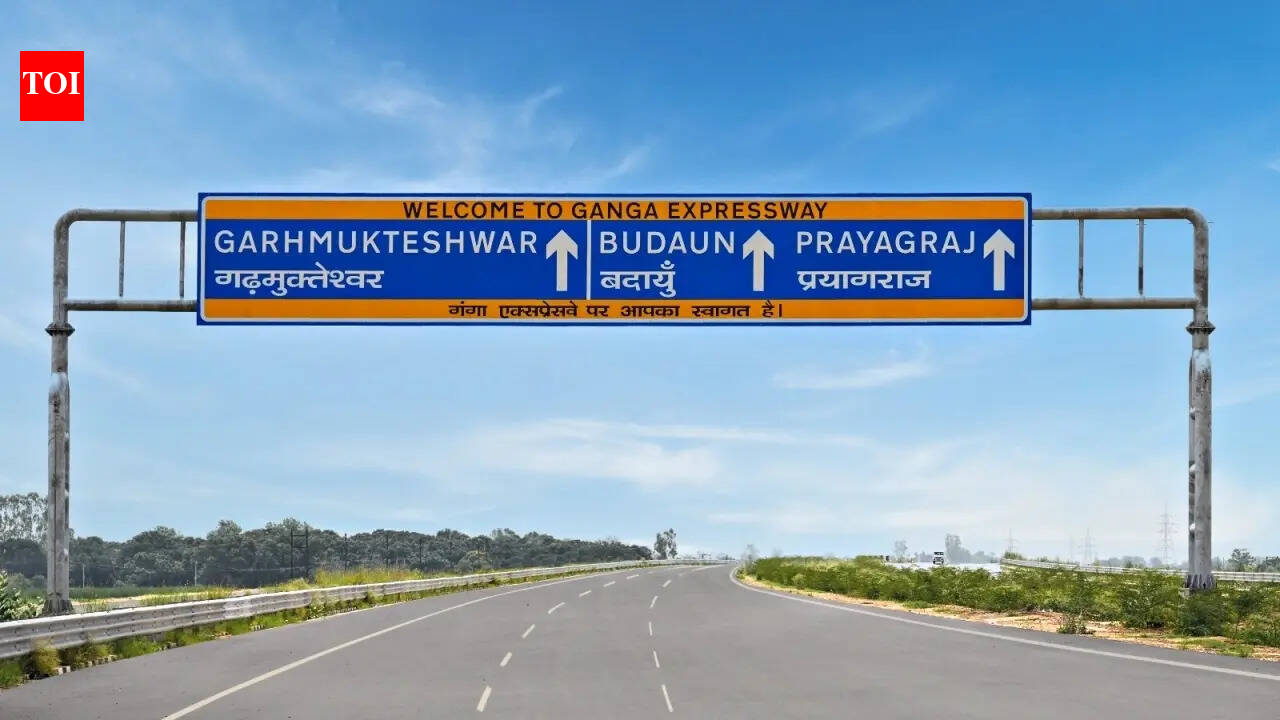
Ganga Expressway, the longest expressway so far in Uttar Pradesh, was inaugurated by Prime Minister Narendra Modi on Wednesday. The 594 kilometres long Ganga expressway is a six-lane expressway that aims to reduce the travel time between Meerut and Prayagraj to just 6 hours!Uttar Pradesh has over 60% of India’s total access-controlled expressway network. Recently, Chief Secretary Manoj Kumar pointed out that of the nearly 2,900 km of such highways across the country, close to 1,200 km are located in the state.Meerut District Magistrate and Collector Vijay Kumar Singh on Tuesday said the project has generated tremendous excitement among the public. He noted that the expressway will greatly enhance connectivity to Prayagraj as well as the state capital, Lucknow.Experts say the expressway’s length is particularly significant. According to the Department for Promotion of Industry and Internal Trade, road transport remains economically efficient for freight over distances of up to about 600 km, while rail becomes more viable beyond that point. At 594 km, the Ganga Expressway falls almost exactly within this crucial range for cargo movement.

How will the Ganga Expressway cut down travel time, what districts will it cover, what will be the toll policy, and what cost has it been constructed at? We take a look:
Ganga Expressway: Top Points About UP’s Longest Expressway
Travel time: One of its most noticeable benefits will be the sharp reduction in travel time. The trip between Meerut and Prayagraj, which currently takes around 10 to 12 hours, is likely to be cut to approximately 6 to 7 hours. Access from Delhi: For travellers from the Delhi-NCR region, access will be seamless through the Delhi-Meerut Expressway, followed by a short connecting link at Bijoli to join the Ganga Expressway.
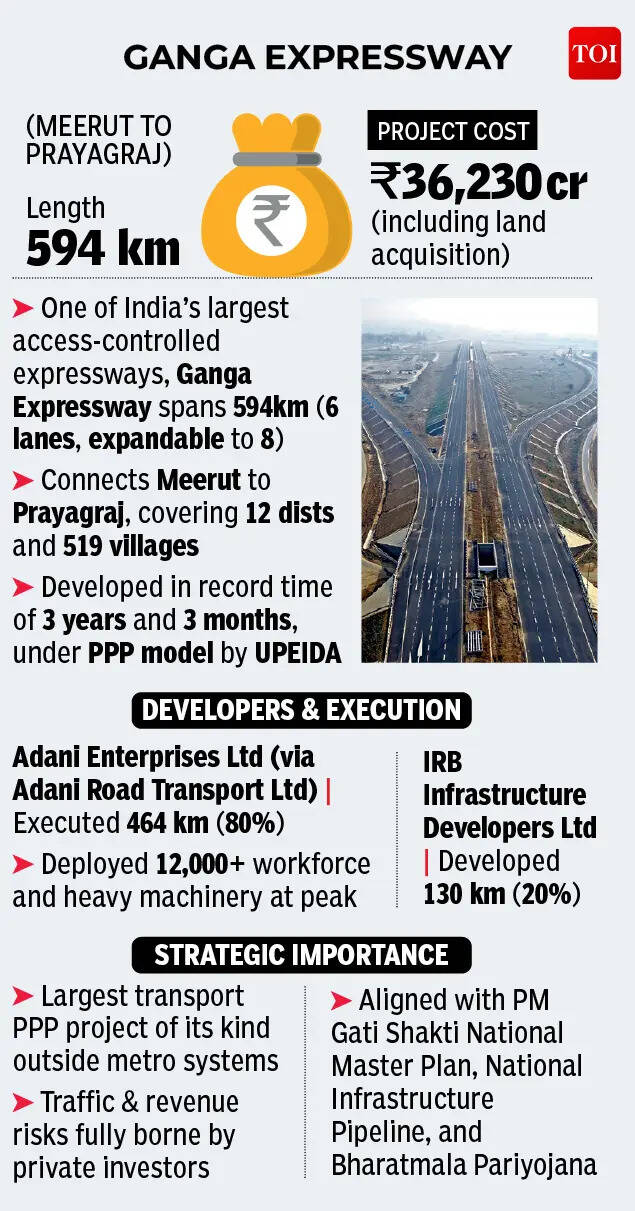
Construction cost: Developed at an estimated cost of Rs 36,230 crore, the Ganga Expressway ranks among Uttar Pradesh’s most ambitious infrastructure initiatives. The Ganga Expressway stretches from Bijoli village in Meerut to Judapur Dandu village in Prayagraj.Speed limit: The expressway has been built for speeds of up to 120 kmph. The six-lane access-controlled expressway, has been designed with the provision for expansion to eight lanes.
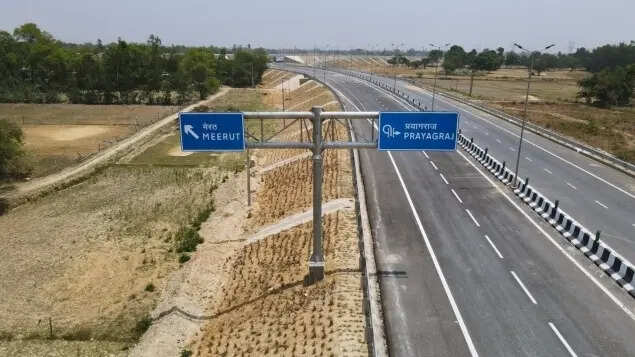
Route & Districts covered: The expressway will pass through 12 districts: Meerut, Hapur, Bulandshahr, Amroha, Sambhal, Badaun, Shahjahanpur, Hardoi, Unnao, Rae Bareli, Pratapgarh and Prayagraj. In doing so, it will directly influence more than 500 villages along its alignment.Interchanges & amenities: Its connectivity is further strengthened by 21 interchanges that link the corridor with existing national highways and state roads.
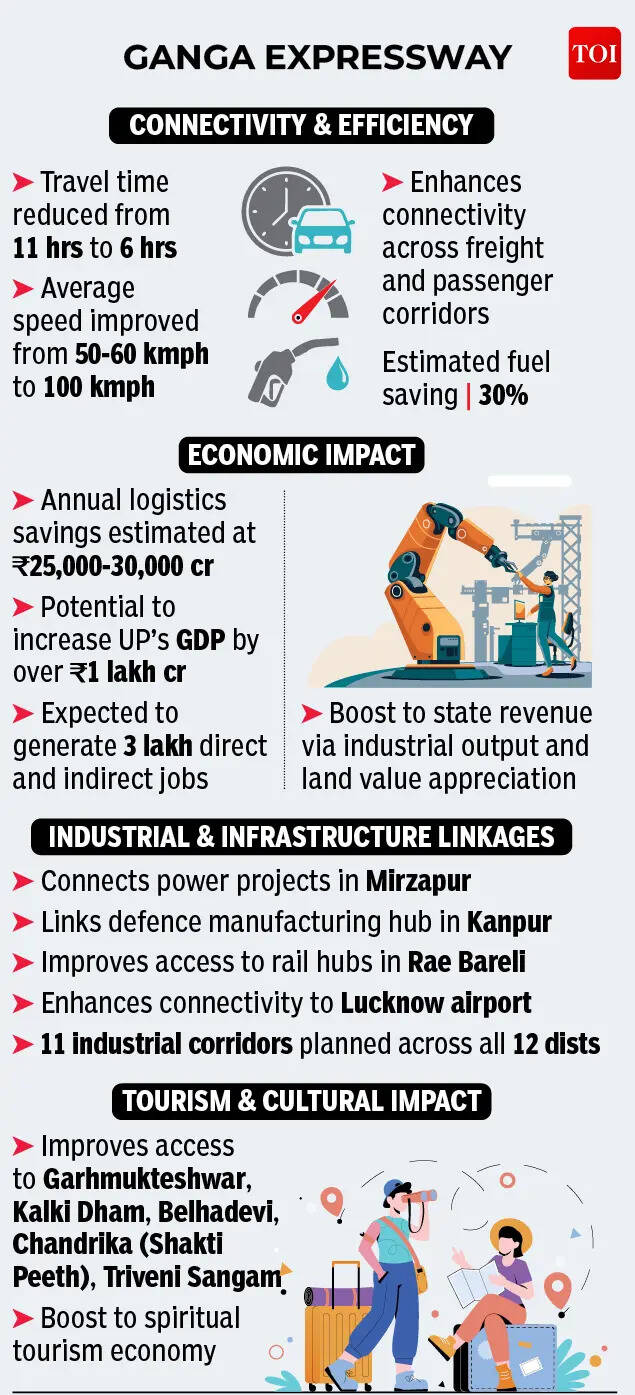
The project also includes major river crossings, notably a 960-metre bridge over the Ganga and a 720-metre bridge across its tributary, the Ramganga. Both structures have been engineered to suit local flood conditions.To support travellers, the expressway will also feature nine public utility complexes equipped with fuel stations, rest areas and food courts.
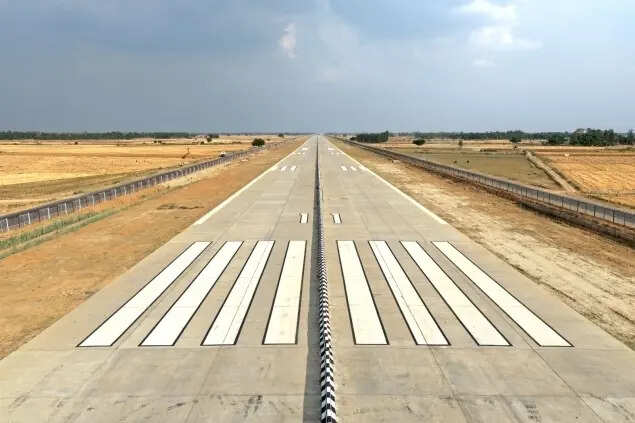
Emergency Landing Strip: One of the expressway’s standout features is a 3.5-km emergency landing strip in Shahjahanpur district. Already tested by the Indian Air Force, this airstrip adds a strategic defence dimension to the project, enhancing national preparedness in addition to its economic significance, according to an official statement.Integration with other expressways: Ganga Expressway will eventually be integrated with existing and even upcoming corridors. These include the Agra-Lucknow Expressway, the Farrukhabad Link Expressway, the Jewar Link Expressway, and a proposed extension that will connect Meerut to Haridwar.According to reports, plans are underway to extend the expressway by around 146 kms up to Haridwar. This extension will pass through Amroha and Bijnor and cover more than 200 villages.
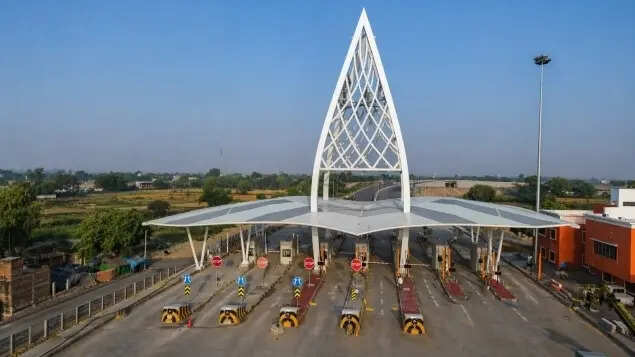
Toll: The project will be operated under a toll-based public-private partnership model. Adani Enterprises and IRB Infrastructure Developers have been awarded concession rights for a period of 30 years.For toll collection, two primary toll plazas will be set up at the main entry points in Meerut and Prayagraj. The final toll charges have not yet been announced, however officials have indicated that they are likely to be in line with other expressways in Uttar Pradesh. At present, four-wheelers pay around Rs 2 to Rs 3 per kilometre.


US-Iran war pushes India denim prices up by $0.66/metre

UAE dismantles drug ring worth over Dh3m
Stock market today (April 29, 2026): Sensex jumps 609 points, Nifty nears 24,200-Check top gainers and losers today – The Times of India

-

 Politics1 week ago
UK’s Starmer seeks to deflect blame over Mandelson appointment
-
 Business1 week ago
How Trump’s psychedelics executive order could unlock stalled cannabis reform
-

 Entertainment1 week ago
Lee Anderson, Zarah Sultana kicked out of UK Parliament for calling PM ‘liar’
-
 Business1 week ago
Us-India Trade Talks: US–India trade deal: Where do talks stand & what to expect – explained – The Times of India
-

 Tech1 week ago
A Humanoid Robot Set a Half-Marathon Record in China
-

 Fashion1 week ago
India, US to resume BTA talks today
-
 Business1 week ago
UK inflation accelerates after Iran war drives sharp rise in fuel prices
-

 Sports1 week ago
‘It’s his superpower’: Inside Fernando Mendoza’s extraordinary rise to No. 1